
Industrial Ethernet is the use of standard Ethernet (IEEE 802.3) in plants and machines, with industrial protocols that exchange control data with a predictable timing, such as PROFINET, EtherNet/IP, EtherCAT and Modbus TCP, and with hardware made for the field: 24 V DC switches on a DIN rail, extended temperature range, shielded cables, M12 connectors and ring redundancy. The frames and the cables are the same as in an office. What changes is the timing, the protocol on top and the hardware around it.
This guide explains how industrial Ethernet differs from office Ethernet, how the protocols reach real time, which cables and connectors are used and where each protocol fits. To choose the protocol for a new line, read EtherNet/IP vs PROFINET vs Modbus TCP.
Industrial Ethernet and office Ethernet are not the same network
| Aspect | Office Ethernet | Industrial Ethernet |
|---|---|---|
| Traffic | Files, web and e-mail in bursts, best effort | Cyclic I/O data between controller and devices, with a defined update time |
| Timing | A delay of some milliseconds goes unnoticed | The cycle and its jitter matter: a late frame can stop a machine |
| Protocols | TCP/IP, HTTP, SMB | PROFINET, EtherNet/IP, EtherCAT, Modbus TCP, POWERLINK, CC-Link IE, plus OPC UA and MQTT for data |
| Connectors | RJ45 | RJ45 inside the cabinet, M12 (D-coded or X-coded) and sealed RJ45 in the field |
| Cable | Unshielded twisted pair | Shielded twisted pair, oil resistant or flexible for drag chains, fibre for long runs |
| Switches | Desktop or rack, mains supply | DIN rail, 24 V DC with redundant inputs, extended temperature range, managed |
| Topology | Star | Star, line and ring with redundancy protocols (MRP, DLR) |
How industrial Ethernet reaches real time
Standard Ethernet does not guarantee when a frame arrives. Industrial protocols solve it in three ways:
- Standard TCP/IP stack. Modbus TCP (port 502) and EtherNet/IP (CIP over TCP and UDP) run on any switch and any IP network. The timing depends on the load of the network, so the network is kept separate and lightly loaded. This covers most machine and process control.
- Own frames on standard hardware. PROFINET RT sends its cyclic data in Ethernet frames with its own EtherType (0x8892), without TCP/IP, and with VLAN priority. It works with normal switches and gives shorter, more stable cycles. POWERLINK also runs on standard Ethernet chips: a managing node polls each device in turn in each cycle.
- Dedicated hardware. PROFINET IRT reserves time slots in the switches. EtherCAT processes the frame on the fly in each device while it passes through. These are used for motion control and synchronized axes.
Time-Sensitive Networking (TSN), a set of IEEE 802.1 standards, adds scheduling and time synchronization to standard Ethernet switches, so that control traffic and normal IT traffic can share the same network. CC-Link IE TSN and PROFINET over TSN are two examples.
What are the industrial Ethernet protocols?
| Protocol | Organization | How it works | Where you find it |
|---|---|---|---|
| PROFINET | PROFIBUS & PROFINET International (PI) | RT frames without TCP/IP; IRT with hardware support | Lines built around Siemens controllers |
| EtherNet/IP | ODVA | CIP over TCP and UDP | Lines built around Rockwell controllers |
| EtherCAT | EtherCAT Technology Group | One frame passes through all devices, processed on the fly | Motion control, fast I/O, test benches |
| Modbus TCP | Modbus Organization | Modbus requests over TCP, port 502 | Meters, drives, gateways, SCADA, small PLCs |
| POWERLINK | Ethernet POWERLINK Standardization Group | A managing node polls each device in turn | Machines built around B&R controllers |
| CC-Link IE | CC-Link Partner Association | Own protocol, now also over TSN | Lines built around Mitsubishi controllers |
Above the control network, OPC UA and MQTT carry data to SCADA, MES and the cloud over the same Ethernet. They are not used for the fast I/O cycle. See Modbus RTU vs Modbus TCP vs OPC UA for that layer.
Ethernet cables and connectors in industry
The usual Ethernet cable is twisted pair: four pairs of wires, each pair twisted together. Each pair carries a differential signal, and the twist makes external noise reach both wires in the same way, so the receiver cancels it. One copper segment is limited to 100 m between two devices.
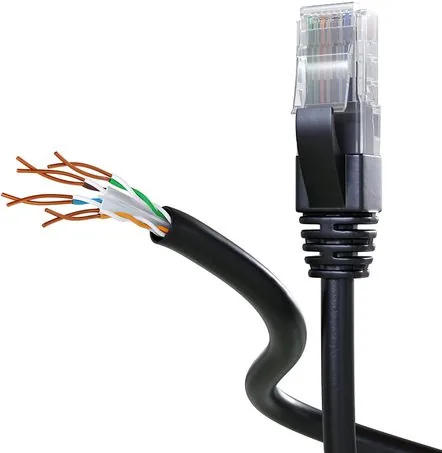
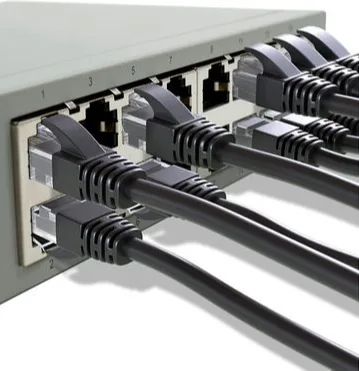
- Category. Cat 5e is enough for 100 Mbit/s and 1 Gbit/s, which covers most PLCs and field devices. Cat 6A is used for 10 Gbit/s backbones.
- Shield. Use shielded cable (for example S/FTP) near drives, motors and power cables, with the shield connected to earth.
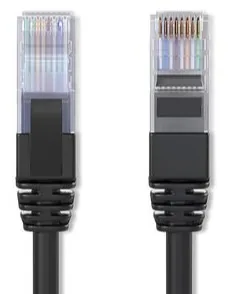
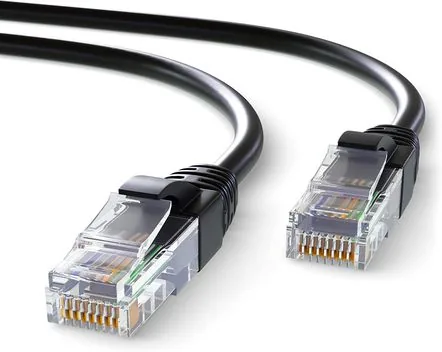
- Connectors. RJ45 inside the cabinet. In the field, M12 D-coded (4 pins, up to 100 Mbit/s) or X-coded (8 pins, up to 10 Gbit/s), with IP65/IP67 sealing.
- Fibre. For runs over 100 m, between buildings and in places with strong electromagnetic interference such as substations.
Where industrial Ethernet is used
- Manufacturing and logistics. PLCs, drives, robots and HMIs share cyclic data, and the same network sends production data to the IT systems for tracking.
- Outdoor installations. Cameras, sensors and lighting are often powered over the data cable with Power over Ethernet (IEEE 802.3af and 802.3at), which saves a power line.
- Electrical substations. Fibre links avoid the electromagnetic interference of high voltage equipment.
- Vehicles and trains. Devices on board must tolerate vibration and shock, so they use M12 connectors and products tested for that environment.
Industrial Ethernet in Industrial Shields PLCs
The M-Duino PLCs use the W5500 controller, a 10/100 Mbit/s chip with the TCP/IP stack in hardware. The ESP32 PLC has Ethernet too, and the Raspberry PLC has two Ethernet ports. On these PLCs the industrial Ethernet protocol is software: Modbus TCP and MQTT with Arduino libraries on M-Duino and ESP32 PLC, and Python, Node-RED or CODESYS on the Raspberry PLC, which can also communicate over PROFINET on Linux.
Run a PLC network in your browser. In the Modbus network simulator, an M-Duino 21 polls four Modbus RTU slaves on RS-485 and serves the values to clients over Modbus TCP on Ethernet. In the case study, Modbus RTU thermometers, local M-Duino PLCs and a main PLC share every reading over Modbus TCP with a server and a Panel PC.
Open the Modbus network simulatorRead the Modbus temperature network case study
FAQ about industrial Ethernet
Is EtherNet/IP the same as industrial Ethernet?
No. EtherNet/IP is one industrial Ethernet protocol, the one of ODVA. Industrial Ethernet is the whole family: PROFINET, EtherNet/IP, EtherCAT, Modbus TCP and others.
Is Modbus TCP industrial Ethernet?
Yes. It is the simplest one: Modbus requests over TCP on port 502. It does not schedule the traffic, so its timing depends on the load of the network.
Can I use a normal Ethernet cable in a control cabinet?
Inside a clean cabinet, a Cat 5e cable with RJ45 works. Near drives and motors use shielded cable, and outside the cabinet use industrial connectors such as M12.
What is the maximum length of an industrial Ethernet cable?
100 m per copper segment between two devices. Each switch starts a new segment. For longer distances, use fibre.
Can different industrial Ethernet protocols share one network?
They can share the cables and switches, but each device speaks the protocol of its controller. Gateways translate between them, and TSN is the standard way to share one network between control and IT traffic.
More about industrial networks
- Communications and protocols used in industrial automation
- Modbus RTU vs Modbus TCP vs OPC UA: which to use
- EtherNet/IP vs PROFINET vs Modbus TCP: choosing the fieldbus for a new line
- PROFINET and Raspberry PLC: trigger alarms with CODESYS
- Industrial applications: 50 real examples by sector
Compare the interfaces of each family in choosing an industrial controller.