LoRa basics: range, modulation, bands and limits
LoRa basics: long range, low power
LoRa (Long Range) is a wireless modulation designed to send small amounts of data over long distances with very little power. It needs no wiring and no Internet connection, which makes it a good fit for installations where cable is expensive, or where cellular coverage is poor or too costly: pumping stations, remote tanks, irrigation, utility metering or distributed machines.
Key characteristics
- Chirp spread spectrum modulation: the signal is spread over a wide band, which gives high tolerance to interference and noise.
- High receiver sensitivity: down to about -148 dBm in the best configuration, which is what makes the long range possible.
- Long range: from a few kilometres in urban areas to 10-20 km in good line-of-sight conditions.
- Low power consumption: devices can run for years on batteries when they transmit rarely.
- Small messages and low data rate: the payload of a LoRa packet is at most 255 bytes, and the data rate goes from a few hundred bit/s to a few kbit/s depending on the spreading factor.
- Licence-free ISM bands: 868 MHz in Europe, 915 MHz in America and 433 MHz in some regions of Asia. Each region has its own rules on power and duty cycle (in Europe the transmission time is typically limited to 1% per sub-band), so check the regulation of the country where you install the device.
Range versus speed
LoRa lets you trade speed for range with the spreading factor (SF7 to SF12). A high spreading factor reaches further and uses more airtime, but sends fewer bytes per second. In practice, you pick the lowest spreading factor that still gives a reliable link.
When LoRa is the right choice
| Good fit | Not a good fit |
|---|---|
| Periodic readings (level, temperature, flow, state) | Real-time control with tight response times |
| Battery-powered or remote devices | Large data, images or audio |
| Sites with no wired network or weak coverage | Very high numbers of messages per device per hour |
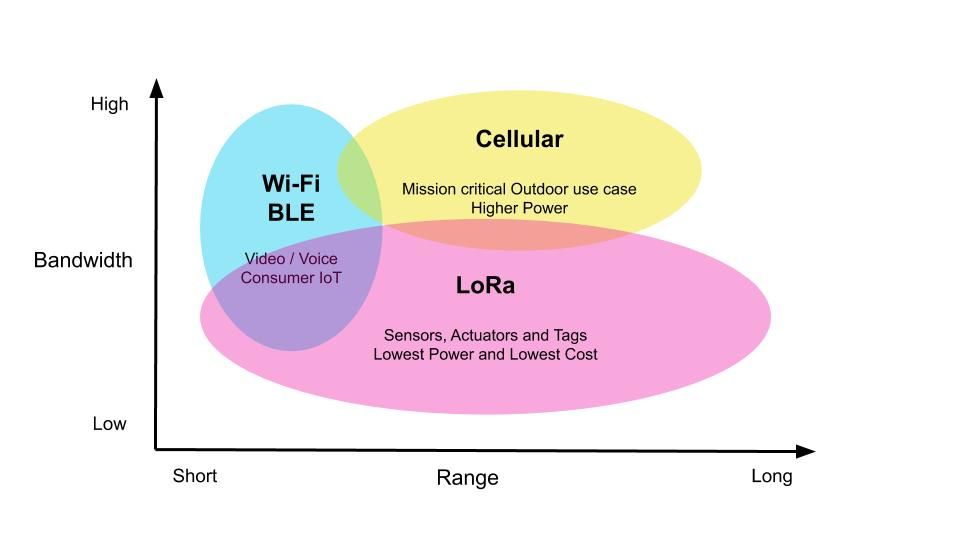
The figure compares the spectrum used by Wi-Fi and BLE, cellular and LoRa:
Next step
The next lessons show how to use LoRa point to point with Industrial Shields PLCs, and later how LoRaWAN adds a network and security on top. Explore the PLC range at www.industrialshields.com.
There are no comments for now.
to be the first to leave a comment.