What is LoRaWAN: architecture, device classes and security
LoRaWAN: from a radio link to a network
LoRaWAN (Long Range Wide Area Network) is a protocol built on top of LoRa for low-power, wide-area IoT networks. LoRa defines how the radio signal is modulated; LoRaWAN adds the network around it: gateways, a network server, device management and security. Where LoRa on its own is a point-to-point link, LoRaWAN lets thousands of devices send data to a platform through shared gateways.
Architecture
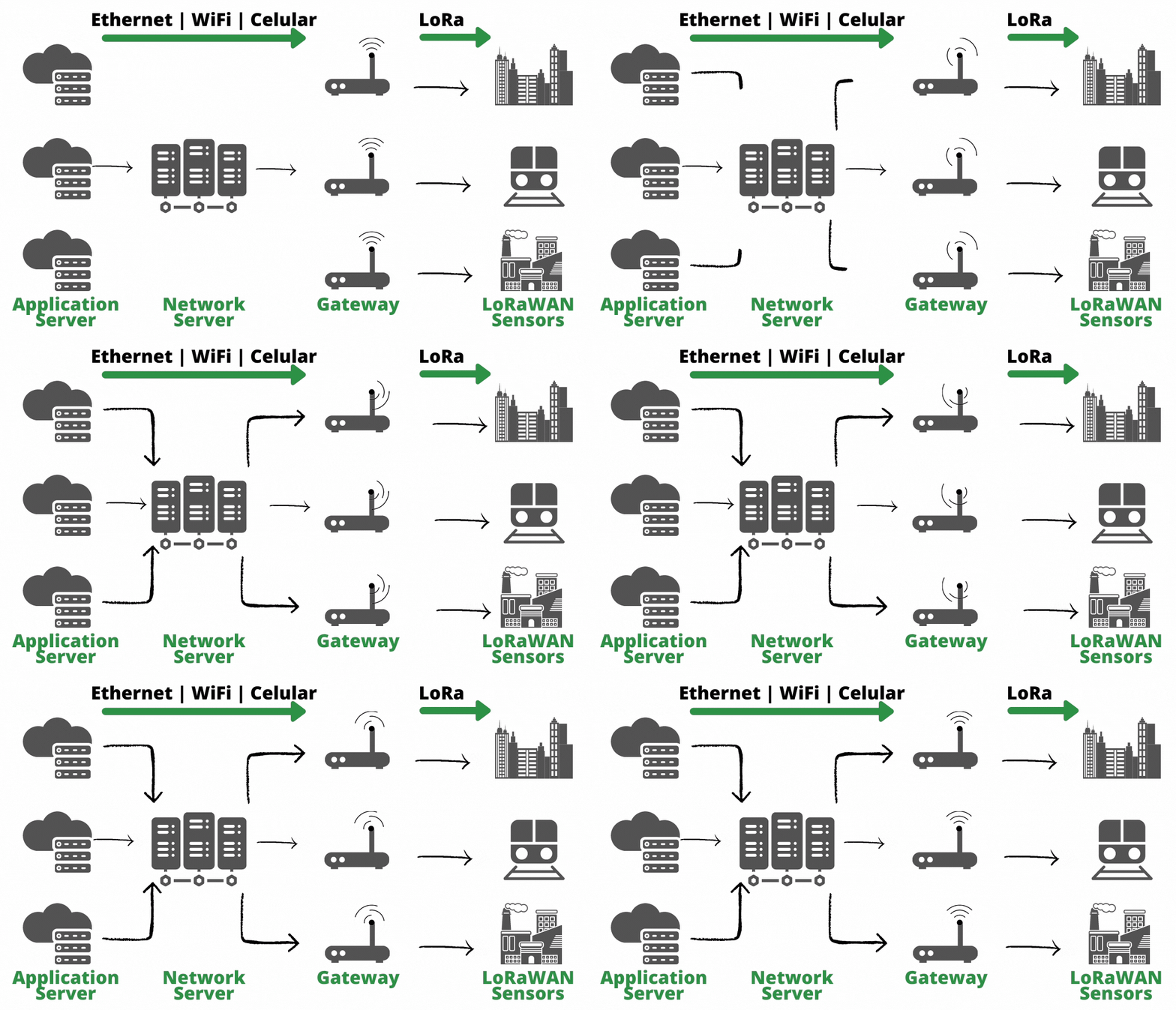
- End devices: sensors and PLCs with a LoRa radio that send small messages (uplinks) and may receive some (downlinks).
- Gateways: receive the messages from every device in range and forward them over IP (Ethernet, Wi-Fi or cellular) to the network server. They are in a star topology: devices talk to gateways, not to each other.
- Network server: removes duplicates, checks security and manages the network (for example, data rate adaptation).
- Application server: receives the decoded data of your devices and hands it to your platform (SCADA, database, dashboard) for example through MQTT or HTTP.
The network server can be a public community network such as The Things Network, a commercial operator, or your own private network (for example with the open source ChirpStack). For industrial installations, a private network is often preferred, because the data and the availability stay under your control.
Device classes
- Class A: the device opens two short receive windows only after sending. It is the lowest-power class and is supported by every device.
- Class B: adds receive windows at scheduled times, synchronised by a gateway beacon.
- Class C: the device listens almost all the time. It gets downlinks with low latency, but it needs mains power.
Security
LoRaWAN uses AES-128 encryption with two session keys: one authenticates the device against the network, and another encrypts the application data end to end, so the network operator cannot read it. A device joins the network either with OTAA (over-the-air activation, which generates new session keys at each join and is the recommended method) or with ABP (activation by personalisation, with fixed keys). Treat the device keys as credentials: do not publish them, and use a different set of keys for every device.
Limits to design around
- The maximum payload per message depends on the data rate and on the regional parameters, and can be as low as about 50 bytes at the longest range.
- Regional duty-cycle rules limit how often a device may transmit.
- LoRaWAN is not meant for real-time control: use it for monitoring and low-frequency commands.
Typical applications are smart city infrastructure, agriculture, environmental sensing, utility metering and asset tracking. See what Industrial Shields PLCs offer at www.industrialshields.com.
There are no comments for now.
to be the first to leave a comment.