Case study · Vaccine cold chain · Raspberry PLC
Every corner of the freezer. One PLC watches it.
Probes in the tank, the PLC outside. Alarm, day count and record on one unit.
Some vaccines and medicines must stay below −20 °C, others in ultra-low freezers at about −80 °C.
The PLC reads every probe, raises the alarm at the limit and keeps the record.
This case is a design proposal by Industrial Shields engineers. It was first written in 2020, for the first mRNA vaccines against COVID-19. It does not name a customer or a site, and it does not publish readings. The system it describes is not tied to one vaccine: it watches the temperature of a cold store for vaccines or medicines. This page follows a reading from a probe in the tank to the alarm, the day count, the database and the cloud.
The challenge
Each product has a temperature band. Out of the band, the batch can spoil.
Vaccines and many medicines must stay in a set temperature band, in storage and in transport. The case quoted two examples from 2020: one vaccine kept below −80 °C, and another kept at 2 to 8 °C for up to 30 days, or for up to 6 months below −20 °C. Always use the storage conditions in the product information of your product.
Very cold bands
Some products need an ultra-low freezer at −80 °C, others −20 °C, others a fridge at 2 to 8 °C. The probes and the limits depend on the band.
Not one temperature
The temperature is not the same at every point of a tank. The case puts several sensors along the reservoir for a more accurate reading.
Act in time
If the tank warms over a limit, the supervisors must know at once. The case says it is crucial to correct the error as fast as possible, so that no samples spoil.
Count the days
Some products must be used within a time window. In the case, within one month. The system must know how long each batch has been in the tank.
Losses, handling and disposal
A batch that leaves its band is lost, and it takes time and resources to handle and dispose of. Keeping the product in its band avoids both.
How it works
Three jobs: watch, count, record.
Each step shows one job of the PLC. Press the buttons. The panels are illustrative simulations: bands, limits, delays, temperatures, batches and record rates are examples, not data from a site.
Four probes in the tank. The PLC reads them all and warns at the limit.
The PLC sits outside the freezing tank. The sensors are inside, distributed along the reservoir, and the PLC reads them by cable. If the temperature in the tank passes a limit, the PLC triggers an alarm to warn the supervisors. A typical way to do it: compare the warmest probe with the limit, and wait a short delay before the alarm, so that a short opening does not raise it. Pick a band, then open the lid or stop the cooling.
- PLC outside the tank, sensors inside
- Sensors along the reservoir for a more accurate reading
- Alarm to the supervisors over the limit
PLC events (example)
Illustrative simulation. Example values, no data from a site. Example limits: −60 °C for the −80 °C freezer, −20 °C for the −20 °C freezer, 2 and 8 °C for the fridge. Alarm when a probe stays over the limit for 5 minutes. One step of the panel is 30 seconds. The case does not publish its limits or delays.
The real-time clock knows how long each batch has been in the tank.
With the RTC (real-time clock), the PLC knows how many days have passed since a batch went into the tank. In the case, the product must be used within one month. A typical way to do it: register each batch when it goes in, store the date from the RTC, and warn some days before the window ends. The clock keeps the time with its own battery. Put a batch in, then move the days.
- Date and time from the RTC of the PLC
- One entry per batch (example)
- A warning before the window ends (example)
Batch register (example)
Illustrative simulation. Example values, no data from a site. Example: a 30-day window, as in the case, and a warning 5 days before the end. The RTC gives the date and time; the operator registers each batch when it goes in. The case does not publish how batches are registered.
Every reading goes to a database on the PLC, and then to the cloud.
The Raspberry PLC runs Linux, so it can keep an internal database with all the data it collects. Over Ethernet or Wi-Fi it sends the data to the cloud. The case also shows the sensor data on a screen. A typical way to do it: write every reading to the local database first, and send it when the link is up, so a network cut leaves no gap. Cut the link, then bring it back.
- Internal database on the PLC
- Ethernet or Wi-Fi to the cloud
- Rows kept while the link is down (example)
Record and cloud link (example)
Illustrative simulation. Example values, no data from a site. Example: one row per minute with the time and the four probes. Rows wait on the PLC while the link is down and go out in order when it comes back. One step of the panel is one minute. The case does not publish its record rate or its database.
System architecture
How does a reading from a vaccine freezer reach the supervisor and the cloud?
Temperature probes inside the tank connect by cable to a Raspberry PLC 21 FLEX outside the cold. The case reads them over the I2C bus. The PLC compares the readings with the limit, drives the alarm and dates every reading with its real-time clock. It keeps the data in an internal database, sends it to the cloud over Ethernet or Wi-Fi and shows it on a screen. In transport, a mobile network board sends the same data from the truck.
| Data | Between | Link | Purpose |
|---|---|---|---|
| Temperature at each corner | BetweenProbes in the tank → PLC | LinkI2C in the case | PurposeTemperature where the products are. The scheme shows four probes |
| Date and time | BetweenRTC of the PLC | LinkBuilt in | PurposeDays since each batch went into the tank |
| Alarm | BetweenPLC → beacon or buzzer | LinkDigital output | PurposeWarns the supervisors over the limit. The output device is an example |
| Record | BetweenPLC | LinkInternal database | PurposeEvery reading kept on the PLC |
| Cloud data | BetweenPLC → cloud server | LinkEthernet or Wi-Fi | PurposeThe data in the cloud, away from the tank |
| Screen | BetweenPLC → screen | LinkHDMI in the case | PurposeSensor data next to the tank |
| Data in transport | BetweenPLC → server | LinkMobile network | PurposeGPRS in the case; a 4G board on the FLEX today |
Why it works
Probes in the cold. Logic, alarm and record out of it.
Probes where the risk is
Several probes along the tank give a more accurate picture than one point. The warmest one decides the alarm.
Electronics out of the cold
The PLC sits outside the tank, inside its 0 to 50 °C range. Only the probes go into the cold.
One controller, five jobs
Reading, alarm, day count, database and cloud link run on the same Raspberry PLC.
Time and data you can trust
The RTC has its own battery. The UPS shuts Linux down safely on a power cut, to protect the database from corruption.
Open and modular
Linux, Python and Node-RED: open tools you already know. Add probes, outputs or a 4G board when you need them.
Industrial hardware
Made for industrial use: DIN rail, 12 to 24 Vdc, inside a cabinet next to the freezer.
Hardware used
One Raspberry PLC next to the tank.
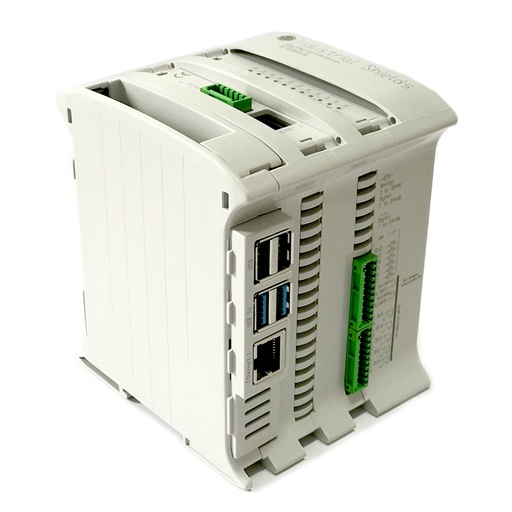
RASPBERRY PLC 21 FLEX
An industrial PLC built around a Raspberry Pi 4, with Debian 64-bit preinstalled. It has 13 inputs, 8 outputs, two Ethernet ports, Wi-Fi, a real-time clock with battery and a UPS. In this case it reads the probes, drives the alarm, counts the days of each batch, and keeps and sends the record.
- Role
- Probes, alarm, day count, database, cloud link
- Computer
- Raspberry Pi 4, 2, 4 or 8 GB of RAM
- Inputs
- 13: 6 analog/digital (0-10 V, 12-bit), 7 digital optoisolated
- Outputs
- 8: 3 analog/PWM (0-10 V), 5 digital optoisolated (70 mA max.)
- Comms
- Ethernet x2, Wi-Fi, Bluetooth LE, RS-485 x2, I2C, SPI, USB
- Reliability
- DS3231 RTC with battery, UPS for a safe shutdown
- Expansion
- One board: 4G (LTE-M/NB-IoT or LTE Cat 4), LoRa, CAN or M-Bus
- Environment
- 0 to 50 °C, DIN rail TS35, IP20
The original case names a Raspberry Pi based PLC from Industrial Shields and does not fix the model. This page uses the Raspberry PLC 21 FLEX: analog inputs for probe transmitters, digital outputs for the alarm and a slot for a 4G board. The CORE version is the standard configuration, without an expansion board. The case shows a screen on HDMI, and the datasheet does not list an HDMI port: show the data on a dashboard in a browser or on a panel PC on Ethernet, or ask our team.
Questions about this case
How do you monitor the temperature of a vaccine freezer with a PLC?
Put several probes inside the freezer and keep the PLC outside, in its working range. The PLC reads the probes, compares them with the limit of the product, triggers an alarm and keeps a dated record. In this case a Raspberry PLC reads the probes over I2C, counts the days of each batch with its RTC, stores the data in an internal database and sends it to the cloud over Ethernet or Wi-Fi. For the alarm history, see alarm logging to MySQL with Node-RED.
Which temperature probe works at −80 °C?
Check the rated range of the sensor first: many digital sensors are not rated for −80 °C. A common choice for ultra-low freezers is a Pt100 or Pt1000 probe with a transmitter. With a 0-10 V transmitter, the Raspberry PLC 21 reads it on an analog input (12-bit). With a 4-20 mA transmitter, add a 500 Ω precision resistor (20 mA × 500 Ω = 10 V), or a lower value if you want to read fault currents above 20 mA, and scale the reading in the program. For −20 °C and 2 to 8 °C, a digital sensor rated for the band can work, for example a DS18B20 on 1-Wire. The case does not publish its sensor model.
Can I2C sensors work on a long cable into a freezer?
I2C is a short bus, made for distances inside a cabinet. The case reads its sensors over I2C, so keep the cable short or use I2C bus extenders. Each sensor needs its own address, and some addresses on the Raspberry PLC bus are taken: the datasheet lists 0x08, 0x0A, 0x20, 0x21, 0x28, 0x40, 0x41, 0x68, 0x6B and 0x70. For longer cables, 0-10 V or 4-20 mA transmitters are more robust. Code example: an I2C ADC on a Raspberry PLC.
Which rules apply to a medicine cold store?
The case does not name any rule. In the EU, the Guidelines of 5 November 2013 on Good Distribution Practice of medicinal products for human use (2013/C 343/01), written for wholesale distribution, ask for a temperature mapping of the storage area before use, monitoring devices where the temperature changes most, equipment calibrated at defined intervals, and alarm systems that warn when the storage conditions are left, with alarm levels set and tested regularly. Computerised systems should be validated or verified before use, and their data protected. Check the rules for your products and your country.
Can the same system watch the tank in transport?
Yes. The case uses a device of the GPRS and GSM family to send the data to a server while the tank travels by truck. Today, the FLEX version takes one 4G board (LTE-M/NB-IoT or LTE Cat 4). For trucks with GPS and the temperature of the load, read the refrigerated fleet cold chain case.
Which parts of this case are facts, and which are examples?
Facts: a design proposal from 2020; the PLC outside the freezing tank and several sensors inside, along the reservoir; sensors read over I2C; an alarm to the supervisors over a temperature limit; the RTC to count the days since a batch went in, with a one-month window; an internal database; Ethernet or Wi-Fi to the cloud; a screen on HDMI; GPRS in transport, and the scheme draws the tank inside a truck. Examples: bands, limits, delays, temperatures, the batch list, the record rate and the output device. The Raspberry PLC 21 FLEX is the current model chosen for this page.
Download the case study
4-page PDF with the challenge, the logic, the architecture and the hardware. No form required.
Similar cold store?
Tell us your product and its band. An engineer will answer.
Tell us what you store, its temperature band, how many freezers or rooms you have, how many probes per unit, how the alarm must reach people and where the data must go. We will tell you which controller and which probes fit, and how to connect them.
- You get an answer from our technical team
- Probe, input and alarm plan for your cold store
- Arduino, ESP32 or Raspberry Pi based PLCs