Case study · Smart city · ESP32 PLC
Compact in the street. Empty it only when it is full.
A solar compacting litter bin run by one ESP32 PLC: press, safety, weight, battery and alerts.
A bin in the street has no operator next to it.
So the PLC compacts, counts, weighs and watches the battery, and tells the control centre when to come.
This case comes from a real project of an Industrial Shields customer, documented in 2023. The customer is not named. The goals, the sensors, the press, the solar roof, the LED, the flap and the photos come from the original case. Thresholds, times, weights, battery values, messages and routes on this page are examples of a typical way to do it.
From the project
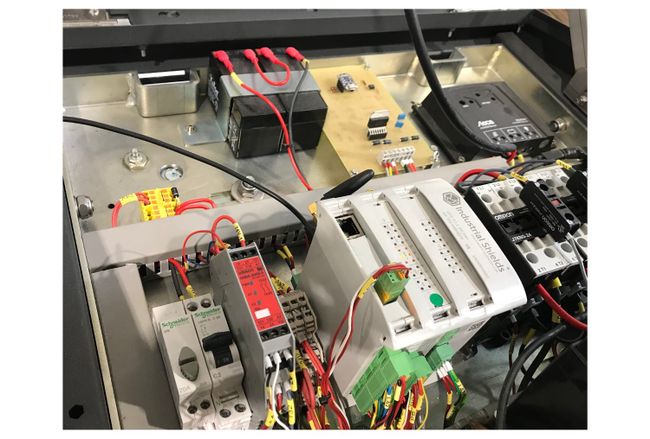
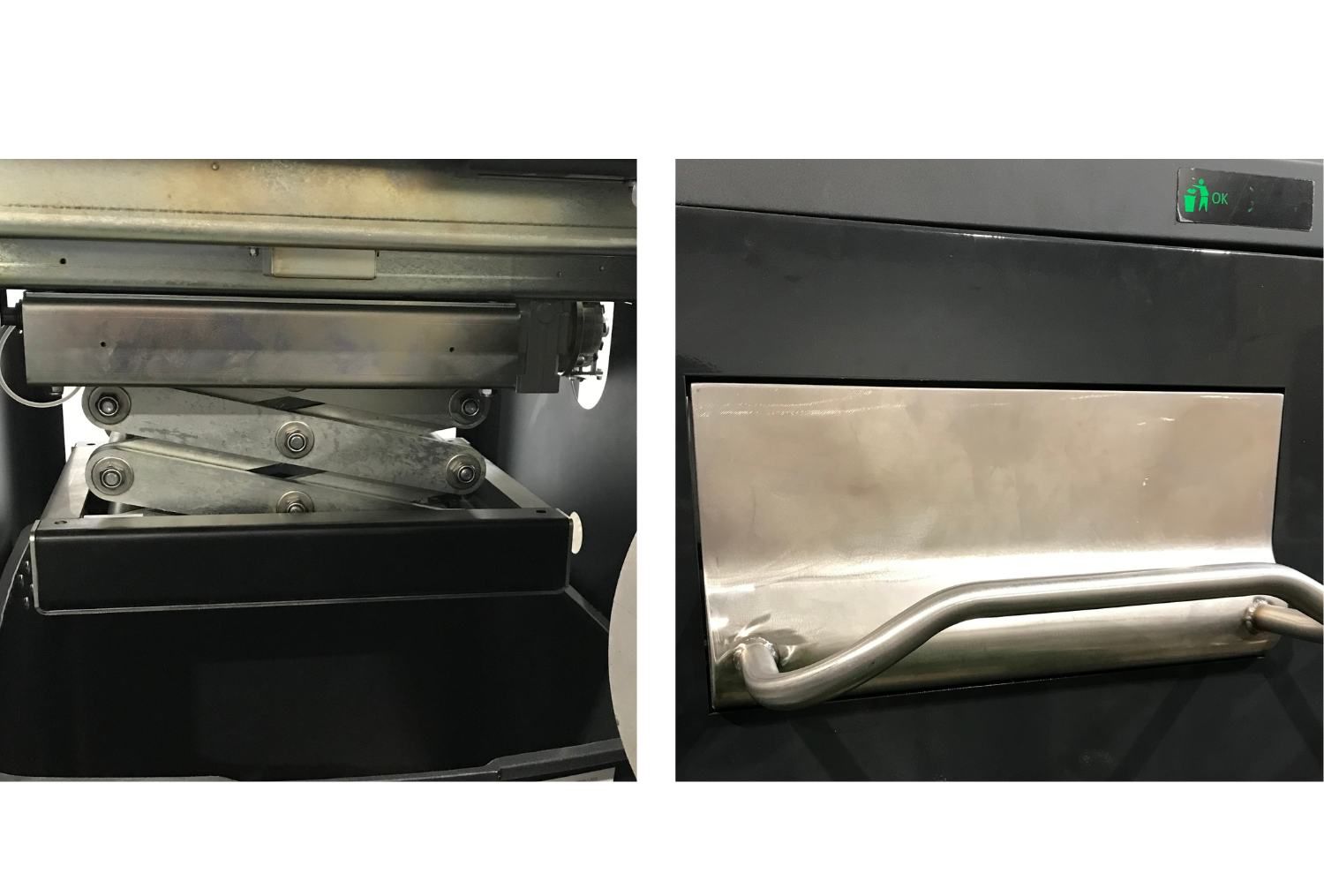
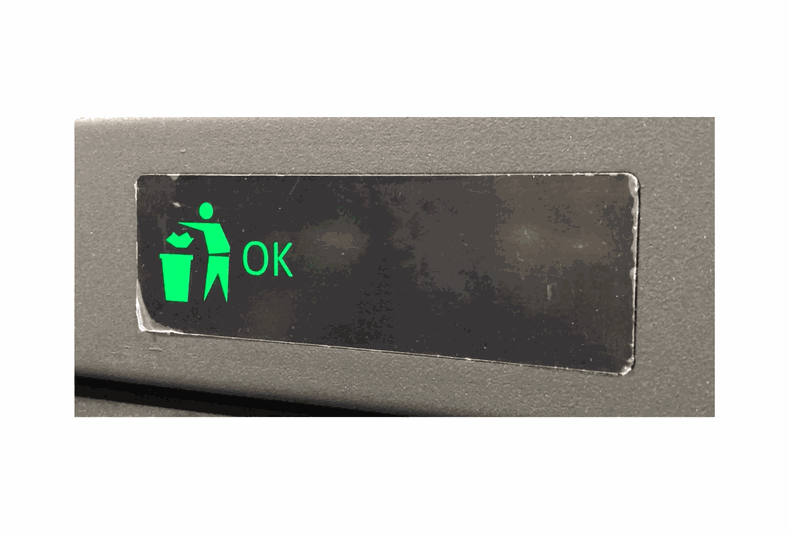
The real bin, inside.
Photos from the original case: the control cabinet, the press, the flap and the status panel.
The challenge
A machine in the street, on its own.
Waste management is one of the challenges that cities work on. The customer's project is a solar compacting litter bin for the street, a solution that is already spreading in some countries. In the street it faces intensive use and the risk of vandalism, so the bin is made entirely of metal. Inside there is a press and a trolley with wheels to make emptying easier, and a solar roof keeps it running on its own.
Compact at the right time
Capacity control: a presence sensor tells the PLC when the waste is high enough to start a compaction cycle.
Never press with the door open
The press must stop when the emptying door is open, to avoid accidents when the operator handles the trolley.
Count, weigh, measure
The system counts the compactions, weighs the waste and monitors the state of the batteries and their total charge.
Tell the control centre
Warnings, incidents and alarms go out by wireless remote communication, so an operator comes to empty the bin when it is needed.
Open, or clearly closed
When there is no incident, people can use the bin at will. Otherwise, the LED shows that the bin is not available and the waste flap is blocked.
How it works
Three parts of one program: press, power, alerts.
Each part shows one job of the PLC. Press the buttons. The panels are illustrative simulations: levels, times, weights, battery values and messages are examples, not data from the real bin.
The sensor sees the waste. The press does the rest.
When the presence sensor detects that a compaction cycle is needed, the PLC runs the press down and back up and adds one to the compaction counter. In this example it also blocks the flap during the stroke. If the emptying door opens, the press stops at once and the LED shows that the bin is not available. Throw some bags, then open the door during a stroke.
- The presence sensor starts the cycle
- The door switch stops the press
- Flap blocked and LED during an incident
PLC events (example)
- Throw a bag to fill the bin.
Illustrative simulation. Example values, no data from the real bin. A typical way: stroke switches on the press, and a door switch that also cuts the press power through a safety relay, because a door interlock should not depend on the program alone. The case does not publish the press drive, the stroke time or the compaction ratio.
The sun charges, the press spends, the PLC keeps the count.
The solar roof charges the batteries, and the press is the big consumer. The PLC monitors the battery and weighs the waste. A typical way: the battery voltage and a load cell on analog inputs, and if the charge gets too low, the PLC blocks the bin before a stroke can stop halfway and sends a warning. Change the weather and the traffic of the street.
- Battery voltage on an analog input
- A load cell transmitter for the weight
- Low charge blocks the bin and sends a warning
Power events (example)
Illustrative simulation. Example values, no data from the real bin. Example values: a 600 Wh battery, 4 W for the PLC and the sensors, 6 Wh per press cycle and 3 kg of waste weighed per cycle. Warning at 40 %, block at 25 %, back in service at 45 %. The case does not publish the battery, the panel or the press power. Time runs fast: one second is one hour.
Only the bins that need it get a visit.
Each bin sends its events over the mobile network: full, door open, low battery. In the control centre, the messages become a list of bins to empty and a route. Pick a day, then add an incident.
- Events, not a constant stream
- One message per warning, incident or alarm
- Fill and weight per bin for the route
Messages to the control centre (example)
Illustrative simulation. Example values, no data from the real bin. Example data for 8 bins, not from a real city. A typical way: each bin sends an event when it changes state, and a short daily report with fill, compactions and weight. The control centre visits the bins above 80 % and the bins with an incident.
System architecture
How does a PLC control a solar compacting litter bin?
An ESP32 PLC 21 FLEX with a 4G board reads the presence sensor, the door, the press position, the weight and the battery. It drives the press through contactors, sets the LED and, in a typical way, blocks the flap. Warnings, incidents and alarms go to the control centre over the mobile network. The solar roof charges the battery that powers the PLC and the press.
| Signal | Between | Type | Purpose |
|---|---|---|---|
| Waste at compaction height | BetweenPresence sensor → ESP32 PLC 21 | TypeDigital in | PurposeStarts the compaction cycle |
| Emptying door open | BetweenDoor switch → PLC (and safety relay, typical way) | TypeDigital in | PurposeStops the press and blocks the bin |
| Press up, press down | BetweenStroke switches → PLC (typical way) | TypeDigital in | PurposeEnds each stroke |
| Press motor | BetweenPLC → contactors | TypeDigital out | PurposeMoves the press down and up |
| Flap lock and LED | BetweenPLC → lock and status panel | TypeDigital out | PurposeBin available or blocked |
| Weight of the waste | BetweenLoad cell transmitter → PLC (typical way) | TypeAnalog in | PurposeKilograms in the trolley |
| Battery voltage | BetweenBattery → divider → PLC (typical way) | TypeAnalog in | PurposeState and charge of the battery |
| Warnings, incidents, alarms | BetweenPLC → control centre | Type4G | PurposeEmpty, check or repair the bin |
Why it works
One controller for a whole street machine.
Sensors decide, not the calendar
The press runs when the presence sensor sees waste at the compaction height, and the operator comes when the bin reports that it is full.
Safety before the cycle
The door switch stops the press and blocks the bin. A typical way adds a safety relay, so the interlock does not depend on the program alone.
Clear state for the public
The LED and the blocked flap tell people at once that the bin is not available. Nobody forces a full or open bin.
Power managed by the PLC
The PLC monitors the battery state and its total charge, as the case asks. A typical way uses that value to block the bin in time and send a warning.
Data for the routes
Compactions, weight and fill per bin let the control centre plan visits. The case says it means fewer trips and more efficient routes.
Open and modular
The customer chose an open controller with no licence fees, programmed with the Arduino IDE. More sensors or Smart City functions are changes in the same program.
Hardware
One ESP32 PLC with a 4G board inside the bin.
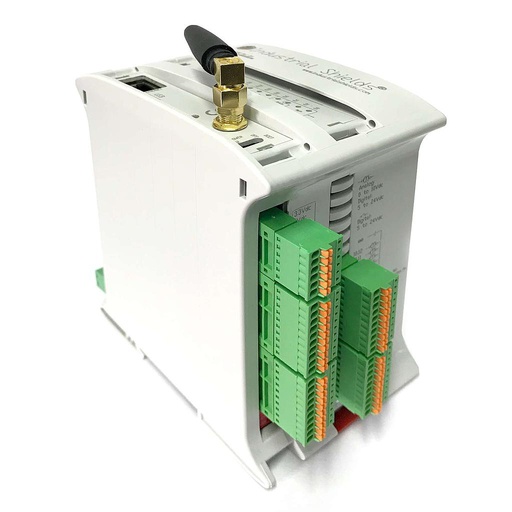
ESP32 PLC 21 FLEX
An industrial controller built on the dual-core ESP32, for DIN rail, programmed with the Arduino IDE. The FLEX version takes one communication board: here, 4G (M1)-NB1 IoT LTE, for the alerts to the control centre. In this case it runs the press, reads the sensors, the weight and the battery, and sends the warnings.
- Role
- Press, interlocks, counts, weight, battery and alerts
- Processor
- ESP32 dual core, up to 240 MHz
- Inputs
- 13: 6 analog/digital (0-10 V, 11-bit), 7 digital optoisolated (5 to 24 Vdc), 2 of them with interrupt
- Outputs
- 8: 3 analog/digital/PWM (0-10 V, 12-bit), 5 digital optoisolated (5 to 24 Vdc)
- Option board
- One: 4G (M1)-NB1 IoT LTE (Ublox), LoRa or CAN
- Communications
- Ethernet, Wi-Fi, Bluetooth LE, RS-485, RS-232
- Clock
- DS3231 real-time clock with backup battery
- Programming
- Arduino IDE
- Power supply
- 12 to 24 Vdc
- Mounting
- DIN rail TS35, IP20, inside a cabinet
The case used an ESP32 PLC with GPRS and does not publish the exact model. GPRS runs on 2G networks, which some operators have already switched off. Today, the equivalent is the ESP32 PLC 21 FLEX with the 4G (M1)-NB1 IoT LTE (Ublox) board, for LTE-M and NB-IoT networks. A typical I/O budget for this bin: 5 of the 7 isolated digital inputs (presence sensor, door switch, two stroke switches, flap closed), 2 of the 6 analog inputs (weight and battery), and 4 of the 8 outputs (press down, press up, flap lock, LED). The outputs are transistor outputs, so the press motor switches through contactors, as in the cabinet photo. The PLC goes in a cabinet (IP20, no condensation) inside the metal body of the bin.
Questions about this case
How does a compacting litter bin know when to compact?
A presence sensor looks across the chamber at the compaction height. When the waste reaches it, the PLC runs the press down and back up and counts one compaction. A typical way also blocks the flap during the stroke. On this page, an ESP32 PLC 21 FLEX does it with stroke switches to end each stroke, as a typical way. The case does not publish the sensor model or the stroke time.
How do you stop the press when the emptying door is open?
Wire a door switch to a digital input, so the program stops the press and blocks the bin as soon as the door opens. For the safety function, a typical way is a safety rated door switch and a safety relay that also cuts the power of the press, so the interlock does not depend on the program alone. ISO 14119 covers interlocking devices on guards, and ISO 13849-1 sets the performance level of the safety function.
Can a solar compacting bin run on its battery all year?
Only if the solar roof and the battery are sized for the worst month at that site and for the traffic of the street. The press is the big consumer. A typical way: the PLC measures the battery voltage, sends a warning at a low charge and blocks the bin before a stroke can stop halfway. The case does not publish the battery, the panel or the press power; the values in the panel are examples.
GPRS or 4G for a new smart bin?
The original case, published in 2023, used GPRS. GPRS runs on 2G networks, and some operators have switched them off or plan to. For a new project, check the coverage and the 2G end dates in your city. LTE-M and NB-IoT are made for devices that send little data and need little power, which fits a bin that sends events. The ESP32 PLC 21 FLEX takes a 4G (M1)-NB1 IoT LTE board.
What data should a smart bin send to the control centre?
Events when the state changes: full, door open, low battery, a fault. A typical way adds a short daily report with the fill, the compaction count and the weight. Keep the counters in non-volatile memory, so a restart does not lose them: see persistent counters on an ESP32 PLC. A machine with no one next to it also benefits from a hardware watchdog.
How do fill alerts make collection routes more efficient?
The operators visit the bins that report full or an incident, not every bin on a fixed round. The case says that this reduces the trips and the costs of operators and vehicles, and lets the operators organise their time. It does not publish figures. Compaction adds to it: the same trolley holds more waste before it is full.
Download the case study
4-page PDF with the challenge, the logic, the architecture and the hardware. No form required.
Similar project?
Tell us about your machine. An engineer will answer.
Tell us what your machine does, which sensors and actuators it has, how it is powered and where the alerts must go. We will tell you which controller and which link fit, and how to wire the safety part.
- You get an answer from our technical team
- I/O count, safety wiring and the mobile link
- Arduino, ESP32 or Raspberry Pi based PLCs