Case study · Fishing fleet · Arduino PLC
Fresh fish, from the fishing grounds to port. PLCs watch every hold.
Temperature, humidity and air quality, alarms for the whole crew.
A fishing company catches fresh fish and carries it to port in the refrigerated holds of its vessels. The conditions in the hold decide the quality and the safety of the catch.
So the holds are measured all the time, and any deviation reaches the crew.
This case describes a monitoring system for the holds of a fishing fleet, published by Industrial Shields in 2023. It does not name the company or the vessels. The parameters, the Modbus link, the screens and the alarms come from the case. The reference values and the times in the panels are examples.
The challenge
Keep the hold right for fresh fish, at sea.
The fish travels at a controlled temperature to keep its quality and freshness. The company wanted to know at every moment that the holds were in the right conditions, and to act before a deviation could damage the catch.
Measure the hold
Temperature, humidity and air quality are the critical parameters. Each one must stay close to its reference value.
Catch deviations early
Any deviation from the reference values must be detected, so the crew can take preventive measures before the fish suffers.
One view for the control room
The values of every hold, and every active alarm, must be visible in real time on the screens of the control room.
Reach the people on board
An alarm must reach the crew where they are, not only the control room: warning lights, messages and wireless devices.
Connected to the cold
The PLCs are connected to the refrigeration and air conditioning systems of the holds, so the monitoring sits next to the machines that keep the fish cold.
How it works
Three loops: measure the hold, share the data, alert the crew.
Each panel shows one loop. Press the buttons. The panels are illustrative simulations: the parameters, the Modbus link and the alarm path are the ones of the case, but the reference values, the times and the addresses are examples, not data from the fleet.
Three values, three reference bands, three kinds of notice.
Sensors in the hold send temperature, humidity and air quality to the PLC on analog or digital inputs. The PLC compares each value with its reference. In this example, a small deviation gives a warning, a lasting one an alarm, and the PLC also sends reports. Choose how the trip goes.
- Sensors on analog or digital inputs of the PLC
- Each value compared with its reference
- Warnings, reports and alarms
Notifications from hold 1 (example)
Illustrative simulation. Example values, not data from the fleet. The case measures temperature, humidity and air quality, compares them with reference values and activates warnings, reports or alarms. It does not publish the sensors or the values. In this example: 0 to 2 °C (fresh fish is kept close to melting ice, as EU Regulation 853/2004 asks), 85 to 95 % relative humidity, an air quality index below 50, a warning when a value leaves its band and an alarm when it stays out for 5 minutes. Time runs fast in the panel.
Modbus brings every hold to the control room.
The PLCs and the other devices on board share their data over Modbus. The screens in the control room ask each PLC for its values and show them in real time, with the active alarms. If a PLC stops answering, that is an alarm too. Cut the link to one hold.
- Modbus between the PLCs, the screens and the warning devices
- Real-time values and alarms on the control room screens
- A silent PLC is detected, not ignored
Modbus master on the control room side (example)
Illustrative simulation. Example values, not data from the fleet. The case uses the Modbus protocol between the PLCs and the other on-board devices, such as the display screens and the warning devices. It does not publish the variant or the addresses. In this example: Modbus RTU on RS-485, one PLC per hold with addresses 1 to 3, one request per second, and the hold is shown as lost after 3 missed answers.
Try polling, addresses and timeouts yourself in the Modbus network simulator
Lights, sirens and messages until someone answers.
When a value leaves its reference, the control room gets warning lights and alarms, and a message goes to different crew members. If necessary, the alert goes to more crew members through wireless devices. Raise a deviation and see who hears it.
- Warning lights and alarms in the control room
- Messages to different crew users
- Wireless alerts to more crew members if necessary
Alarm path (example)
Illustrative simulation. Example values, not data from the fleet. In the case, alarms and warning lights in the control room alert the crew, the alarm is sent as a message to different crew users, and alerts also go to other crew members through wireless devices if necessary. In this example the first message goes to the watch officer, and if nobody acknowledges within 5 minutes, it goes to the rest of the crew.
System architecture
How do you monitor the holds of a fishing fleet with PLCs?
Temperature, humidity and air quality sensors in the holds go to PLCs that are also connected to the refrigeration and air conditioning. The case does not say how many PLCs there are; our proposal, drawn here, is one PLC per hold. The PLCs share their data over Modbus with the other on-board devices: the display screens of the control room and the warning devices. The alarms go out as warning lights, sirens and messages to the crew, through wireless devices when necessary.
| Signal | Between | Type | Purpose |
|---|---|---|---|
| Temperature | BetweenSensor in the hold → PLC | TypeAnalog input, 0-10 V | PurposeKeep the fish at its controlled temperature |
| Humidity | BetweenSensor in the hold → PLC | TypeAnalog input, 0-10 V | PurposeKeep the hold in the right conditions for fresh fish |
| Air quality | BetweenSensor in the hold → PLC | TypeAnalog input, 0-10 V | PurposeDetect a hold that needs ventilation |
| Refrigeration and air | BetweenPLC ↔ refrigeration and air conditioning | TypeRelay outputs and inputs | PurposeThe monitoring is connected to the cold |
| Hold data | BetweenPLC ↔ control room screens | TypeModbus (RTU on RS-485 or TCP) | PurposeReal-time values and alarms of every hold |
| Warning lights and siren | BetweenPLC → control room | TypeRelay outputs | PurposeAlert the crew in the control room |
| Crew messages | BetweenControl room → crew devices | TypeWireless message | PurposeReach the crew members where they are |
| Reports | BetweenPLC → control room | TypeModbus data | PurposeRegular reports on the state of each hold |
Why it works
Deviations found early, and heard on board.
Preventive, not reactive
Each value is compared with its reference all the time, so the crew can act on a deviation before it damages the catch.
Three kinds of notice
Warnings, reports and alarms: the crew gets the right level of attention for each situation.
One picture of all the holds
The control room screens show every hold and every active alarm in real time.
The alarm finds people
Warning lights, sirens and messages, and wireless alerts to more crew members when necessary.
Next to the machines
The PLCs are connected to the refrigeration and air conditioning systems of the holds.
Open and modular
No licence fees. The system can be extended later, and our technical team is there from the first contact to after sales.
Hardware
Our proposal: one Arduino based PLC per hold.
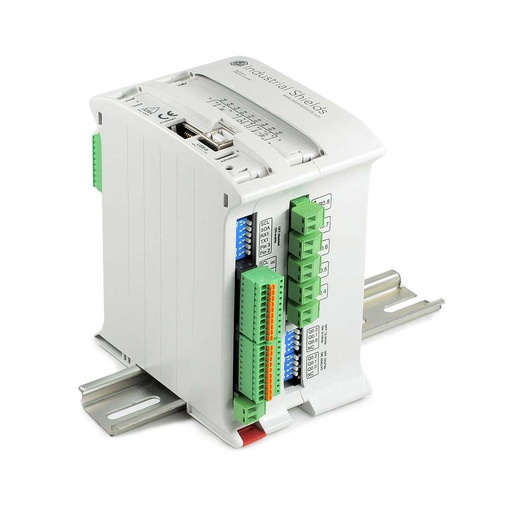
Our proposalM-DUINO ETHERNET PLC ARDUINO 19R
An Arduino Mega based PLC with analog inputs for the sensors of a hold, relays for lights and sirens, and RS-485 and Ethernet for Modbus.
- Role in our proposal
- Reads temperature, humidity and air quality of one hold, drives the warning devices and talks Modbus with the screens
- Inputs
- 6: 4 analog/digital (0-10 V, 10-bit) and 2 digital optoisolated
- Outputs
- 11: 8 relays (230 Vac 4 A / 24 Vdc 2 A, resistive) and 3 analog/PWM (0-10 V)
- Communication
- Ethernet, RS-485, RS-232, I2C, SPI, serial TTL, USB
- Controller
- Arduino Mega 2560, ATmega2560, 16 MHz
- Clock and storage
- Real-time clock and micro SD card
- Power
- 12 to 24 Vdc
- Environment
- 0 to 60 °C, 10 to 90 % RH without condensation, DIN rail
The case says Arduino PLC and does not publish the model or how many there are; its image shows an M-Duino. We propose one 19R per hold: its analog inputs and relays cover the sensors and the warning devices of one hold. On board, mount the PLC in a closed cabinet away from condensation and salt spray, and check the marine requirements of your vessel. All the models are in the M-Duino family datasheet.
Questions about this case
What does the system measure in a fish hold?
Temperature, humidity and air quality, the critical parameters named in the case. The PLC compares each value with its reference and activates warnings, reports or alarms when it detects a deviation.
Which temperature should a hold with fresh fish keep?
The case does not publish its reference values. EU Regulation 853/2004 asks for fresh fishery products to be kept at a temperature approaching that of melting ice, so a typical band is 0 to 2 °C. Set the real band with the people who handle the catch.
Why use Modbus on a vessel?
Because many on-board devices speak it. In the case, Modbus carries the data between the PLCs and the display screens and warning devices. A typical choice is Modbus RTU on RS-485 for long cable runs, or Modbus TCP over Ethernet. The Modbus temperature network case shows both.
How does an alarm reach the crew?
In the case, alarms and warning lights go off in the control room, the alarm is sent as a message to different crew users, and wireless devices alert other crew members if necessary. A typical rule escalates the alert when nobody acknowledges it in a few minutes.
What happens if a PLC stops communicating?
The case does not say. A typical way is to treat a missing Modbus answer as an alarm: after a few failed requests the control room screen shows the hold as lost, so a broken cable never looks like a calm hold.
Can it run on other cold stores?
Yes, the same pattern works on land. See the refrigerated fleet cold chain case for trucks. See the warehouse temperature and humidity case for stores.
Download the case study
4-page PDF with the challenge, the logic, the architecture and the hardware. No form required.
Monitoring holds or cold rooms?
Tell us about your vessels. An engineer will answer.
Tell us how many holds you have, what you measure today, how the cold is made and who must receive the alarms. We will propose the PLCs, the Modbus network and the alarm path.
- You get an answer from our technical team
- Sensors, Modbus, screens and crew alarms
- Arduino, ESP32 or Raspberry Pi based PLCs