Case study · Concrete plant · M-Duino with relays
Weigh each material. Mix to the recipe.
Hopper levels, a scale input, relays for belts and mixer, recipes on a Panel PC.
The operator picks the concrete. The PLC doses it.
A scale and a water meter decide when each material stops.
This case describes a model of a concrete plant that Industrial Shields developed in reply to customer requests. It does not name a customer or a site. The model fits dry and wet concrete plants. This page follows one batch: the hopper levels, the weighing, the mixing and the data that goes to the server.
The challenge
The aim: the right dose in every batch, with no manual action.
A concrete plant makes concrete from aggregate, cement and water. The plant stores each material, doses it in the right proportions and mixes it. The goal of this model: a machine that produces constantly, with accuracy, and complies with safety regulations. All the components work together, controlled by a PLC and a Panel PC.
Any type of concrete
There are dry and wet concrete plants. The model must be easy to replicate and to adjust to each kind of concrete.
Shorter cycle time
Get the most out of the plant and save cycle time in each batch.
No manual action
The aim is not to act by hand in the process. The operator selects the concrete, and the PLC runs the dosing and the mixing.
Data for a forecast
Monitor the plant and send all the information to the cloud, to forecast the raw materials that the plant needs.
Production, billing and failures
The production data goes to a server by LoRa. With it, the plant can make a forecast of production, billing and also machine failures.
How it works
Three loops: store, dose, mix.
Each loop shows one part of the batch. Move the sliders and press the buttons. The panels are illustrative simulations: sensor heights, recipes, weights, volumes and times are examples, not data from a plant.
Three sensors tell the PLC how full a hopper is.
The raw materials wait in hoppers. The case gives an example: three capacitive sensors at three heights in each hopper, each one on a digital input of the PLC. Sensor 1 at "1" means the level is minimum. Sensors 1 and 2 at "1" mean medium. All three at "1" mean full. Move the slider to fill or empty the hopper.
- Three capacitive sensors per hopper (example from the case)
- One digital input per sensor
- Three states: minimum, medium, full
Illustrative simulation. Example values, no data from a plant. Sensor heights at 20, 50 and 85 % of the hopper are examples. A typical way to do it: flag a pattern such as 1 0 1 as a sensor fault, because a higher sensor cannot see material that a lower one does not.
The scale stops the feed at the recipe weight.
Conveyor belts lift and carry each material to the weighing system. The PLC moves them with relay outputs. A programmable weighing machine sends the weight to an analog input. When the weight reaches the value of the recipe, the system stops dumping material. Then the gate opens and drops the material into the mixer. A water meter measures the water by volume. Pick a recipe and press Start batch.
- Relay outputs move the conveyor belts
- Analog input from the programmable weighing machine
- Water by volume, with a water meter
Batch steps (example)
Illustrative simulation. Example values, no data from a plant. Example recipes: aggregate 1,800 to 1,900 kg, cement 250 to 350 kg, water 150 to 170 L. Example scale: 0 to 10 V means 0 to 2,500 kg. A typical way to do it: stop the belt a little before the target, because material still falls after the relay opens (in-flight).
A timer runs the mixer. The record goes out by LoRa.
For the PLC, the mixer motor is one more relay output, controlled by a timer. The mixing time depends on the type of concrete. When the mix is homogeneous, the concrete drops into the truck. On the TouchBerry Pi Panel PC, the operator selects the type of concrete, the quantity and the mixing time. The Panel PC stores the production history, the mixing times and the quantities of each material, and sends them to the PLC. The data goes to the server by LoRa.
- Mixer motor on a relay output with a timer
- Mixing time set by the type of concrete
- History on the Panel PC, records to the server by LoRa
Batch records (example)
Illustrative simulation. Example values, no data from a plant. The timer runs 10 times faster than real time. Example record of 12 bytes: batch number, recipe, mixing time and the weight of each material.
System architecture
How does a PLC run a concrete batching plant?
An M-Duino with relays reads the capacitive level sensors of the hoppers on digital inputs, and the weighing machine and the water meter on analog inputs. Its relay outputs move the conveyor belts and the mixer motor. A TouchBerry Pi Panel PC talks to the PLC over Ethernet. The production data goes to a server in the cloud by LoRa.
| Signal | Between | Type | Purpose |
|---|---|---|---|
| Hopper level | BetweenCapacitive sensors → M-Duino | TypeDigital in | PurposeThree sensors per hopper in the example: minimum, medium, full |
| Weight | BetweenProgrammable weighing machine → M-Duino | TypeAnalog in | PurposeThe feed stops when the weight reaches the recipe value. Range not published |
| Water volume | BetweenWater meter → M-Duino | TypeAnalog in | PurposeMeasures the water by volume, instead of on a scale |
| Conveyor belts | BetweenM-Duino → belts | TypeRelay out | PurposeLift and carry the raw materials to the weighing system |
| Weighing gate | BetweenWeighing system → mixer | TypeOutput | PurposeOpens after each material is weighed. The case does not say how it is driven |
| Mixer motor | BetweenM-Duino → mixer | TypeRelay out | PurposeRuns for the mixing time of the type of concrete, with a timer |
| Recipe and history | BetweenTouchBerry Pi ↔ M-Duino | TypeEthernet | PurposeType of concrete, quantity and mixing time. History, times and quantities |
| Production data | BetweenM-Duino → server | TypeLoRa | PurposeData for the forecast of raw materials, production, billing and machine failures |
Why it works
One model for many plants.
Replicate and adjust
The case presents the plant as a model: easy to replicate and to adjust to dry and wet concrete. In the same area, you can duplicate the system to make different types of concrete at the same time.
The weight ends the dose
Each material stops on the reading of the weighing machine, at the value of the recipe. The water stops on the volume of the water meter.
Relays for the loads
The relay outputs of the M-Duino switch the belts and the mixer. Each relay switches up to 4 A at 230 Vac with a resistive load. For motors, the relay drives the coil of a contactor; add an RC snubber.
Recipes on a screen
The TouchBerry Pi Panel PC holds the type of concrete, the quantity and the mixing time, and keeps the production history.
Data for the forecast
The production data goes to a server by LoRa. The plant can forecast raw materials, production, billing and machine failures.
Code you can change
The M-Duino is programmed with the Arduino IDE. The level logic, the recipes and the timers are code that you can read and change.
Hardware used
M-Duino with relays to dose. Panel PC to choose.

M-Duino Ethernet PLC Arduino 57R
An industrial PLC built on an original Arduino Mega 2560, with 18 inputs and 31 outputs, 23 of them relays, Ethernet, RS-485 and RS-232, for DIN rail. In this plant it reads the hopper levels, the scale and the water meter, and switches the belts and the mixer.
- Role
- Hopper levels, weighing, water, belts, mixer timer
- Inputs
- 18: 12 analog or digital (0-10 V), 6 digital optoisolated
- Outputs
- 31: 23 relays (230 Vac 4 A, resistive), 8 analog, digital or PWM (0-10 V)
- Comms
- Ethernet (RJ45), RS-485, RS-232, TTL, I2C, SPI. LoRa: with the LoRa version of the M-Duino (see the LoRa family datasheet)
- Power supply
- 12 to 24 Vdc
- Mounting
- DIN rail TS35, IP20
The case says "one of our M-Duino PLCs with relays" and does not fix the model. The old page shows an M-Duino 19R. With the example of this page (three hoppers with three sensors each, the scale and the water meter), the PLC needs 11 inputs, and the 19R+ has 6. This page shows the 57R+: 18 inputs and 23 relays. Choose by the number of hoppers and loads. For the radio link, see the M-Duino LoRa family datasheet.
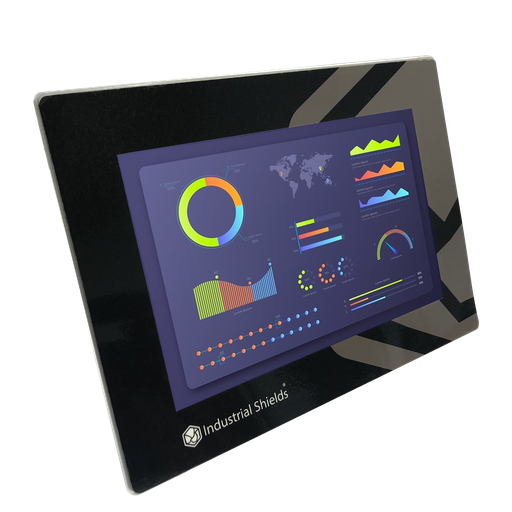
TouchBerry Pi Panel PC 10.1" FLEX
The operator station of the plant. An industrial Panel PC with a Raspberry Pi 4. The operator selects the type of concrete, the quantity and the mixing time. It stores the production history and sends the data to the PLC.
- Role
- Recipe selection, production history
- Screen
- 10.1"
- Computer
- Raspberry Pi 4
- Link to the PLC
- Ethernet
The case names the TouchBerry Pi, and the old page links the 10.1" model. The image and the link show the TouchBerry Pi Panel PC 10.1" FLEX. The family also has 7" and 18.5" models.
Questions about this case
How does a PLC control a concrete batching plant?
The PLC reads the level of each hopper, moves the conveyor belts that carry the materials to the weighing system, and stops each feed when the scale reaches the recipe value. Then the gate drops the material into the mixer, the water is measured by volume, and a timer runs the mixer. In this case an M-Duino with relays does it, and a TouchBerry Pi Panel PC holds the recipes.
How do three capacitive sensors give the level of a hopper?
Each sensor is a digital input that switches when material is in front of it. With three sensors at three heights: sensor 1 at "1" means minimum, sensors 1 and 2 mean medium, all three mean full. For a continuous level, use a 4-20 mA level transmitter on an analog input; the M-Duino reads 0-10 V, so add a 500 Ω precision shunt.
How does the PLC read the weighing machine?
In this case a programmable weighing machine sends the weight to an analog input, and the PLC stops the feed at the recipe value. A common choice is a weighing indicator with a 0-10 V or 4-20 mA output. You can also read the load cells through a transmitter: see how to connect a load cell with an HX711 to an Arduino based PLC. For the water, a meter with a pulse output or Modbus also works: see the Modbus flow meter counter example.
How do the batch data reach the server by LoRa?
The case sends the information by LoRa to a server, to forecast production, billing and machine failures. LoRa sends small packets with a low data rate, so a typical way to do it is a compact record per batch: number, recipe, times and weights. See how to work with LoRaWAN and a PLC controller.
What about safety on the belts and the mixer?
The goal of the case includes complying with safety regulations. The case does not publish the safety circuit. On belts and mixers, the emergency stop and the guard interlocks must also work without the PLC program and the screen. Design them as a hardwired safety circuit that follows your risk assessment, IEC 60204-1 and ISO 13850.
Which parts of this case are facts, and which are examples?
Facts: aggregate, cement and water dosed and mixed; dry and wet plants; three capacitive sensors per hopper as an example of level detection; conveyor belts on relay outputs of an M-Duino; a programmable weighing machine on an analog input; a gate into the mixer; the mixer motor on a relay with a timer; a water meter; a TouchBerry Pi Panel PC on Ethernet; data to a server by LoRa. Examples: sensor heights, recipes, weights, volumes, times, the scale range, the in-flight stop, the fault check and the record size.
Download the case study
4-page PDF with the challenge, the logic, the architecture and the hardware. No form required.
Similar plant?
Tell us your materials and your recipes. An engineer will answer.
Tell us how many hoppers and materials you dose, how you weigh them, how you measure the water, and where the data must go. We will tell you which controller fits and how to wire it.
- You get an answer from our technical team
- I/O count and controller sizing for your plant
- Arduino, ESP32 or Raspberry Pi based PLCs