Case study · Bakery · Arduino PLC retrofit
The ovens still bake well. Now they also report.
A retrofit of rotary bakery ovens with an Arduino based PLC and a Panel PC.
The ovens worked and were in perfect condition. What they lacked was data.
So the retrofit keeps the ovens and adds sensors, a PLC and a screen.
This case describes the retrofit of the rotary ovens of a bakery with Industrial Shields Arduino based PLCs and a TouchBerry Panel PC. Industrial Shields won the project. The case does not name the bakery. The sensors, the alarms, the screens and the results come from the case, which publishes no figures. The values in the panels are examples, not data from the bakery.
The challenge
Bake more, in less time, with less energy.
The bakery wanted more productivity from its ovens: shorter baking times, lower energy consumption and better control of the other indicators that drive the cost of each bake. The goals of the project: avoid human error, increase the daily production, control the performance of each oven, cut the baking time and reduce the consumption.
Thermometers you could not trust
The ovens used irreversible thermometers. They failed, and they were not 100% reliable. The operator could not be sure of the real temperature inside the oven.
Two values decide the bake
Temperature and rotation speed. If both stay where they should, the bread comes out the same every time, and the operator spends less time supervising the oven.
Trays in the hottest zones
The trays sit in the extreme temperature areas of the oven. The system must know, with no contact, whether there are trays inside, and flag an oven running with empty trays or full trays with the oven off.
Heat that escapes
Heat that leaks through the door, or hot air that does not move, leaves cold spots inside the oven and an uneven bake.
Keep the ovens, add the data
The ovens were still in perfect condition, so replacing them was not the plan. The retrofit adds the functions they lacked, extends their life and gives a longer time to amortise them.
How it works
Three jobs: bake to a profile, watch the trays, record every bake.
Each panel shows one job. Press the buttons. The panels are illustrative simulations: the sensors, the alarms and the screens are the ones of the case, but the profiles, the set points, the speeds and the timings are examples, not data from the bakery.
One profile per bread. The PLC holds it.
The operator picks the profile for the bread. The PLC reads the temperature sensors placed around the oven and keeps the temperature and the rotation speed at the values of the profile. The fans drive the hot air and the sealed door keeps the heat in. Change the bread, stop the fans or open a leak in the seal.
- Temperature sensors in several parts of the oven
- Temperature and rotation speed set by the profile
- Fans and a sealed door for an even bake
Oven control (example)
Illustrative simulation. Example values, not data from the bakery. The case controls the temperature and the rotation speed to predefined parameters, with one baking profile per type of bread, and does not publish them. In this example: three profiles with their own set point and speed, three temperature sensors at the top, middle and bottom, and the spread that appears when the fans stop or the door seal leaks.
Trays seen without contact, in the hottest zones.
Inductive sensors detect the metal trays with no physical contact, in the extreme temperature areas of the oven. With them the PLC switches the oven on and off and raises two alarms: an oven running with no trays, and full trays waiting with the oven off. Load the trays, start a bake, or try it the wrong way round.
- Inductive sensors detect the trays
- On/off control of the oven from the trays
- Two alarms for the two tray mistakes
Trays and alarms (example)
Illustrative simulation. Example values, not data from the bakery. The case puts inductive sensors in the extreme temperature areas, uses them for the on/off control of the oven and raises alarms for empty trays in the oven or full trays without the oven activated. It does not publish the logic. In this example: the bake only starts with trays in, a start with no trays raises the empty oven alarm, trays loaded and not started within 2 minutes raise the waiting alarm, and a bake lasts 20 minutes, run fast.
Temperature, bakes, gas and who was on shift.
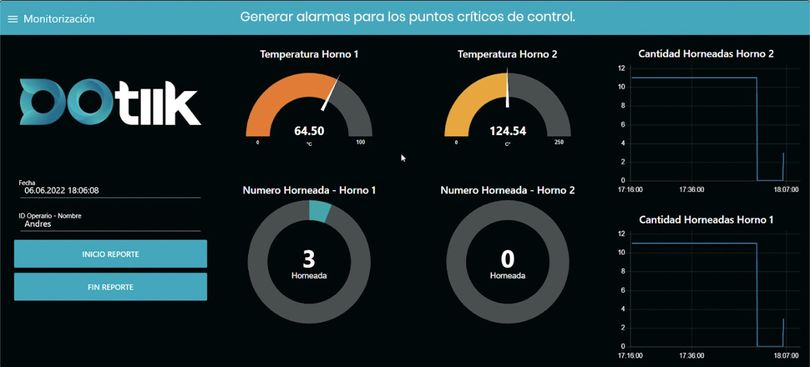
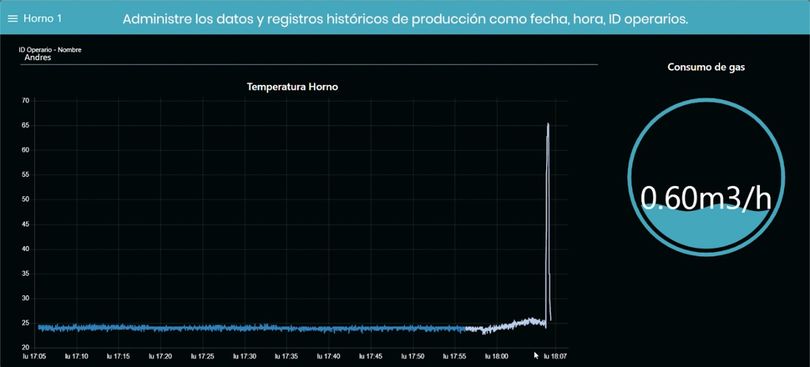
The Panel PC shows each oven with its temperature and its number of bakes, the temperature log, the gas consumption and the ID of the operator. The operator opens and closes a report, and the data stays as a record of the production. Pick an oven, open a report and close it after a few bakes.
- Temperature and bakes per oven
- Temperature log and gas consumption
- Operator ID and start and end of each report
Production records (example)
Illustrative simulation. Example values, not data from the bakery. The operator screens of the case show, for each oven, the temperature and the number of bakes, a temperature log, the gas consumption and the ID of the operator, with start and end report buttons. They do not publish the format of the records. In this example the report adds up the bakes, the average temperature and the gas of one oven between the start and the end. The operator ID is an example.
Try it on a full line
Practise with alarms and counts on a monitored line.
The panels above show the ovens of one bakery. The simulator below runs a production line with its alarms, its stops and its counts.
System architecture
How do you add monitoring to an oven that already works?
Place temperature sensors in several parts of the oven, inductive sensors where the trays sit and a seal on the door, and wire them to the PLC. The PLC drives the rotation of the rack, the heating and the high power fans to the parameters of the selected profile, and raises the tray alarms. A Panel PC next to the ovens is the operator screen: it sets the parameters and shows the temperature, the bakes, the log and the consumption of each oven, with the ID of the operator. In this case the PLC is an Arduino based PLC from Industrial Shields and the screen is a TouchBerry Panel PC.
| Signal | Between | Type | Purpose |
|---|---|---|---|
| Oven temperature | BetweenSensors in several parts of the oven → PLC | TypeTemperature sensors | PurposeReplace the old thermometers; real-time value for control and records |
| Rotation speed | BetweenPLC → rack rotation | TypeSet by the profile | PurposeThe second critical value of the bake |
| Tray presence | BetweenInductive sensors → PLC | TypeNo contact, detects metal | PurposeOn/off control of the oven and the two tray alarms |
| Door seal | BetweenHermetic seal on the door → PLC | TypeConnected to the PLC | PurposeKeeps the heat in for a stable bake |
| Hot air flow | BetweenPLC → high power fans | TypePLC output | PurposeMoves the heat; no cold spots inside the oven |
| Baking profile | BetweenPanel PC → PLC | TypeParameters per type of bread | PurposeTemperature, rotation speed and other functions |
| Production record | BetweenPLC → Panel PC | TypeTemperature, bakes, log, consumption | PurposePer oven, with the ID of the operator |
| Alarms | BetweenPLC → operator | TypeOn the Panel PC | PurposeEmpty trays in a running oven, full trays with the oven off |
What changed
More bread per day, less energy per bake, the same ovens.
More production
The case reports a significant increase in the daily production. Baking times went down, so the bakery makes more bread in the same time.
Less energy
The case reports a significant reduction in energy consumption, and lower operating costs with it. The case publishes no figures.
A more uniform bread
With the temperature and the rotation under control, the bread comes out with a more uniform texture and taste. Fans and a sealed door keep the heat even.
Remote management
With the PLCs in place, the plant and its status can be managed remotely, and the production process can be tuned from the data.
A longer life for the ovens
The retrofit extends the life of the ovens, and with it the time to amortise them. The bakery keeps equipment that still works.
Open and modular
There are no licence fees. The system can be extended in the future, and the technical team supports it before, during and after the project.
From the original case
The operator screens of the case.
The case does not publish photos of the installation.
Hardware
An Arduino based PLC and a TouchBerry Panel PC.

Current optionM-DUINO ETHERNET PLC ARDUINO 38AR
An industrial PLC built around an original Arduino Mega 2560, for DIN rail, programmed with the Arduino IDE. Its analog inputs take the temperature sensors through a transmitter, its digital inputs take the inductive sensors and the door seal, and its relays and analog outputs can drive the fans and the rotation.
- Role in this design
- Reads the oven sensors, holds the profile, raises the tray alarms
- Inputs
- 19: 10 analog/digital (0-10 V, 10-bit), 9 digital optoisolated (5 to 24 Vdc), 4 with interrupt
- Outputs
- 19: 6 analog/digital/PWM (0-10 V), 5 digital optoisolated, 8 relays (230 Vac 4 A / 24 Vdc 2 A, resistive)
- Communications
- Ethernet (W5500, RJ45), RS-485, RS-232, I2C, SPI
- Built in
- Real-time clock, microSD slot
- Power and mounting
- 12 to 24 Vdc, DIN rail TS35, IP20
The case names Arduino based PLCs from Industrial Shields and does not publish the model. The original page shows a product photo of an M-Duino 54ARA, which is not in the online shop today. The M-Duino 38AR is a current model with analog inputs and relay outputs. Size it for your ovens: count the sensors and the outputs per oven. The M-Duino family has smaller and larger models.
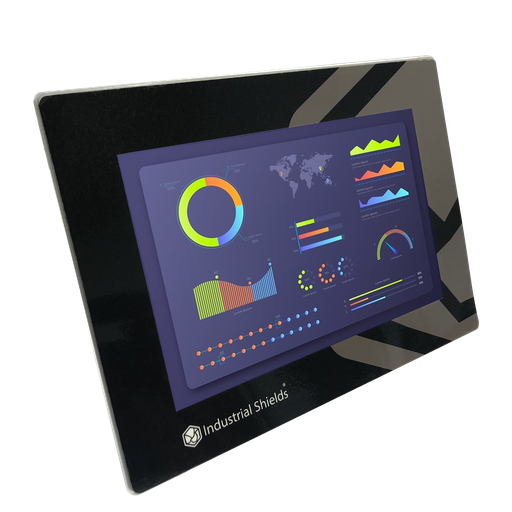
Current equivalentTouchBerry Pi Panel PC 10.1" FLEX
The operator screen of the case is a TouchBerry Panel PC. A current option is this industrial Panel PC with a Raspberry Pi 4 and a 10.1" touchscreen, connected to the PLC over Ethernet. It sets the baking parameters and shows the temperature, the bakes, the log and the consumption of each oven.
- Role in this design
- Operator screen, profiles, records and alarms
- Screen
- 10.1", capacitive touch
- Computer
- Raspberry Pi 4
- Network
- Gigabit Ethernet
The case does not publish the model or the size of the TouchBerry. The current family has 7", 10.1" and 18.5" models.
Questions about this case
What does a PLC retrofit add to a rotary bakery oven?
In this case: temperature sensors in several parts of the oven, inductive sensors that detect the trays, hermetic seals on the door connected to the PLC, high power fans driven by the PLC, baking profiles per type of bread, and an operator screen with the temperature, the bakes and the consumption of each oven. The ovens stay. The case reports more daily production, shorter baking times, lower energy consumption and a more uniform bread.
How does a PLC measure the temperature inside a baking oven?
In this case, temperature sensors placed in different parts of the oven replaced irreversible thermometers that failed and were not fully reliable. The case does not publish the sensor type. A typical way: a thermocouple or a Pt100 rated for the oven temperature, with a transmitter that gives 0-10 V or 4-20 mA to an analog input of the PLC. On the M-Duino 38AR the analog inputs are 0-10 V; for 4-20 mA, add a 500 Ω precision shunt and scale the value in the program.
How do inductive sensors detect the trays in the oven?
An inductive sensor detects metal without physical contact, so it can see a metal tray without touching it. In this case the sensors are in the extreme temperature areas of the oven and connect to the PLC. The PLC uses them for the on/off control of the oven and for two alarms: empty trays in the oven, and full trays without the oven activated. Choose a sensor rated for the temperature at its mounting point. Try the logic in the second panel.
What is a baking profile, and how does the PLC apply it?
A baking profile is a set of predefined parameters for one type of bread: the temperature, the rotation speed of the oven and other functions. The operator selects it on the Panel PC, and the PLC adjusts the oven to it automatically. The case does not publish its profiles; the values in the first panel are examples.
What does the operator see on the Panel PC?
The screens of the case show each oven with its temperature and its number of bakes, the bake counts over time, a temperature log, the gas consumption in m³/h and the ID of the operator, with buttons to start and end a report. The aim is to manage the production history by date, time and operator.
Which hardware fits a similar oven retrofit?
The case uses Arduino based PLCs from Industrial Shields and a TouchBerry Panel PC, and does not publish the models. Start from the signal list of each oven: temperature sensors, tray sensors, door, fans, rotation and heating. The M-Duino 38AR has 10 analog inputs, 9 digital inputs and 8 relays; the TouchBerry Pi Panel PC 10.1" FLEX is a current operator screen. Send us the list and an engineer will answer.
Download the case study
4-page PDF with the challenge, the logic, the architecture and the hardware. No form required.
Retrofitting ovens or other process machines?
Tell us about your ovens. An engineer will answer.
Tell us how many ovens you have, which values you want to see and control, and where the data must go. We will propose the PLC, the sensors and the screen.
- You get an answer from our technical team
- Sensors, PLC and operator screen for your ovens
- Arduino, ESP32 or Raspberry Pi based PLCs