
Complete guide: Choosing an industrial controller
Six trends shape industrial robotics in 2026: cobots that are easier to program, robots that adapt with vision and force sensors, the first humanoid robots in factory pilots, autonomous drones for inspection, modular robot cells, and robot fleets managed from the cloud. The market is large and stable: the International Federation of Robotics (IFR) counted 542,000 industrial robots installed in 2024 and 4,664,000 in operation, and expects 575,000 installations in 2025. In every one of these trends, the robot still needs a cell controller, usually a PLC, to handle safety signals, part sensors, conveyors and the link to the plant systems.
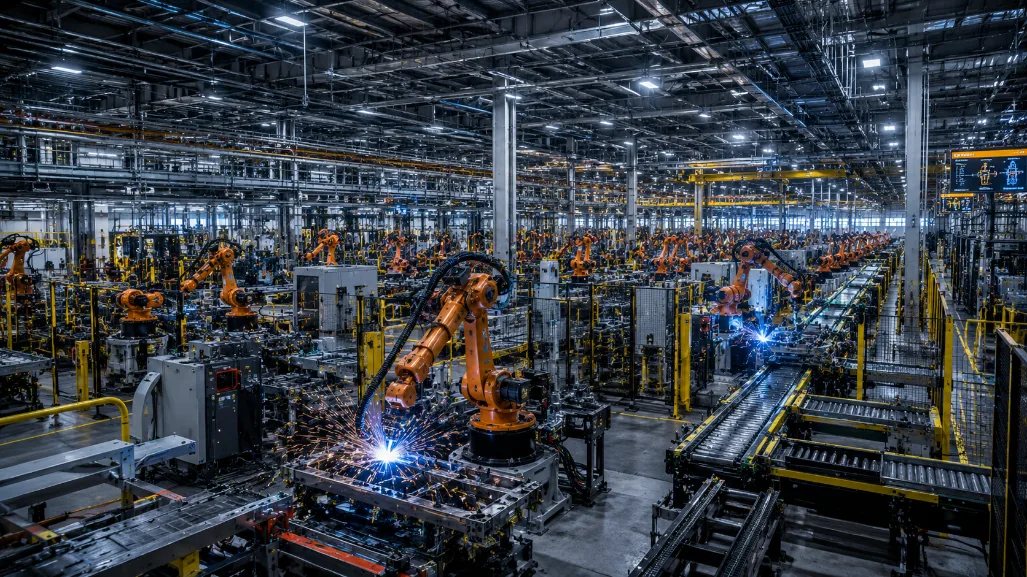
Industrial robots in figures
Data from the IFR press release on World Robotics 2025, published in September 2025:
| Figure | Value |
|---|---|
| New industrial robots installed in 2024 | 542,000 |
| Industrial robots in operation, 2024 | 4,664,000 (+9 %) |
| Installations in China, 2024 | 295,000 (54 % of the world) |
| Japan, United States, South Korea, Germany, 2024 | 44,500; 34,200; 30,600; 26,982 |
| Forecast for 2025 | 575,000 (+6 %) |
| Forecast for 2028 | More than 700,000 per year |
1. Cobots that are easier to program
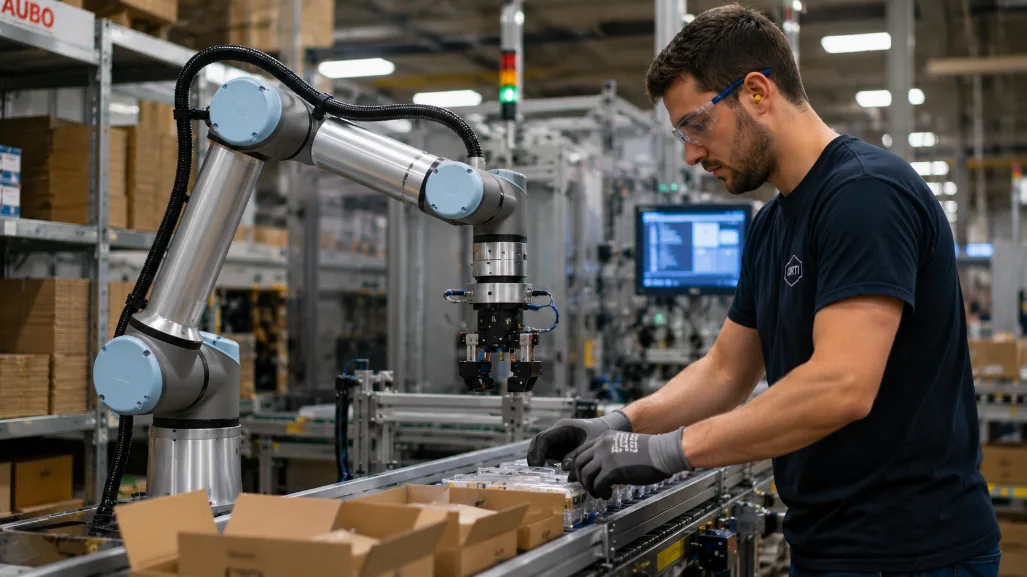
Collaborative robots work next to people, with force and speed limits instead of fixed guards, after a risk assessment of the application. The change in 2026 is the programming. Cobot makers offer graphical programming, programming by demonstration (the operator guides the arm and the robot records the path) and assistants that suggest the program from a description of the task. A production team can move a cobot to a new task without a robot specialist.
For the controls engineer: the cobot program changes more often, so the interface with the cell controller must be simple and stable: a recipe or part number, start, ready, done and fault signals, read by the PLC over digital I/O or Modbus TCP.
2. Robots that adapt with vision and force sensors
Robots with cameras and force-torque sensors correct their grip, path and speed from what they measure: bin picking of mixed parts, welding of parts with variable geometry, assembly with tolerances, and quality checks with a camera on the robot arm. Machine learning models run in the vision system or in an industrial PC next to the robot.
For the controls engineer: the AI does not replace the cell controller. The robot and its vision system plan the motion inside the task that the PLC defines. The PLC keeps the safety circuit, the conveyor timing and the coordination with the other machines.
3. Humanoid robots in factory pilots
Several companies, such as Figure, Tesla (Optimus), Agility Robotics (Digit) and Boston Dynamics (Atlas), show humanoid robots doing structured tasks such as moving totes. Car makers and logistics companies have announced pilots, for example BMW with Figure and GXO with Agility Robotics. The appeal is that a humanoid can use the aisles, tools and stations designed for people. The open points are cost, reliability over long shifts, and how to program and certify them at scale.
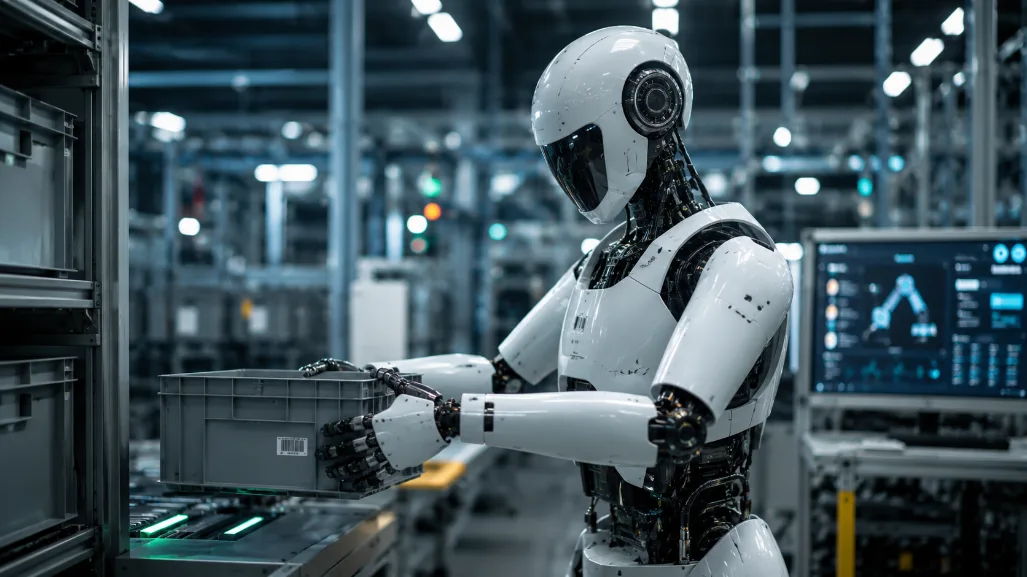
For the controls engineer: a humanoid that works at a station still needs the station to tell it when a part is ready and to stop safely. The signals are the same as for any robot: part present, request, done and safety.
4. Autonomous drones for inspection
Drones with thermal and optical cameras inspect solar plants, wind turbines, pipelines, power lines and large indoor spaces such as warehouses. In the European Union, flights beyond visual line of sight (BVLOS) are possible in the specific category with an operational authorisation (Regulation (EU) 2019/947), and the U-space rules (Regulation (EU) 2021/664) apply since January 2023.
For the controls engineer: the value is in the data. Inspection results that reach the maintenance system or the SCADA as work orders and alarms are more useful than a folder of images.
5. Modular robot cells
Manufacturers build cells that can be moved and changed when the product changes: six-axis robots or cobots on mobile bases, quick-change end-of-arm tools, standard electrical connectors and fixtures that can be swapped. The cell controller is often an open platform that talks to robots of several brands.
For the controls engineer: define one I/O and register map per cell module. When a module moves to another line, the controller program changes less.
6. Robot fleets managed from the cloud
Connected robots send status, cycle times and alarms to a central server. The fleet can be monitored remotely, maintenance can be planned from the data of all the units, and software updates can be distributed from one place. In logistics, fleets of mobile robots already share maps and tasks this way. The robots keep the time-critical work local and send data to the cloud.
For the controls engineer: plan the data path from the start: what the PLC or the robot publishes, at what rate, over which protocol (MQTT or OPC UA are common), and what happens when the connection is lost.
Where the PLC fits in a robot cell
| Function | Who does it | Typical signals |
|---|---|---|
| Motion and path | Robot controller | Program number, start, done |
| Perception | Vision system or industrial PC | Part position, pass or fail |
| Cell sequence | PLC | Part present, clamps, conveyor, request and ready signals |
| Safety | Safety relay or safety PLC | Emergency stop, guards, light curtains; the cell PLC only reads their state |
| Data to the plant | PLC or gateway | Counters, cycle times, alarms over Modbus TCP, MQTT or OPC UA |
In the cases below, an ESP32 PLC and an M-Duino of Industrial Shields work as this cell controller, with digital I/O for the handshake with the robots. The guide to choosing an industrial controller helps to pick the family.
FAQ about industrial robotics trends
How many industrial robots are installed every year?
According to the IFR, 542,000 in 2024, with 575,000 expected in 2025 and more than 700,000 per year by 2028.
Does AI replace the PLC in a robot cell?
No. AI helps the robot to see and plan its motion. The PLC still runs the cell sequence and the interface with the other machines, and a safety relay or safety PLC handles the stops.
Can a cobot work without guards?
Only when the risk assessment of the whole application allows it. The tool, the part and the speed matter as much as the robot itself.
Which protocols connect a PLC to a robot?
Digital I/O for the basic handshake is the most common. Many robot controllers also offer Modbus TCP, and plant data often goes over MQTT or OPC UA.
Take it further
A robot cell needs a controller that coordinates fixtures, robots and safety signals. See a cobot cell, a welding cell and an assembly station simulator.
Case study
One cobot, many references. One PLC to run it.
An ESP32 PLC 38R runs the program of each part and shows the production figures live.
Read the case study
Case study
The robots weld one side. The operator loads the other.
One PLC coordinates the fixtures, the robots, the air and the gas, and a safety relay handles the stops.
Read the case study
Simulator
Run an assembly station: check each part and hand the cycle to the robot
An M-Duino 38R weighs the part, reads the press force and measures a distance with a laser. Safety runs on a separate circuit that the PLC only reads.
Open the simulator