
Three forces are converging right now: AI is moving from the cloud to the factory floor faster than most roadmaps anticipated, EU regulation is making OT security and energy monitoring mandatory, and IT/OT integration has matured beyond pilot projects into operational deployments. The pace of AI development in particular is set to reshape what is possible at the edge within the next 12 to 24 months — the organisations building the right hardware and data infrastructure today will be the ones capturing value from those advances. This post covers 10 developments with the most impact for manufacturers and system integrators.
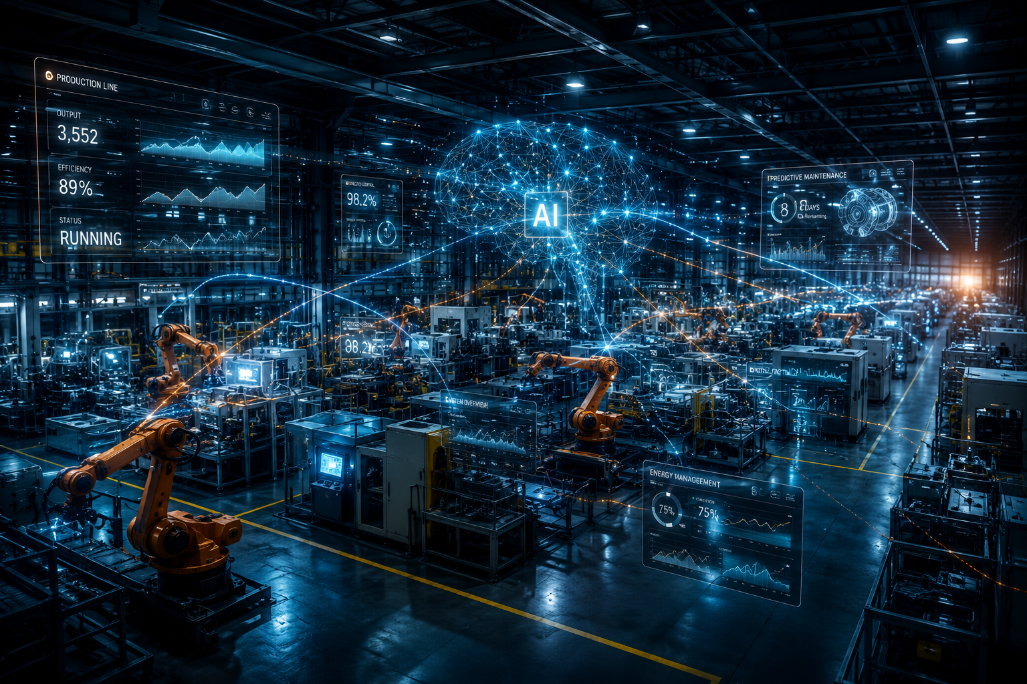
1. IT/OT convergence reaches operational maturity
No longer a roadmap item. AI tools are the new driver: manufacturing execution systems (MES) feeding real-time data into inference engines running on the OT side. The boundary between IT and OT is dissolving — bringing both integration opportunities and security risks. Industrial networks that were once air-gapped are now connected, and the organisations that manage this transition well are seeing measurable gains in throughput and visibility. Those that do not are accumulating risk.
Expect to see solutions that go beyond convergence and merge IT and OT toolchains into unified offerings — single panes of glass covering both the ERP and the PLC.
2. AI moves from the cloud to the factory floor
The most significant shift in 2025–26 is not AI itself — it is where AI runs. Inference is moving to edge hardware. Instead of sending sensor data to the cloud for analysis, companies are running lightweight models directly on industrial controllers and gateways, enabling real-time anomaly detection and process optimisation without cloud latency or connectivity dependency.
Open-weight models such as Llama and Mistral are being fine-tuned for specific industrial processes — vibration signature classification, thermal profile monitoring, quality inspection — and deployed on hardware already installed in the panel. The cloud remains useful for training; the edge is where decisions happen.
3. From automated to autonomous operations
Traditional PLCs execute fixed logic. AI-augmented controllers adjust parameters in real time based on sensor feedback, closing the loop between measurement and actuation in ways that rule-based systems cannot. Early industrial applications are already in production: adaptive chemical dosing, energy consumption optimisation, and vision-based quality control that improves its own accuracy over time.
The limiting factor is no longer the hardware or the algorithms — it is training data quality and organisational change management. Companies that invest in structured data collection today will have a decisive advantage when deploying autonomous systems tomorrow.
4. Cyber resilience: NIS2 is now law
The EU NIS2 Directive entered into force in October 2024. For manufacturers supplying or operating critical infrastructure — energy, water, transport, food — OT cybersecurity is now a legal obligation: network segmentation, documented incident response, supply chain vetting, and mandatory breach reporting within 24 hours.
This is changing industrial procurement. Controllers and gateways must now meet security requirements, not just functional ones. OT networks must be architected with zero-trust principles. Vendors without a published security policy and a software bill of materials (SBOM) are increasingly disqualified from tenders. Organisations that treat NIS2 as a compliance exercise rather than an engineering problem will struggle to keep pace.
5. Digital twins gain industrial traction
Digital twins — virtual replicas of physical assets or processes updated with real-time data — are moving beyond aerospace and automotive into broader manufacturing. The key enabler is affordable IoT hardware that can stream operational data to simulation environments at low cost and without proprietary lock-in.
Practical use cases in 2026: pre-installation commissioning validation (test the logic before the machine ships), predictive maintenance at the individual asset level (the twin degrades before the physical asset does), and operator training in virtual environments that replicate actual plant conditions.
6. Cobots and AI: flexible automation cells
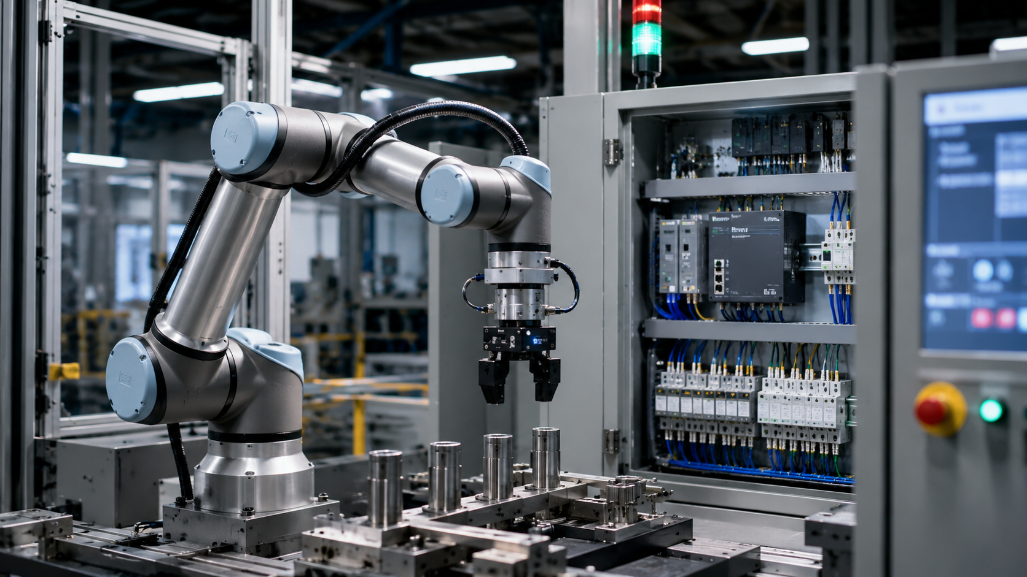
Collaborative robot programming is no longer about teaching waypoints. AI-driven programming — where the robot learns a task from human demonstration and generalises it — is reducing integration time from weeks to hours. Deployment cost is falling, and the accessible skill set required is shrinking.
The industrial PLC remains the orchestration layer in these cells: it coordinates the cobot, the conveyor, the vision system, and the safety circuit. Open-source controllers are increasingly used as the integration backbone precisely because they offer the flexibility to interface with any robot brand over standard protocols such as Modbus TCP, EtherNet/IP, or MQTT.
7. Edge automation platforms built for OT teams
A new category of edge platform is emerging: designed for OT engineers, not IT specialists. These platforms run containerised applications for data acquisition, protocol conversion, and local analytics on hardware already installed in the control panel — no Linux expertise, no cloud dependency, no IT ticket required to make a configuration change.
The impact is significant. Deployments that previously required a week of IT involvement can now be handled by the automation engineer on-site. This is compressing project timelines and reducing integration costs for small and mid-size facilities that cannot justify a dedicated IT/OT team.
8. Open-source automation and accessible hardware
The combination of open-source PLC firmware — OpenPLC, CODESYS, Node-RED — with Arduino and Raspberry Pi-based industrial controllers is changing the economics of automation. Small and mid-size manufacturers can now deploy capable, standards-compliant systems at a fraction of the cost of proprietary DCS or SCADA solutions.
This is not a compromise. Open platforms support IEC 61131-3 ladder logic, structured text, and function block diagrams. They communicate over Modbus, MQTT, OPC-UA, and REST. They run on hardware with industrial I/O protection, DIN-rail mounting, and wide-voltage power supplies. The barrier to entry for serious industrial automation has never been lower.
Industrial Shields: hardware for the trends that matter
Industrial Shields PLCs — M-Duino, ESP32 PLC, Raspberry PLC, and Ardbox — are built on original Arduino and Raspberry Pi boards with industrial-grade I/O, DIN-rail enclosures, and 12–24 VDC power input. They are a direct enabler of several of the trends above.
IT/OT convergence: standard Linux and Arduino environments bridge both worlds without middleware. Edge AI: ESP32 and Raspberry Pi run lightweight inference locally, closing the loop at the source. Open-source automation: full compatibility with OpenPLC, Node-RED, and CODESYS. Accessible automation: standard IDE, no vendor lock-in, no proprietary runtime licence.
Clients in energy, water treatment, food and beverage, and manufacturing are already using Industrial Shields hardware to advance their automation roadmap — without replacing existing infrastructure and without waiting for a large-scale migration project.