
ACQUISITALL: Open Technology for Industrial Monitoring and Energy Control
Project Overview
ACQUISITALL is an industrial monitoring and energy automation solution developed for plastic injection environments using open technologies and scalable cloud infrastructure. The project was developed between November 2024 and January 2026 with the objective of improving production visibility, reducing unplanned downtime and enabling real-time monitoring of industrial processes and machine performance.
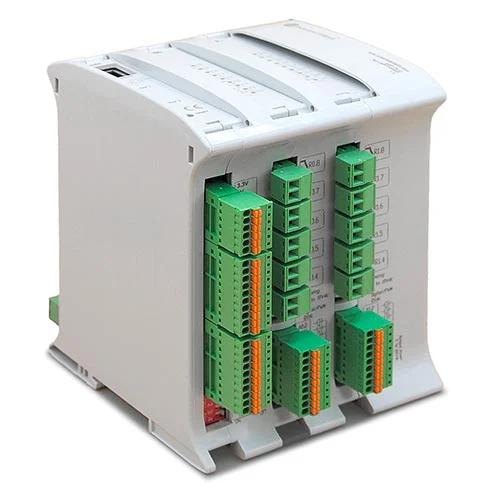
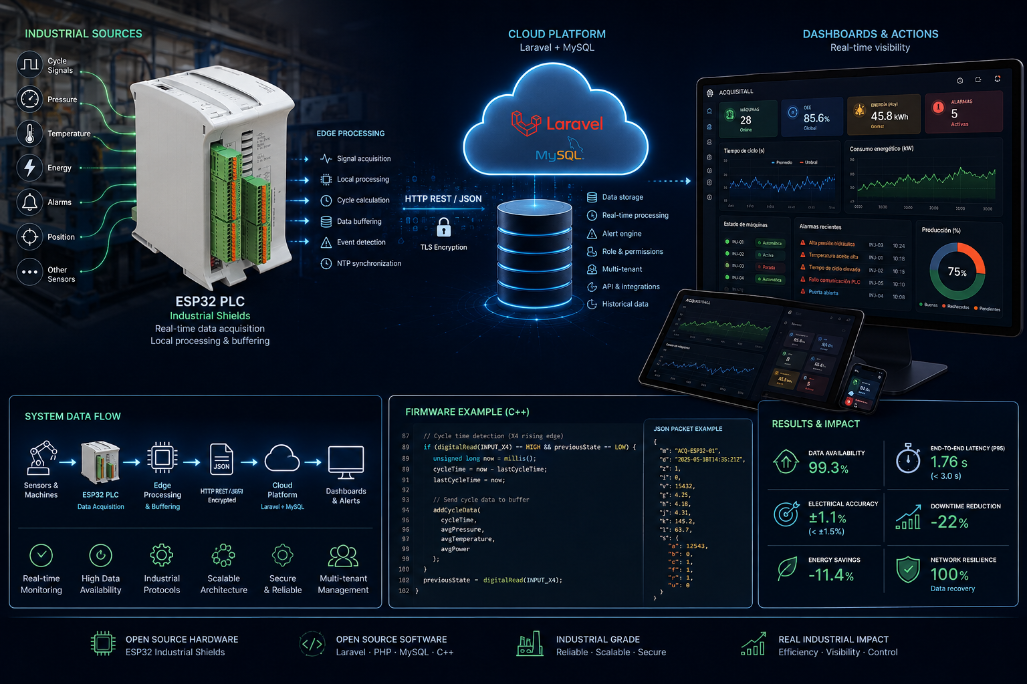
The system is based on ESP32 PLCs programmed in C++ through the Arduino framework and connected to a cloud platform developed with Laravel 9, PHP 8.1, Livewire and MySQL 8. The complete architecture allows continuous acquisition, processing and visualization of industrial data from injection machines and auxiliary equipment.
Objectives:
Real-time visibility of machine status, historical analysis of production data, early anomaly detection through configurable alerts, measurable reduction of unplanned downtime, and quantifiable energy savings.
Place of execution: Sant Fruitós de Bages (Barcelona)
Execution period: 1 nov 2024 – 31 dec 2025
Budget: 423.172,00 € | Funding: 177.471,00 €
CDTI and ERDF co-financing
Industrial Data Acquisition and Process Monitoring
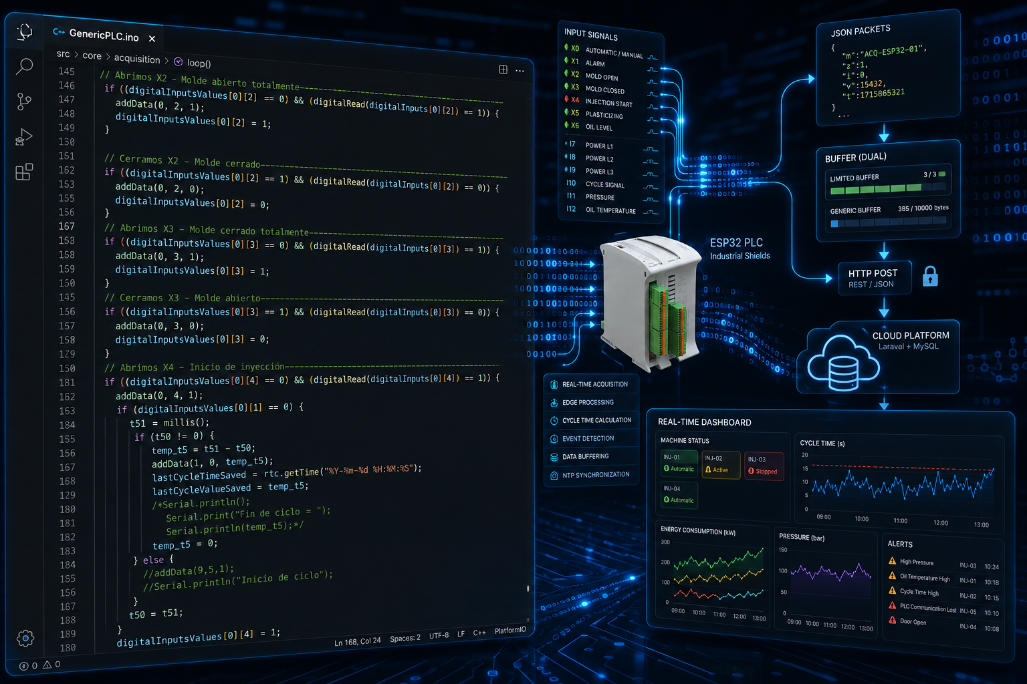
The platform captures machine, process, production and product-related indicators directly from the production environment. Different industrial signals are monitored in real time, including machine states, injection cycles, mould positions, hydraulic pressure, oil temperature, alarms, electrical consumption and production counters.
The ESP32 PLC firmware performs local signal processing, event detection and cycle-time calculations before transmitting the information to the server through HTTP REST communication using JSON structures optimized for industrial environments.
The system was designed to support continuous operation in production plants while maintaining low infrastructure costs and deployment simplicity compared to traditional industrial architectures.
Scalable Cloud Platform for Industrial Analytics
Laravel-Based Industrial Infrastructure
All collected information is centralized in a cloud platform developed using Laravel 9, Livewire, Tailwind CSS and MySQL 8. The platform provides real-time dashboards, historical analysis, KPI visualization, alarm systems and production traceability tools accessible remotely from desktop, tablet and mobile devices.
The architecture supports hierarchical industrial structures including companies, factories, machines, products and users with different permission levels. The system incorporates six user roles with granular access control and multi-company scalability.
Real-Time Dashboards and Production Visibility
The frontend interface includes real-time machine status visualization, production cycle charts, energy consumption graphs, pressure and temperature monitoring, alarm management and historical production reports exportable to CSV and Excel formats.
Machines are classified dynamically using traffic-light status indicators to identify active, automatic or stopped equipment in real time. The platform also integrates maintenance activity management and configurable notification systems for abnormal process conditions.
AI-generated conceptual image.
Industrial Firmware and Communication Architecture
ESP32 PLC Firmware Developed in C++
The firmware developed for the Industrial Shields ESP32 PLCs uses a dual-core architecture to separate industrial data acquisition from server communication tasks. One core continuously monitors digital and analog industrial signals while the second core manages JSON serialization, HTTP communication, NTP synchronization and OTA firmware updates.
The communication system incorporates a double-buffer architecture designed to maintain data integrity during network interruptions and high-frequency production cycles. This approach allows temporary local storage and automatic retransmission of industrial data after reconnection.
Optimized Industrial Communication
The project evaluated different industrial communication protocols including Modbus TCP, OPC-UA, MQTT and HTTP REST. HTTP REST combined with JSON serialization was selected due to its simplicity, reduced infrastructure requirements and direct PLC-to-server communication capabilities.
The communication protocol was optimized to transmit complete injection-cycle information in compact JSON messages below 500 bytes while maintaining compatibility with future scalability improvements.
Validation, Performance and Industrial Results
Prototype Deployment and Validation
Six ESP32 PLC prototypes were deployed in real industrial environments connected to plastic injection machines, compressors, hydraulic systems and assembly lines. The solution monitored more than 22 industrial sensors including current transformers, pressure transducers, optical sensors and temperature probes.
The system successfully validated the complete industrial data flow from physical signal acquisition to cloud visualization and dashboard analytics.
Performance and Optimization Results
Stress tests simulated up to 50 PLCs simultaneously transmitting industrial data with peaks of 1,200 messages per second. The final system achieved:
• End-to-end latency below 2 seconds
• Data availability above 99.3%
• Electrical measurement precision within ±1.1%
• Real-time dashboard response times below 200 ms
• Full data recovery after network interruptions
Additional optimizations included database indexing, temporal tables for high-speed queries, firmware memory improvements and frontend lazy-loading strategies to improve scalability and responsiveness.
Towards More Connected Industrial Environments
Flexible and Open Industrial Digitalization
ACQUISITALL demonstrates how technologies based on open source hardware can be applied to industrial digitalization projects requiring scalability, flexibility and cost optimization.
The solution enables manufacturers to improve operational efficiency, increase production visibility, optimize maintenance planning and reduce downtime through real-time industrial data acquisition and cloud analytics.
Its modular architecture allows future expansion toward predictive maintenance, AI-driven analytics and integration with additional industrial communication technologies.
Project Results and Technical Validation
Verified Technical Outcomes
The ACQUISITALL project resulted in a fully operational industrial monitoring system combining ESP32 PLC firmware, cloud software and real-time dashboards. The final solution includes a Laravel-based web platform, a MySQL database architecture optimized for industrial time-series data, a REST API for PLC communication, configurable alerts and a responsive interface for production monitoring.
The ESP32 PLC firmware was developed in C++ and enables multichannel data acquisition, real-time cycle calculation, analog sensor averaging, local buffering, NTP synchronization, embedded configuration tools and secure OTA firmware updates.
Performance KPIs Achieved
During validation, the system achieved the main technical and operational objectives defined for the project. Data availability reached 99.3%, end-to-end latency remained below 2 seconds, electrical measurement precision reached ±1.1%, and the system demonstrated full data recovery after network interruptions.
The deployment also showed measurable industrial impact, including a 22% reduction in unplanned downtime and an 11.4% reduction in energy consumption, exceeding the initial project targets.
Conclusions and Future Evolution
Lessons Learned
The project confirmed the technical feasibility of using ESP32-based industrial PLCs and open technologies for real-time monitoring and energy optimization in industrial environments. Key lessons included the importance of resilient data buffering, optimized database structures for fast dashboard response, robust permission management and user-safe confirmation flows for critical actions.
AI-generated conceptual image.
Next Development Steps
Future improvements may include MQTT communication for high-frequency scenarios, predictive maintenance based on historical data, advanced multi-tenant capabilities, enhanced frontend interactivity and digital signature mechanisms to strengthen data integrity and cybersecurity.