Success story · ATS Panama · M-Duino
Sonic barriers for birds. On time, all year.
One M-Duino PLC follows the seasonal schedule and logs its run hours.
The authorities set when the barriers sound. It changes with the season.
The PLC keeps the schedule, and the card keeps the proof.
ATS Panama asked Industrial Shields to improve a sonic barrier design that was already proven. The barriers are installed at a wind farm to keep birds away from the turbines. ATS Panama integrated one M-Duino PLC that switches the barriers on by the schedules of the environmental authorities, accepts a remote switch-on from the customer's SCADA, and logs the operating hours on a removable microSD card. The case does not publish the location of the wind farm, the number of barriers or the real schedules. The values in the panels are examples.
From the project
The client and the control cabinet.
Material from the original case document.

The project of ATS Panama: improve an already proven sonic barrier design and control it with open source technology. atspanama.com
The challenge
Switch the barriers when the authorities ask, and prove it.
Birds die when they hit wind turbine blades. The original case cites a US Fish and Wildlife Service estimate of 140,000 to 500,000 birds killed by wind turbines each year in the United States, and says that the figures must be interpreted. Even low mortality can be serious for endangered species, so wind farms must plan, build and monitor their projects to keep bird deaths low. At this wind farm, sonic barriers keep birds away. ATS Panama wanted to control them with one PLC, record the operating hours and manage the whole process remotely.
Follow the schedule
The environmental authorities set the hours when the barriers must work. The schedules change with the time of year.
Switch from a distance
The operator must be able to switch the barriers on from the SCADA, with no visit to the site.
Keep a record
The operating hours and the most important parameters must stay on a removable memory.
Fit what is there
The barrier design was already proven. The PLC had to fit into the existing system and leave room to grow.
Proof for the audit
With the log on the card, the authorities can check that the equipment worked as required.
How it works
Three jobs: the schedule, the remote order, the log.
Each stage shows one part of the system. Move the sliders and press the buttons. The panels are illustrative simulations: the schedule windows, the number of barriers and the logged values are examples, not data from the wind farm.
The clock says when. The period says how long.
The M-Duino 38AR has a real-time clock. The program holds the schedules of the environmental authorities, which change with the time of year. When the clock enters a window of the current period, the PLC switches the barriers on, in this example through its relay outputs. When the window ends, it switches them off. Move the month and the time.
- Real-time clock in the PLC
- One table of windows for each period of the year
- Relay outputs switch the barriers
Illustrative simulation. Example values, no data from the wind farm. Example schedule with two periods: period A (March to May and September to November) from 05:00 to 09:00 and from 16:00 to 20:00, period B (the other months) from 06:00 to 08:00. The case says the schedules come from the environmental authorities and vary with the time of year, and does not publish them.
The SCADA can switch the barriers on. No one drives to the site.
The PLC talks to the customer's SCADA. When required, the operator switches the barriers on from the SCADA, and the PLC does it at once, with no on-site activation. A second order returns the barriers to the schedule. Press the buttons and cut the link.
- Remote switch-on from the SCADA
- No visit to the wind farm
- The schedule stays in the PLC
Orders (example)
Illustrative simulation. Example values, no data from the wind farm. Example at 12:00 in June, outside the schedule windows. The case says the SCADA can switch the barriers on remotely if required, with no on-site activation. It does not publish the protocol or what happens when the link drops. Example rule here: without the link, the PLC goes back to the schedule.
Every hour of work goes on the card.
The PLC writes a log on a removable microSD card: the operating hours and the most important operating parameters of the system. The authorities can take the card and check that the barriers worked when they had to. Run a few days and read the card.
- Operating hours of the barriers
- Main operating parameters
- A removable card for the audit
Log on the card (example)
Illustrative simulation. Example values, no data from the wind farm. Example: three barriers, one line each time a barrier switches, with the time from the real-time clock, the source of the order and a supply voltage. The case says the log keeps the operating hours and the most important operating parameters, and does not publish the fields.
System architecture
How does one PLC control sonic barriers at a wind farm?
One M-Duino PLC is the controller of the sonic barriers. Its program decides when the barriers must sound, by the schedules of the environmental authorities for each time of year, and the customer's SCADA can send a remote switch-on order. On a removable microSD card, the PLC logs the operating hours and the main parameters for the audit. In this layout, the real-time clock gives the date, relay outputs switch the barriers and the SCADA sends the remote order over Ethernet. The case does not publish the protocol, the outputs, the number of barriers or the signals from them.
| Signal | Between | Type | Purpose |
|---|---|---|---|
| Barrier on and off | BetweenPLC → each sonic barrier | TypeRelay out (example) | PurposeSwitch on by the schedule or by a SCADA order |
| Date and time | BetweenReal-time clock → program | TypeInternal | PurposeFind the period of the year and the window of the day |
| Remote switch-on | BetweenSCADA → PLC | TypeEthernet (example) | PurposeOrder with no visit to the site. The case does not publish the protocol. A typical way to do it: a Modbus TCP coil |
| State and hours | BetweenPLC → SCADA | TypeEthernet (example) | PurposeRemote monitoring of the whole process |
| Barrier state | BetweenBarrier → PLC | TypeDigital in (example) | PurposeA feedback contact per barrier, if the barrier has one. The case does not publish it |
| Operating log | BetweenPLC → microSD | TypeLocal file | PurposeOperating hours and main parameters for the audit |
Why it works
The schedule lives in the PLC. The proof lives on the card.
One controller
One PLC runs the schedule, takes the SCADA orders and keeps the log. ATS Panama asked for one PLC.
A clock that knows the season
The program holds the windows for each time of year. When the authorities change the hours, you change the table.
Remote, not dependent
The SCADA adds a remote order. The schedule runs in the PLC itself.
Proof on a removable card
The operating hours and the main parameters stay on the microSD. The auditor reads the card.
Fits an existing design
Many inputs and outputs let the PLC fit a barrier design that was already proven.
Room to grow
More barriers or more signals: the M-Duino family scales, and the program is open in the Arduino IDE.
Hardware used
One PLC for the whole barrier system.

M-DUINO ETHERNET PLC ARDUINO 38AR
An industrial PLC built around an original Arduino Mega 2560, with Ethernet, RS-485 and RS-232, for DIN rail. It is programmed with the Arduino IDE. In this project it runs the seasonal schedules, takes remote orders from the SCADA and logs the operating hours on its microSD card. The case does not say which outputs or which link were used; on the 38AR, the usual way is its relays and its Ethernet port.
- Role
- Schedule, relay outputs to the barriers, SCADA link, log
- Inputs
- 19: 10 analog/digital (0-10 V, 10-bit), 9 digital optoisolated (5 to 24 Vdc), 4 with interrupt
- Outputs
- 19: 6 analog/digital/PWM (0-10 V), 5 digital optoisolated, 8 relays (230 Vac 4 A / 24 Vdc 2 A, resistive)
- Communications
- Ethernet (W5500, RJ45), RS-485, RS-232, I2C, SPI
- Built in
- Real-time clock, microSD slot
- Programming
- Arduino IDE
- Power supply
- 12 to 24 Vdc
- Mounting
- DIN rail TS35, IP20, inside a cabinet
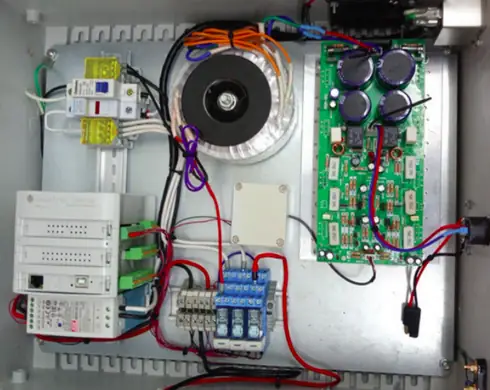
The case used the M-DUINO PLC Arduino Ethernet 38AR I/Os Analog / Digital / Relay PLUS. It is in the catalogue today as the M-DUINO ETHERNET PLC ARDUINO 38AR, reference IS.MDuino.38AR+. The relays switch up to 4 A at 230 Vac with a resistive load; for the supply of a barrier or for inductive loads, use interface relays or contactors sized for the load. The cabinet photo shows interface relays next to the PLC. The M-Duino family has smaller and larger models.
Questions about this project
How does a PLC switch sonic bird barriers on a schedule?
With a real-time clock and a table of time windows in its program. In this project, the M-Duino PLC holds the schedules set by the environmental authorities for each time of year. When the clock enters a window, the PLC switches the barriers on; when the window ends, it switches them off. On an M-Duino, the usual way is a relay output per barrier. The case does not publish the real schedules or the outputs.
How does the schedule change with the time of year?
The schedules of the authorities vary with the time of year, and the program takes this into account. A typical way to do it: a list of periods, each with a start date, an end date and its daily windows. The PLC finds the period from the date of its real-time clock. When the authorities change the hours, only the table changes.
Can the SCADA switch the barriers on remotely?
Yes. In this project the barriers can be switched on from the customer's SCADA if required, with no on-site activation. The case does not publish the protocol. A typical way to do it on an M-Duino is a Modbus TCP server over Ethernet with one coil for the order and registers for the state and the hours. See a Modbus TCP register map on an M-Duino PLC.
What does the microSD log keep, and how is it audited?
The case logs the operating hours and the most important operating parameters of the system on a removable microSD card, so the authorities can audit the equipment. A typical way to do it: one text line per event with the time from the real-time clock, the barrier, the new state and the source of the order. The same file idea is shown on an ESP32 PLC in SD card datalogging with daily files.
What happens if the link to the SCADA drops?
The schedule is programmed in the PLC itself, so the barriers keep following it without the SCADA. The case does not publish what the PLC does with an active remote order when the link drops. A typical rule: the PLC returns to the schedule and logs the event, and the SCADA shows the state again when the link is back.
Which controller should I choose for a similar project?
Count the barriers and the signals. Each barrier needs an output, and maybe an input for its state. The M-Duino 38AR has 8 relays and 19 inputs, a real-time clock, a microSD slot and Ethernet. For loads above the relay rating, add interface relays. Send us the number of barriers and how they are supplied, and an engineer will answer.
Download the case study
4-page PDF with the challenge, the logic, the architecture and the hardware. No form required.
Similar project?
Tell us what must switch, when, and who must check it.
Tell us which equipment must switch on and off, which schedules it must follow, which system must send remote orders and what your log must prove. We will tell you which controller fits and how to connect it.
- You get an answer from our technical team
- I/O count and controller sizing for your project
- Arduino, ESP32 or Raspberry Pi based PLCs