
Short answer: Raspberry Pi 5 is the stronger Linux computer: a faster CPU, up to 16 GB of RAM, Gigabit Ethernet and PCIe. Arduino UNO Q is the better fit when Linux has to work next to deterministic I/O, because it adds an STM32U585 real-time microcontroller to a quad-core 64-bit Arm processor running Debian. For panel installs, Industrial Shields builds PLCs on both platforms: Ardbox Q on Arduino UNO Q and the Raspberry PLC family on Raspberry Pi.
Raspberry Pi 5 vs Arduino UNO Q: board comparison
Both boards run Linux on a quad-core 64-bit Arm processor and both have Wi-Fi and Bluetooth. Raspberry Pi 5 is a single-board computer. Arduino UNO Q is a hybrid: a Linux processor and a microcontroller on one PCB. For a wider view of how Arduino, ESP32 and Raspberry Pi based controllers differ, see industrial controllers based on Arduino, Raspberry Pi and ESP32.
Processor and RAM
Raspberry Pi 5 uses a Broadcom BCM2712 with four Arm Cortex-A76 cores at 2.4 GHz. It is offered with 1, 2, 4, 8 or 16 GB of LPDDR4X RAM. Arduino UNO Q uses a quad-core Arm Cortex-A53 processor at 2.0 GHz, with 2 GB of RAM and 16 GB of eMMC, or 4 GB of RAM and 32 GB of eMMC.
Cortex-A76 is a more powerful core than Cortex-A53, and the Pi 5 can carry four times more memory. For several containers, a local database and a dashboard at once, Raspberry Pi 5 has more headroom.
Real-time capability
This is the main architectural difference. Arduino UNO Q includes an STM32U585 microcontroller (Arm Cortex-M33 up to 160 MHz, 2 MB flash, 786 kB SRAM). Arduino sketches run on this MCU over Zephyr OS, while Debian runs on the main processor. The Arduino Bridge RPC library connects the two sides.
Raspberry Pi 5 has no user-programmable real-time microcontroller on board. Its 40-pin GPIO header is driven from Linux, which is not a deterministic operating system by default. Projects that need deterministic timing on a Pi pair it with an external microcontroller or a separate controller.
I/O and interfaces
Raspberry Pi 5 offers the standard 40-pin GPIO header, two USB 3.0 and two USB 2.0 ports, dual 4Kp60 HDMI output, two 4-lane MIPI camera or display connectors and a PCIe 2.0 x1 interface for fast peripherals through an M.2 HAT or other adapter.
Arduino UNO Q keeps the classic UNO headers for shields and adds I2C/I3C, SPI, PWM, CAN, UART, ADC, a Qwiic connector, a single USB-C port and bottom high-speed connectors for MIPI-CSI cameras, MIPI-DSI displays and audio.
Networking
Raspberry Pi 5 has Gigabit Ethernet on board (PoE+ with a separate HAT), dual-band 802.11ac Wi-Fi and Bluetooth 5.0. Arduino UNO Q has dual-band Wi-Fi 5 and Bluetooth 5.1 but no native Ethernet port: wired Ethernet requires a USB-C dongle.
AI capability
Both boards run Linux and Python, so both can run compact AI models at the edge. Arduino positions UNO Q for running compact models locally, with pre-built App Lab Bricks. Raspberry Pi 5 has more CPU and RAM, which leaves more margin for larger models.
Power
Raspberry Pi 5 needs a 5 V, 5 A USB-C supply with Power Delivery. Arduino UNO Q is specified for 5 V at 3 A over USB-C, or 7 to 24 V on its VIN input. The lower supply rating and wide VIN range make UNO Q easier to power from a cabinet rail.
Software ecosystem
Raspberry Pi 5 runs Raspberry Pi OS, the official operating system. Its community, documentation and HAT range are very large. Arduino UNO Q runs Debian Linux on the processor and the Arduino core on Zephyr OS on the MCU. It is programmed with Arduino App Lab (Python and sketches, for both sides), Arduino IDE 2 (MCU only) or Arduino CLI, and supports Docker.
Price range
Raspberry Pi has raised prices several times since December 2025 because of memory costs. After the April 2026 change, Raspberry Pi 5 list prices range from 45 USD for the 1 GB model to 305 USD for the 16 GB model. On the Arduino Store, UNO Q costs 59.90 EUR (2 GB) and 82.90 EUR (4 GB), VAT included.
Comparison table: Raspberry Pi 5 vs Arduino UNO Q
| Feature | Raspberry Pi 5 | Arduino UNO Q | Advantage |
|---|---|---|---|
| Main processor | Quad-core Cortex-A76, 2.4 GHz | Quad-core Cortex-A53, 2.0 GHz | Raspberry Pi 5 |
| RAM | 1, 2, 4, 8 or 16 GB | 2 GB or 4 GB | Raspberry Pi 5 |
| Storage | microSD, NVMe via PCIe adapter | 16 GB or 32 GB eMMC on board | Depends on project |
| Real-time MCU | None on board | STM32U585, Cortex-M33 up to 160 MHz | Arduino UNO Q |
| Wired Ethernet | Gigabit, PoE+ with HAT | No native port (USB-C dongle) | Raspberry Pi 5 |
| Wireless | Wi-Fi 802.11ac, Bluetooth 5.0 | Wi-Fi 5, Bluetooth 5.1 | Similar |
| PCIe | PCIe 2.0 x1 | No | Raspberry Pi 5 |
| Power input | 5 V, 5 A USB-C PD | 5 V, 3 A USB-C or 7 to 24 V VIN | Arduino UNO Q |
| Software | Raspberry Pi OS | Debian, Zephyr, App Lab, Arduino IDE | Pi 5 for ecosystem size, UNO Q for Arduino workflow |
| Price (board only) | 45 to 305 USD | 59.90 to 82.90 EUR incl. VAT | Depends on RAM |
Which board for which project
- Choose Raspberry Pi 5 for edge servers, gateways that need wired Ethernet, data logging with a local database, vision projects with heavy processing, and any workload that needs more than 4 GB of RAM or NVMe storage.
- Choose Arduino UNO Q when the same device must read sensors and drive outputs with predictable timing while also running Linux applications, when the team already works with Arduino code, or when the supply comes from a 12 or 24 V rail.
- Choose neither as a bare board for a production machine. A development board has no isolated 24 V I/O and no DIN rail enclosure.
Ardbox Q vs Raspberry PLC: choosing the right industrial PLC
Industrial Shields builds PLCs on both platforms. Ardbox Q is the first industrial PLC with Arduino UNO Q, developed by Industrial Shields in collaboration with Arduino. The Raspberry PLC family is based on Raspberry Pi. Current Raspberry PLC models use the Raspberry Pi 4B with a quad-core 64-bit BCM2711 at 1.8 GHz. They are two tools for different jobs.
Ardbox Q
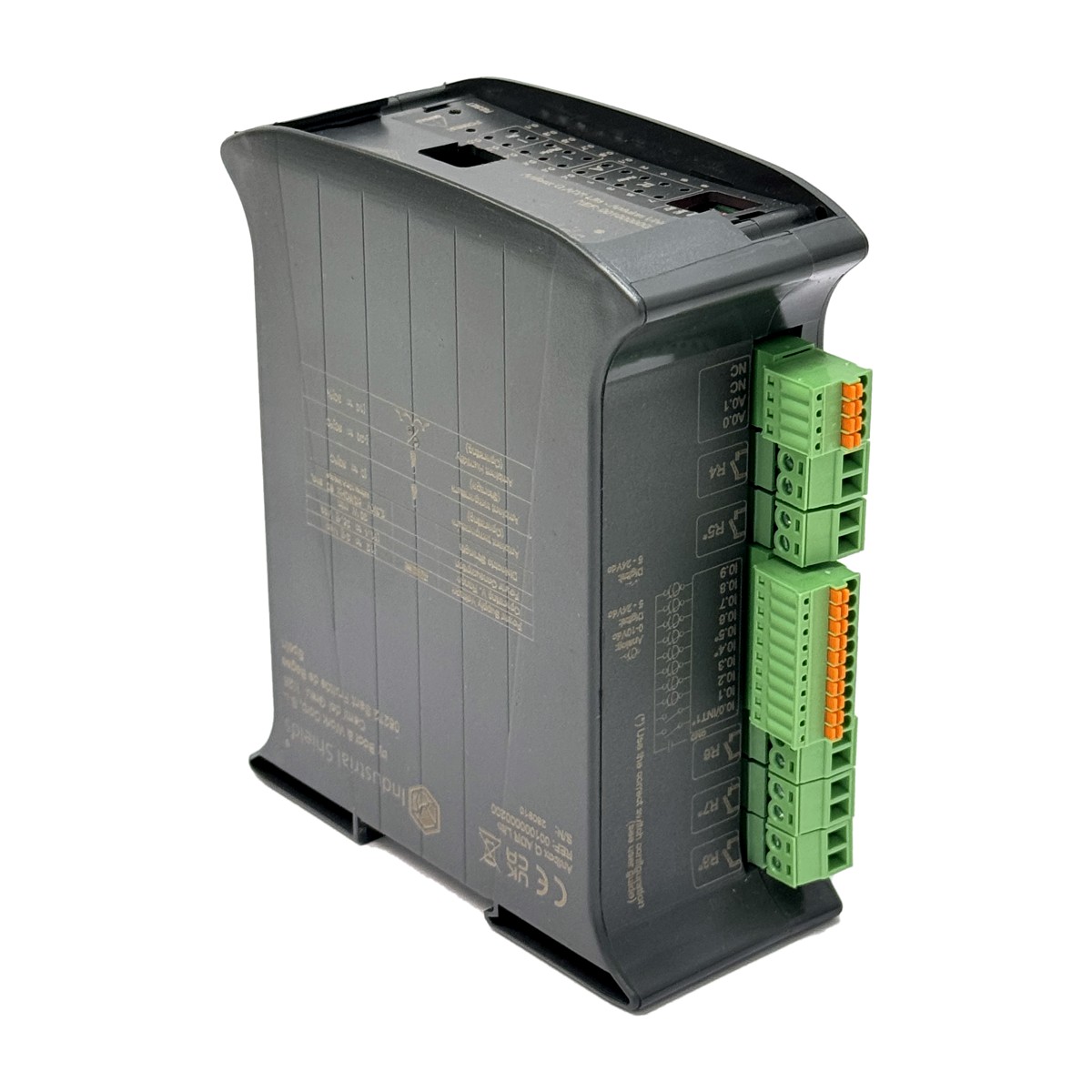
Ardbox Q combines the STM32U585 MCU for real-time control with a quad-core 64-bit processor running Debian Linux for data, dashboards and AI models. It comes in two versions, with 19 (Analog) or 20 (Relay) I/O (see how it works in detail in Ardbox Q, the first industrial PLC with Arduino UNO Q):
- Analog: 4 digital inputs, 6 analog or digital inputs (0 to 10 V), 3 digital outputs and 6 analog outputs (0 to 10 V or PWM).
- Relay: 4 digital inputs, 6 analog or digital inputs (0 to 10 V), 8 relay outputs and 2 analog outputs (0 to 10 V).
Communications are RS-485 (Modbus RTU), RS-232, Wi-Fi 5, Bluetooth 5.1 and USB-C. There is no wired Ethernet. Memory is 2 GB RAM with 16 GB eMMC, or 4 GB RAM with 32 GB eMMC. It runs on 12 to 24 Vdc, mounts on DIN rail, measures 100 x 45 x 115 mm, is IP20 and CE marked. It is programmed with Arduino IDE, Arduino App Lab, Python, Node-RED and Docker. Price starts at 225 EUR excluding VAT (Relay, 2 GB). Full specifications are in the Ardbox Q datasheet (PDF).
Raspberry PLC
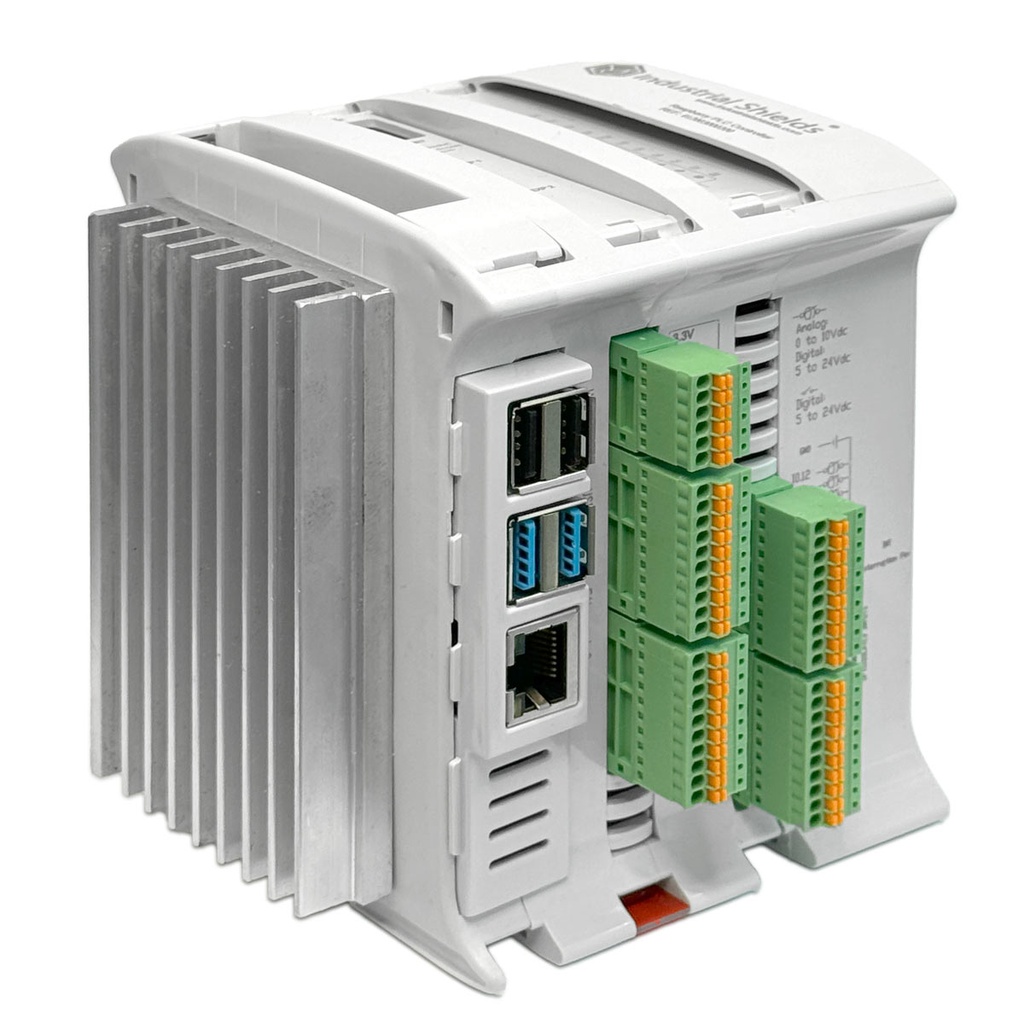
The family ranges from the CPU-Gateway, with no local I/O, to models with up to 58 inputs and 33 outputs. The Raspberry PLC 21, for reference, has 13 inputs and 8 outputs. Every model has two Ethernet ports, one Gigabit and one 10/100. Communications include dual RS-485, Wi-Fi and Bluetooth, and FLEX versions accept one expansion board for CAN, LoRa or 4G. Further I/O can be added over Modbus RTU. Models such as the CPU-Gateway and the Raspberry PLC 21 run on 12 to 24 Vdc and include a UPS for safe shutdown.
Side by side
| Criterion | Ardbox Q | Raspberry PLC |
|---|---|---|
| Platform | Arduino UNO Q | Raspberry Pi 4B |
| Local I/O | 19 (Analog) or 20 (Relay) I/O | From 0 (CPU-Gateway) up to 58 inputs and 33 outputs |
| Real-time control | On-board STM32U585 MCU | Linux on the main processor |
| Wired Ethernet | No | 2 ports (Gigabit and 10/100) |
| Fieldbus and serial | RS-485 (Modbus RTU), RS-232 | 2 x RS-485, CAN with FLEX expansion |
| Expansion | Field devices over RS-485 | FLEX boards (CAN, LoRa, 4G), remote I/O over Modbus RTU |
Typical use cases
Ardbox Q suits compact machines and retrofits where a few signals need reliable control and the data needs processing on site: predictive maintenance based on vibration, current or temperature, vision quality checks next to the line, machine HMIs served to a browser, remote telemetry and Modbus RTU to MQTT gateways.
Raspberry PLC suits projects that need more I/O in one unit, two wired networks (for example, plant and machine networks kept separate), CAN, LoRa or 4G, and more RAM for Docker services, Node-RED dashboards and data acquisition. Industrial Shields points to its Arduino based PLCs or its ESP32 PLC when a simple deterministic execution model is the priority. Ardbox Q adds a dedicated real-time MCU to a Linux PLC.
Frequently asked questions
Is Raspberry Pi 5 faster than Arduino UNO Q?
Yes, for Linux workloads. Raspberry Pi 5 uses four Cortex-A76 cores at 2.4 GHz and up to 16 GB of RAM, while Arduino UNO Q uses four Cortex-A53 cores at 2.0 GHz with 2 or 4 GB of RAM.
Does Arduino UNO Q have real-time control?
Yes. Arduino UNO Q includes an STM32U585 microcontroller (Cortex-M33 up to 160 MHz) that runs Arduino sketches on Zephyr OS, separate from the Debian Linux processor. Raspberry Pi 5 has no user-programmable real-time microcontroller on board.
Does Arduino UNO Q have Ethernet?
No native port. Arduino UNO Q has Wi-Fi 5 and Bluetooth 5.1, and wired Ethernet requires a USB-C dongle. Raspberry Pi 5 has Gigabit Ethernet on board.
What is the difference between Ardbox Q and Raspberry PLC?
Ardbox Q is based on Arduino UNO Q, with 19 or 20 I/O, an STM32U585 MCU for real-time control and Linux for data and AI, from 225 EUR excluding VAT. Raspberry PLC is a family based on Raspberry Pi 4B with up to 58 inputs and 33 outputs, two Ethernet ports and expansion for CAN, LoRa or 4G.
Which Industrial Shields PLC should I choose for a machine without Ethernet?
Ardbox Q, if the machine connects over RS-485 Modbus RTU, Wi-Fi or Bluetooth and needs up to 20 I/O. For wired Ethernet or more I/O, choose a Raspberry PLC.
Can I use a bare Raspberry Pi 5 or UNO Q board in an industrial cabinet?
They are development boards without isolated 24 V I/O or DIN rail housings. For production machines, a PLC built on the same platform, such as Ardbox Q or Raspberry PLC, adds the I/O, power input and mounting a cabinet needs.
To choose a version or ask about your project, see the Ardbox Q product page or the Raspberry PLC family.