Case study · Sector: agricultural irrigation
Program the pivot by sector. Watch it from the phone.
One PLC in the pivot panel sets the depth, guards the water line and reports over 4G.
A center pivot waters a whole circle, but the field is rarely one crop with one need.
So the PLC splits the circle into sectors and gives each one its own speed, its own depth and its own rules.
Based on real installations by customers in the sector; data and names are not published. Builders and integrators of irrigation systems buy controllers from Industrial Shields for their pivot and pump panels. This page shows the architecture, the signals and the logic of that kind of panel with the ESP32 PLC 21 FLEX, our option for this role, chosen by datasheet. The thresholds, depths and messages are examples of a typical way to do it, not the settings of a real farm.
The challenge
The same water everywhere is not what the field needs.
A pivot turns around its center, and the speed of the last tower sets how much water each part of the circle gets. With a basic panel, speed and direction are set by hand at the pivot point, and the farmer drives to the field to change them. The builder or the integrator wants a panel that knows where the pivot is, waters by sector, stops on its own when something is wrong and can be checked from a phone.
Water by sector
Different crops, a dry corner or a road across the circle: each sector needs its own depth, or no water at all.
Know where it is
The position of the pivot drives the program: start a sector, switch the end gun, park at the right angle.
Stop before the damage
A burst pipe or a pump that trips shows up as low pressure. The pivot must stop before it drives dry.
Less driving to the field
Start, stop and check the pivot from a phone, and get a message when it stops on its own.
Rain changes the plan
When rain is forecast or the gauge already counts it, the next pass can wait. The program decides, the farmer confirms.
How it works
Three jobs of the pivot panel: program, protect, report.
Each panel shows one job of the PLC. Press the buttons. They are illustrative simulations: angles, depths, thresholds and messages are examples, not data from a real farm.
Each sector gets its own speed, so its own depth.
The PLC reads the angle of the pivot and looks up the sector. For each sector the program holds a depth and the water on or off. The depth sets the percent timer: the share of each minute that the last tower moves. Slower means more water. Try a crop sector, a dry pass, a corner with the end gun and a park.
- Sectors defined by start and end angle
- Percent timer from the target depth
- End gun only where the corners are
- Park at a set angle at the end of the cycle
Pivot program (example)
- Program loaded: 4 sectors.
Illustrative simulation. Example values, no data from a real farm. Example values. Depth model of this panel: 5 mm at 100 %, inverse to the timer. The real curve comes from the pivot builder and the nozzle package.
Low pressure stops the pump. The safety circuit stops the pivot.
The PLC reads the line pressure from a 4-20 mA transmitter and the flow from the meter pulses. If the pressure stays low for a set time, it stops the pivot and the pump. The alignment safety circuit belongs to the pivot: when it opens, the towers stop on their own. The PLC only reads it, stops the pump and sends the alarm.
- Low pressure with a delay, then stop
- Safety circuit read, never bypassed
- Pump stopped when the pivot stops
- A restart needs a person to reset
Protections (example)
- Watching pressure and flow.
Illustrative simulation. Example values, no data from a real farm. Example values: low pressure below 1.8 bar for 30 s. A real panel uses the pressure and the delays of the nozzle package and the pump.
Try pressure alarms and pumps on a water network: remote site telemetry simulator
The phone starts it. The weather can hold it.
Over the 4G board the PLC publishes its state and receives commands over MQTT. A rain forecast or rain at the gauge can hold the next pass, and the farmer can start it anyway. If the link drops, the PLC keeps running its local program and keeps the messages until the link is back.
- Start and stop from the phone
- Hold the pass on a rain forecast or measured rain
- Local program first, link second
- Messages queued while the link is down
Phone and server (example)
- Next pass at 22:00.
Illustrative simulation. Example values, no data from a real farm. Example values: hold the pass above 5 mm of forecast rain. The forecast comes from a weather service; the rule is yours.
System architecture
How does a PLC control a center pivot and its irrigation program?
An ESP32 PLC 21 FLEX sits in the panel at the pivot point. It reads the pivot status, the safety circuit, the angle, the line pressure, the flow meter, and the rain gauge and the anemometer. Through interface relays it starts and stops the pivot, sets the direction, drives the percent timer and switches the end gun and the pump. A 4G board links it to a server and to the phone of the farmer over MQTT.
| Signal | Between | Type | Purpose |
|---|---|---|---|
| Running, forward, reverse | BetweenPivot panel → ESP32 PLC 21 | TypeDigital in, through relays | PurposeKnow what the pivot does |
| Safety circuit state | BetweenPivot safety circuit → PLC | TypeDigital in, read only | PurposeStop the pump and send the alarm |
| Angle | BetweenAngle sensor or GPS → PLC | TypeAnalog 0-10 V or serial (typical) | PurposeFind the sector, park |
| Line pressure | BetweenTransmitter → PLC | Type4-20 mA on a 0-10 V input with a shunt | PurposeLow pressure stop |
| Flow | BetweenMeter → PLC | TypePulses on an interrupt input | PurposeVolume per pass and per sector |
| Rain and wind | BetweenGauge and anemometer → PLC | TypePulses | PurposeHold the pass, end gun off in wind |
| Start, stop, direction | BetweenPLC → pivot panel | TypeDigital out, interface relays | PurposeRun the program |
| Percent timer | BetweenPLC → last tower control | TypeDigital out, on and off per minute | PurposeSet the speed, so the depth |
| End gun, pump | BetweenPLC → end gun valve, pump starter | TypeDigital out, interface relays | PurposeCorners and water supply |
| State, alarms, commands | BetweenPLC ↔ server and phone | Type4G, MQTT | PurposeRemote start, holds, messages |
Why it works
The program lives at the pivot. The phone is a window, not a crutch.
Position drives the program
Sectors, end gun and park are all angles. Once the PLC knows the angle, a new crop plan is a new table, not new wiring.
Depth from speed
The percent timer is how a pivot sets its depth. The PLC computes it from the depth you ask for each sector.
Safety stays where it belongs
The alignment circuit of the pivot keeps stopping the towers by itself. The PLC reads it and acts on the pump, and never bypasses it.
Works without the network
The program and the protections run in the PLC. The 4G link adds commands and messages; if it drops, the pass goes on and the messages wait.
Standard signals
Pressure on 4-20 mA, flow and rain on pulses, commands on relays: parts that any irrigation installer can source and replace.
One design for many pivots
The same panel and program fit pivots of different lengths. The sectors, the depth curve and the delays are settings.
Hardware
One ESP32 PLC with a 4G board in the pivot panel.
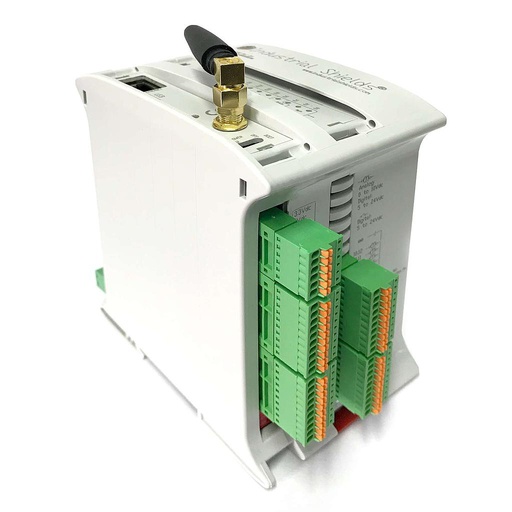
Our option for this roleESP32 PLC 21 FLEX
An industrial controller built on the dual-core ESP32, for DIN rail, programmed with the Arduino IDE. The FLEX version takes one communication board: here, 4G (M1)-NB1 IoT LTE for the link to the server and the phone.
- Role
- Reads the pivot, runs the sector program and the protections, talks to the phone
- Processor
- ESP32 dual core, up to 240 MHz
- Inputs
- 13: 6 analog/digital (0-10 V, 11-bit), 7 digital optoisolated (5 to 24 Vdc), 2 of them with interrupt
- Outputs
- 8: 3 analog/digital/PWM (0-10 V, 12-bit), 5 digital optoisolated (5 to 24 Vdc)
- Wireless and option board
- Wi-Fi and Bluetooth LE built in; one option board: 4G (M1)-NB1 IoT LTE (u-blox) here, or LoRa or CAN
- Wired
- Ethernet, RS-485, RS-232
- Programming
- Arduino IDE
- Power supply
- 12 to 24 Vdc
- Mounting
- DIN rail TS35, IP20, inside a cabinet
The outputs are transistor outputs at 24 Vdc. Pivot panels often switch 24 Vac, 120 Vac or 230 Vac: use interface relays. For a 4-20 mA pressure transmitter on a 0-10 V input, add a precision shunt. The cabinet at the pivot point needs the protection degree, the surge protection and the earthing of an outdoor panel.
Questions about this case
How do you control a center pivot remotely with a PLC?
Put a PLC with a mobile link in the panel at the pivot point. The PLC reads the status, the angle and the pressure, and drives start, stop, direction and the percent timer through interface relays. It publishes its state and receives commands over MQTT, so a phone or a server can start a pass, hold it or read the alarms. See remote commands over MQTT on an ESP32 PLC and a Telegram bot for irrigation.
How does the PLC set the water depth of a pivot?
With the percent timer. The last tower moves for a share of each minute, and the other towers follow it. At 100 % the pivot moves at full speed and applies the least water; at 50 % it takes twice as long and applies about twice the depth. The PLC computes the share from the depth you set for each sector. The real relation comes from the pivot builder and the nozzle package.
Does the PLC replace the safety circuit of the pivot?
No. The alignment safety circuit stops the towers when one gets out of line, and it stays wired in the pivot as the builder designed it. The PLC reads its state, stops the pump, sends the alarm and waits for a reset by a person on site. It never bypasses it.
Which signals does a pivot panel need?
A typical list: running, forward and reverse; the state of the safety circuit; the angle from a sensor at the pivot point or from GPS at the last tower; the line pressure on 4-20 mA; the flow on pulses; rain and wind. Outputs: start, stop, direction, percent timer, end gun and pump. See how an ESP32 PLC reads 4-20 mA sensors.
What happens when the mobile link drops?
Nothing changes in the field. The sector program and the protections run in the PLC, so the pass goes on and a low pressure still stops it. The PLC keeps the messages and sends them when the link is back. A typical way is described in MQTT datalogging with an offline buffer on an ESP32 PLC.
Can the irrigation program follow the weather forecast?
Yes. Before each pass, the program checks a weather service and the rain gauge, and holds the pass when the rain is enough. Our smart irrigation project pack does it with a forecast service, a pump drive and a Telegram bot; the weather API example shows the rule step by step.
Download the case study
4-page PDF with the challenge, the logic, the architecture and the hardware. No form required.
Similar project?
Tell us about your pivots. An engineer will answer.
Tell us the pivot brand and length, the signals in the panel today, how you set the depth and which network reaches the field. We will tell you which controller, which signals and which link fit.
- You get an answer from our technical team
- Pivot signals, sectors and the mobile link
- Arduino, ESP32 or Raspberry Pi based PLCs