
Industrial robotics is no longer growing steadily — it is accelerating. Global industrial robot installations exceeded 590,000 units in 2023 and are projected to surpass one million annual deployments before 2030. Three forces are driving this: AI is making robots easier to programme and more adaptable, the cost of collaborative systems is falling below the threshold for small and mid-size manufacturers, and a new category — humanoid robots capable of general-purpose tasks — is moving from research labs to factory floors. This post covers six trends shaping where industrial robotics is headed, and what they mean for the engineers and integrators building automation systems around them.
1. Cobots: AI programming replaces waypoints
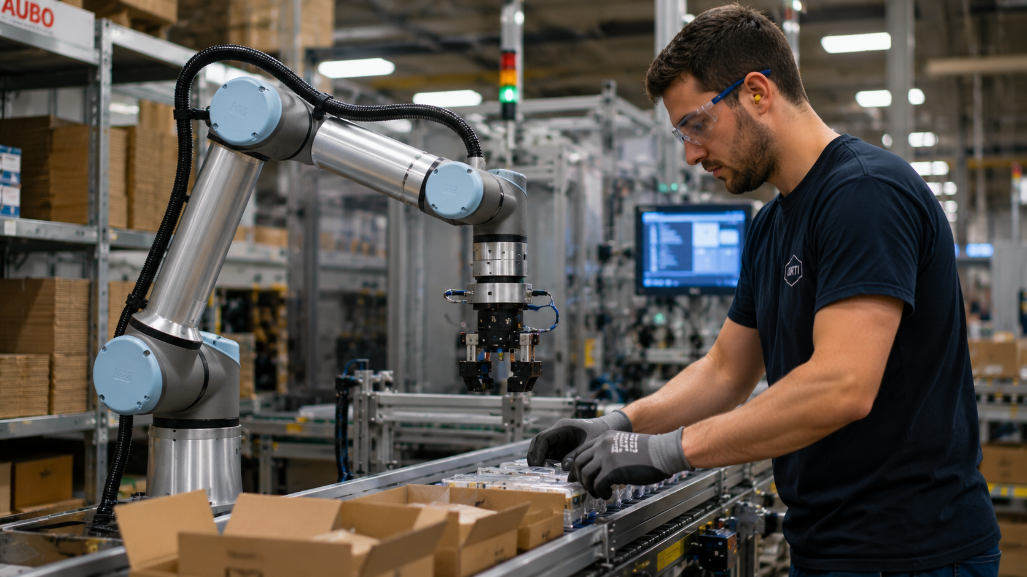
Collaborative robots were originally designed to work alongside humans without safety barriers. They are now being trained by them. AI-driven programming — where the robot observes a human demonstration and generalises the motion into a repeatable task — is collapsing integration time from weeks to hours. Major cobot manufacturers are shipping AI programming interfaces as standard. The result: cobots are moving from specialised cells requiring robot programmers into general-purpose tools that production staff can redeploy between shifts without specialist support.
The cobot segment is the fastest-growing area of industrial robotics, driven partly by this accessibility shift and partly by the persistent shortage of skilled manufacturing labour in Europe and North America. For small and mid-size manufacturers that cannot justify a robotics integration project, the lowered programming barrier is the deciding factor.
2. AI-enabled robots: autonomous in production
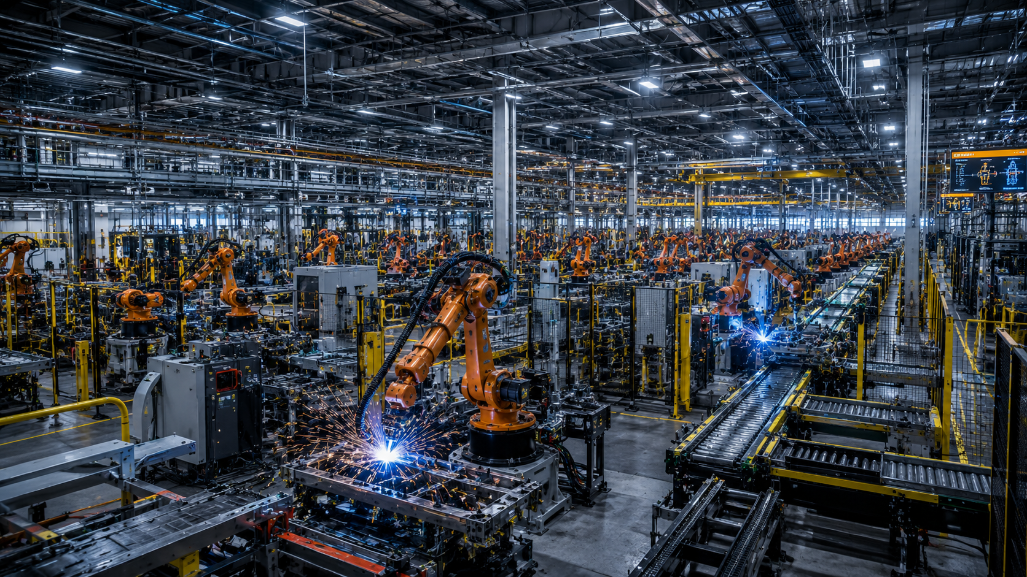
AI-enabled robots have moved from pilot programmes to production deployments. The key capability is closed-loop adaptation: a robot equipped with vision and force sensors adjusts its grip, path, and speed in real time based on what it detects — without a human rewriting the programme. Applications already running in production include bin picking with unstructured parts, adaptive welding on variable-geometry workpieces, quality inspection integrated into end-of-arm tooling, and assembly tasks with tolerance variation that previously required human dexterity.
The AI layer does not replace the PLC — it runs alongside it. The controller manages the safety system, conveyor timing, and inter-machine coordination. The AI manages perception and motion planning within the task envelope the PLC defines. This division of responsibilities is what makes AI-enabled robots deployable in certified industrial environments.
3. Humanoid robots: from labs to factory floors
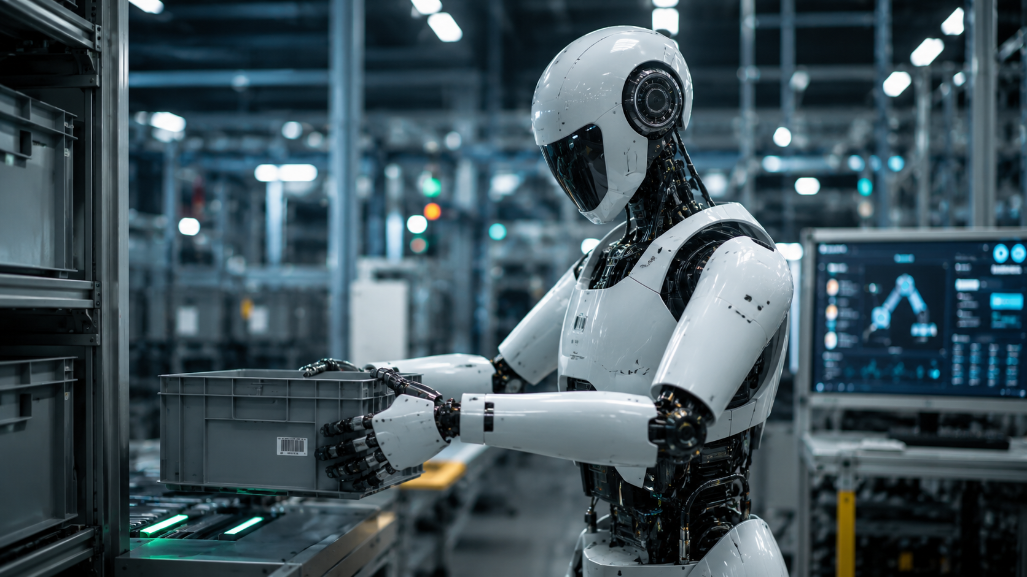
The most significant development in robotics in 2025–26 is the transition of humanoid robots from research to deployment. Tesla Optimus, Figure 02, and Boston Dynamics Atlas are now running structured tasks in controlled manufacturing environments. BMW, Amazon, and several automotive suppliers have announced or begun pilot deployments of bipedal robots in production settings.
The industrial case for humanoids is straightforward: factories are designed for human-shaped workers. A robot that can navigate the same aisles, use the same tools, and operate the same equipment without facility redesign offers a fundamentally different deployment model than traditional fixed-arm automation. The limiting factors remain cost, task reliability at scale, and the training infrastructure required to programme them efficiently. But the trajectory is unambiguous — humanoid robots will be a significant part of the manufacturing landscape within this decade.
4. Industrial drones: autonomous inspection at scale
Commercial drone technology has matured from a niche survey tool into standard infrastructure for industrial inspection. Autonomous drones equipped with thermal, optical, and acoustic sensors now conduct routine inspection of solar farms, wind turbine arrays, oil and gas pipelines, transmission line corridors, and large indoor facilities such as warehouses and ports.
Beyond visual line of sight (BVLOS) operation is now permitted in multiple EU member states under the U-Space regulatory framework, enabling fully automated inspection routes without an on-site operator. Integration with SCADA and plant management systems is the immediate next step: inspection data feeding directly into maintenance workflows rather than being processed manually after each flight.
5. Modular robot cells and open integration
Manufacturers are moving away from monolithic robotic installations toward modular cells that can be reconfigured for different products. Six-axis robots remain the dominant platform for their reach and flexibility, but the real innovation is in how cells are assembled: standardised electrical interfaces, plug-and-play end-of-arm tooling, and mobile robot bases that allow cells to be relocated when production lines change.
The integration layer — the controller that coordinates robot, conveyor, vision system, and safety circuit — is increasingly standardised on open platforms. This reduces lock-in to a single robot brand and allows the same control logic to manage multi-vendor cells. Integrators that can deliver a vendor-agnostic cell architecture are winning projects that previously required commitment to a single robotics ecosystem.
6. Cloud-connected robot fleets
Robots connected to the cloud can share learning across a fleet. When one robot learns to handle a new part variant, that knowledge transfers to every other robot running the same task — without a human reprogramming each unit. This is already operational in logistics, where warehouse automation systems share learned picking strategies across hundreds of units in real time.
In manufacturing, cloud connectivity enables remote diagnostics, fleet-level predictive maintenance, and centralised software updates — critical for operators managing multi-site installations. The edge-cloud architecture is key: robots process sensor data and run inference locally, while fleet-level learning and management runs in the cloud.
Industrial Shields: the orchestration layer for robotic cells
The PLC remains the orchestration layer in every robotic cell, regardless of how sophisticated the robot itself becomes. It manages safety circuits, inter-machine timing, sensor integration, and communication with upstream systems — functions that AI and the robot controller do not handle.
Industrial Shields M-Duino, ESP32 PLC, and Raspberry PLC provide this backbone using open-source programming environments and standard industrial protocols — Modbus TCP, MQTT, EtherNet/IP — making it straightforward to integrate any robot brand without proprietary middleware. Clients building modular, multi-vendor automation cells are already using IS hardware as the flexible integration layer between robots, conveyors, vision systems, and their plant management software.