
If you've ever built a working prototype with Arduino and then faced the challenge of deploying it in a real industrial environment — dealing with noise, 24 Vdc signals, relay loads, or Modbus networks — the Ardbox was built for exactly that moment.
The Ardbox is a compact industrial PLC that includes an original Arduino Leonardo board (ATmega32u4) as its controller. It runs entirely on Arduino IDE. And it's built to handle real industrial signals.
Two models, one family
The Ardbox family comes in two distinct models, both sharing the same hardware platform and programming environment:
- Ardbox Analog (IS.AB20AN.HF+) — 20 I/Os, optimized for analog measurement and mixed analog/digital control
- Ardbox Relay (IS.AB20REL.HF+) — 18 I/Os, optimized for direct load switching with galvanically isolated relay outputs
Ardbox Analog: 20 I/Os for measurement and process control
The Ardbox Analog is the right choice when your application requires reading sensors, generating analog control signals, or mixing analog and digital I/O in a single device.
Inputs (10 total):
- 2× Digital optoisolated inputs (5–24 Vdc)
- 8× Analog/Digital 10-bit inputs (0–10 V or 5–24 Vdc, configurable by software)
- 1× High-speed interrupt input (5–24 Vdc, galvanically isolated)
The 8 analog/digital inputs are particularly versatile: each one can be configured in software to work either as a 10-bit analog input (0–10 V) or as a digital optoisolated input (5–24 Vdc). The same hardware adapts to your wiring, not the other way around.
Outputs (10 total):
- 3× Digital optoisolated outputs (5–24 Vdc, up to 70 mA each)
- 7× Analog (0–10 Vdc) / Digital / PWM isolated outputs (5–24 Vdc)
Typical applications: temperature and pressure control loops, sensor data acquisition, analog signal generation for variable frequency drives, process monitoring.
Ardbox Relay: 18 I/Os for direct load switching
The Ardbox Relay shares the same input section as the Analog model but replaces the analog outputs with 8 relay outputs — ideal for switching real loads directly without external relay modules.
Inputs (10 total): same as Ardbox Analog: 2 digital + 8 configurable analog/digital + 1 interrupt.
Outputs (8 total):
- 8× Relay outputs with galvanic isolation and diode protection
- DC rating: 30 Vdc / 3 A
- AC rating: 250 Vac / 5 A
These relay outputs handle real industrial loads: single-phase motors, solenoid valves, contactors, lamps, heaters. No external relay board needed.
Typical applications: motor starters, valve control, conveyor systems, HVAC control, door and gate automation.
The hardware: Arduino Leonardo at the core
Both models are based on an original Arduino Leonardo board — not a clone, not a compatible:
| Microcontroller | ATmega32u4 |
| Clock speed | 16 MHz |
| Flash memory | 32 KB (4 KB for bootloader) |
| SRAM | 2.5 KB |
| EEPROM | 1 KB |
| Power supply | 12–24 Vdc |
| Dimensions | 100 × 45 × 115 mm |
The PLC runs on 12–24 Vdc, draws a maximum of 30 W, and operates between 0°C and 60°C — making it suitable for installation inside standard industrial control panels.
Communications and expandability
Serial communications: RS-485 (half/full), RS-232, SPI, I2C, USB
Protocols: Modbus RTU. Modbus TCP when using Ethernet-capable variants.
Expansion: Via I2C bus, up to 127 modules can be connected — enabling Master-Slave architectures with up to approximately 7,100 inputs and outputs.
Connectivity variants
The Ardbox hardware is available in five connectivity variants, all with the same I/O specs:
- Standard — RS-485, RS-232, I2C, SPI (Ethernet option available)
- WiFi & BLE — 2.4 GHz Wi-Fi + Bluetooth LE
- GPRS/GSM — Cellular connectivity + Ethernet
- LoRa — Long-range, low-power wireless (EU and USA frequency bands)
- DALI — Digital Addressable Lighting Interface + Ethernet
Programming: Arduino IDE, as you'd expect
Because the Ardbox contains a genuine Arduino Leonardo board, programming is exactly what Arduino developers expect:
- Open a sketch in Arduino IDE
- Select the correct board (Arduino Leonardo)
- Use Industrial Shields libraries for simplified I/O access
- Upload via USB
Industrial Shields provides dedicated libraries for reading and writing Ardbox I/Os with clean, readable code. All libraries are open source and available on GitHub.
Beyond Arduino IDE, the Ardbox is also compatible with Node-RED, enabling visual programming for IIoT applications, dashboards, and server-side logic.

Certifications
- CE, FCC, RoHS
- EN61010-1 / EN61010-2-201
- EN61131-2:2007 (Clause 8: Zone A/B EMC and clause 11: LVD)
- EN61000-6-4:2007 + A1 2011 (Emissions)
- EN61000-6-2:2005 (Immunity)
- EMC: FCC Part 15
Which Ardbox is right for you?
Elige Ardbox Analog si tu aplicación implica lectura de sensores analógicos, generación de señal analógica de salida para variadores o actuadores, o E/S mixtas analógicas/digitales en un formato compacto.
Elige Ardbox Relay si tu aplicación implica conmutación directa de cargas AC o DC, control de motores, válvulas o actuadores sin módulos de relés externos, o aplicaciones que requieren contactos de relé con aislamiento galvánico.
Both models are available in all five connectivity variants.
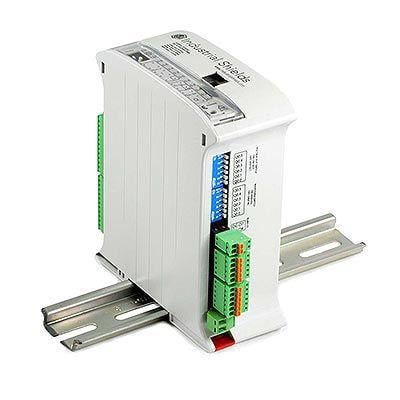
→ Buy Ardbox Analog · Buy Ardbox Relay · View technical specs
Download the Ardbox Family User Guide (PDF) or the full datasheet.