Case study · Sugar industry · Raspberry PLC
Beet piles spoil from the inside. A buried sensor watches the core.
Battery radio nodes report the core every hour.
A pile holds the beets well. But the beets inside it get more heat and moisture than the beets on the outside.
So the case puts the sensor where the damage starts: the bottom centre.
This case describes a monitoring system for the beet piles of a sugar manufacturer, with OpenMote B radio nodes and a Raspberry PLC. It does not name the manufacturer. The problem, the hardware, the sensor position, the timings and the radio bands come from the case. The values in the panels are examples, not data from the piles.
The challenge
Find the warm beets before they rot.
Before the beets go into the factory, they wait outdoors in very large piles. In this case the beets at the bottom centre of the piles spoiled before they were removed for sugar production. Part of the raw material had to be discarded, and the losses added up to a significant amount every year. The manufacturer wanted a system that detects when the beets are about to rot, so they can be taken out in time.
The problem starts inside
The beets inside a pile are more affected by heat and moisture than the beets on the outside. A walk around the pile does not show it. The measurement has to be at the bottom centre.
Bulldozers move the pile
The beets are removed with bulldozers. A sensor on the surface would be destroyed. The sensor is buried at the base, out of reach of the blades, but still close to the beets.
Outdoors, all season
The system works in the open, in the rain and the cold of the season. The electronics stay in a closed electrical box at the edge of the pile. Only the sensor cable goes under the beets.
No cables between piles
The piles are spread over the yard and they change as the season goes on. Each node runs on batteries and sends its data by radio. The batteries are expected to last almost 2 years.
Why it matters
Every beet that rots in the pile is raw material that never becomes sugar. The case reports that the system reduced the losses from spoiled beets, kept the product in good condition and cut the work of handling and disposing of bad beets. It does not publish figures.
How it works
Three jobs: read the core, sleep between readings, warn in time.
Each panel shows one job. Press the buttons. The panels are illustrative simulations: the hourly rhythm, the radio bands and the 15 m distance are the ones of the case, but the temperatures, the thresholds and the number of piles are examples, not data from the piles.
One sensor where the heat builds up.
The sensor sits at the base of the pile, under the bottom centre, up to 15 m from the node box at the edge. The air around the pile goes up and down with day and night. The core changes slowly. A steady rise in the core, while the air does not explain it, is the sign to look for. Pick a pile and watch the trend.
- Sensor buried at the base, under the bottom centre
- Up to 15 m from the box at the edge
- Watch the trend, not one reading
Pile events (example)
Illustrative simulation. Example values, not data from the piles. One reading per hour, shown faster than real time. The case does not publish its warning values. In this example: watch at a core rise of more than 1 °C in 24 h, warning at more than 2 °C in 24 h or a core above 10 °C. Set yours with your agronomists.
Wake, read, send, sleep. Once an hour.
Beets do not spoil in minutes, so one reading per hour is enough. The node sleeps the rest of the time. It wakes, reads the DS18B20 through a level shifter, because the sensor runs at 5 V and the radio board at 3.3 V, sends the value to the master and goes back to sleep. This is how the batteries are expected to last almost 2 years. Change the interval and the band.
- One wake-up per hour in the case
- 2.4 GHz: less range, more data rate
- 868 MHz: more range, less data rate
Node events (example)
Illustrative simulation. Example values, not data from the piles. The cycle is the one of the case: sleep, wake every hour, read, send to the master, sleep again. The counts are arithmetic: 24 wake-ups per day and 8,760 per year at one per hour. The case does not publish the energy of one cycle, so the panel does not compute a battery life.
From a warm core to a planned removal.
The master radio board near the factory passes every message to the Raspberry PLC over USB. The PLC stores the data in a database or sends it to the cloud over Ethernet or Wi-Fi. When the heat in a pile goes too high, it sends a warning, so the yard can remove that pile first. Break something and read the log.
- Warning signal on high heat in a pile
- A silent node is found by its missing messages
- Future option: a beacon on the node box
Raspberry PLC events (example)
Illustrative simulation. Example values, not data from the piles. One tick is one hour. Six piles, the pile numbers and the 3-hour rule for a silent node are examples. The warning signal is in the case. The beacon on the node box is an option the case plans for the future, not part of the installation.
Try it on a full network
Run the same pattern day and night.
The panels above show one pile at a time. The simulators below run a whole network.
Battery nodes, one gateway, a day and a night
Choose the site "Field storage pile". Watch the core and the surface of a pile, then block a link, drain a battery or cut the gateway. It uses a GateBerry FLEX gateway; the logic is the same.
Open the simulatorSimulator · Remote site telemetryAlarms from sites far from the control room
Practise how alarms from remote sites reach the operator and how they are acknowledged. The example is a water network.
Open the simulatorSystem architecture
How do you monitor the temperature inside a beet pile?
Bury a temperature sensor at the base of the pile, under the bottom centre, and run its cable to a radio node in a closed box at the edge of the pile. In this case each pile has one OpenMote B node with a DS18B20 sensor, a level shifter and batteries. Every hour the node wakes up and sends its reading by radio, on 2.4 GHz or 868 MHz, to a master OpenMote B near the factory. The master is connected by USB to a Raspberry PLC, which stores the data in an internal database or sends it to the cloud over Ethernet or Wi-Fi, and raises a warning when a pile gets too warm.
| Signal | Between | Type | Purpose |
|---|---|---|---|
| Pile temperature | BetweenDS18B20 → node | TypeDigital, 1-Wire | PurposeSensor buried at the base, up to 15 m from the node box |
| Level shift | BetweenDS18B20 (5 V) ↔ OpenMote B (3.3 V) | TypeLevel shifter | PurposeAdapts the data line between the two voltages |
| Humidity | BetweenPile → node | TypeNot named in the case | PurposeThe case monitors heat and humidity; it names only the DS18B20, which measures temperature |
| Hourly reading | BetweenNode of each pile → master | TypeRadio, 2.4 GHz or 868 MHz | PurposeThe node wakes every hour, sends and sleeps again |
| Battery | BetweenIn the node box | TypeBatteries | PurposeExpected to last almost 2 years |
| Collected data | BetweenMaster OpenMote B → Raspberry PLC | TypeUSB | PurposeAll the piles reach the PLC near the factory |
| Uplink | BetweenRaspberry PLC → database or cloud | TypeEthernet or Wi-Fi | PurposeInternal database, or the cloud directly |
| Warning | BetweenRaspberry PLC → yard team | TypeWarning signal | PurposeSent when a high level of heat and humidity is detected |
| Visual alert | BetweenNode box → yard | TypeBeacon (future option) | PurposePlanned in the case to show a pile above its limits; not installed |
Why it works
The right point, the right rhythm, nothing in the way of the bulldozers.
Measure where it starts
The damage starts at the bottom centre of the pile. A buried sensor reads that point directly, instead of guessing it from the surface.
Electronics out of the pile
Only the sensor and its cable go under the beets. The radio board and the batteries stay in a closed box at the edge, where the bulldozers do not work and the batteries can be changed.
A rhythm that matches the beet
Spoiling takes hours and days, not minutes. One reading per hour shows the trend and lets the node sleep almost all the time.
A band for each yard
With 2.4 GHz you get more data rate and less range. With 868 MHz you get more range and less data rate. A large yard with a few bytes per hour is a good fit for the lower band.
A Linux PLC at the end
The Raspberry PLC takes the data on USB and does the rest in software: database, cloud, rules and warnings. See an MQTT to SQL Server bridge in Python and a Node-RED MQTT concentrator.
Open and modular
There are no licence fees. A new pile is one more node and one more line in the rules. The same network can grow with the yard.
From the original case
The scheme of the case.
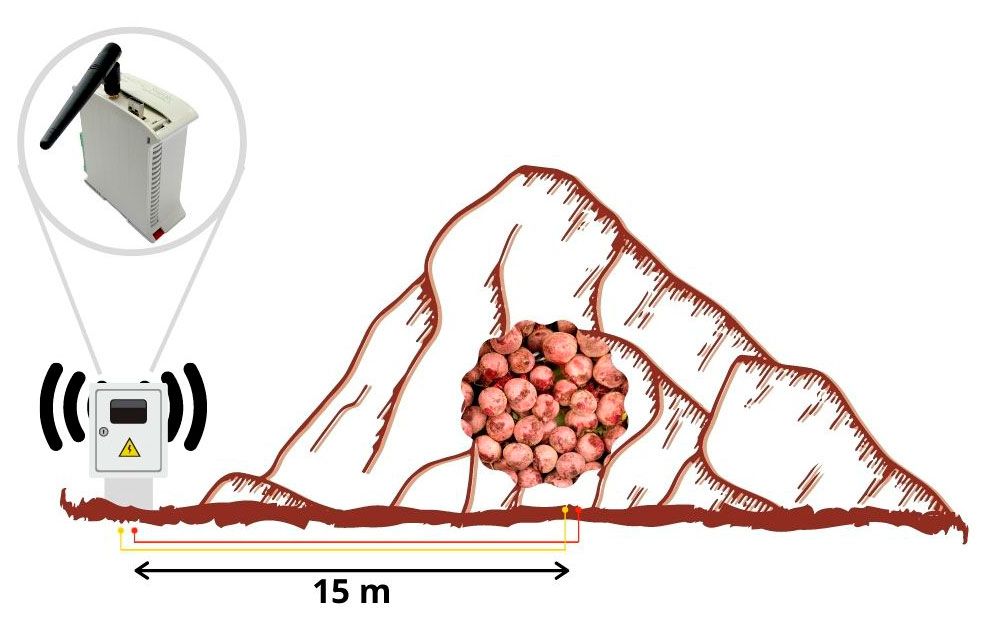


The case does not publish photos of the installation.
Hardware
The PLC today. The nodes of the case.

Current equivalentRASPBERRY PLC CPU-Gateway FLEX
For the role of the case, a current option is the Raspberry PLC without local I/O: it takes the master radio board on USB and sends the data over Ethernet or Wi-Fi.
- Role in this design
- Receives the master radio board on USB, stores the data, sends it on and raises the warnings
- Compute
- Raspberry Pi 4, quad core 64-bit, 1.8 GHz, 2, 4 or 8 GB RAM
- Ports
- 1 x Gigabit and 1 x 10/100 Ethernet, Wi-Fi, Bluetooth LE, 2 x USB 2.0, 2 x USB 3.0, 2 x RS-485
- Expansion
- One optional board: CAN, LoRa or 4G (LTE-M/NB-IoT or LTE Cat 4)
- Software
- Debian 64-bit preinstalled; runs Python, Node-RED and C/C++
- Power and mounting
- 12 to 24 Vdc, UPS with supercapacitors, real-time clock, DIN rail TS35, IP20, 0 to 50 °C
The case names a Raspberry PLC and does not publish the model. The CPU-Gateway FLEX is the Raspberry PLC without local I/O. If you want to drive a beacon or a siren at the factory from the same PLC, the RASPBERRY PLC 21 FLEX adds 13 inputs and 8 outputs. The radio boards are not part of the PLC.

OpenMote B (image from the original case)
Each pile has one OpenMote B in an electrical box at its edge, with a DS18B20 sensor, a level shifter and batteries. One more OpenMote B, near the factory, is the master that receives all the piles.
- Sensor
- DS18B20 digital temperature sensor, buried at the base of the pile
- Voltages
- Sensor at 5 V, radio board at 3.3 V, level shifter between them
- Radio
- 2.4 GHz or 868 MHz
- Cycle
- Sleep, wake every hour, send to the master
- Power
- Batteries, expected to last almost 2 years
OpenMote B is no longer in the Industrial Shields catalogue. The pattern still applies: low-power radio nodes, one receiver and a Linux PLC. Tell us your yard and your piles and we will propose the nodes and the radio.
Questions about this case
Why do sugar beet piles spoil from the inside?
A harvested beet is still alive: it keeps breathing, uses its sugar and gives off heat and water. On the outside of a pile the air takes that heat away. Inside, the heat and the moisture stay, and the beets get warmer and wetter. In this case the beets at the bottom centre of the piles spoiled before they were removed for sugar production.
Where do you place the temperature sensor in a beet pile?
At the point where the problem starts. In this case the sensor is buried at the base of the pile, under the bottom centre, so the bulldozers that remove the beets cannot reach it. The sensor is up to 15 m from a closed electrical box at the edge of the pile, where the radio node and the batteries are.
How often should a storage pile be measured?
In this case once per hour. Beets do not spoil in minutes, so a reading per hour shows the trend. Between readings the node sleeps, which is why its batteries are expected to last almost 2 years. A shorter interval gives more points and a shorter battery life.
2.4 GHz or 868 MHz for battery sensor nodes?
In this case the nodes can use either. 2.4 GHz gives more data rate and less range. 868 MHz gives more range and less data rate. For a few bytes per hour across a large yard, range counts more than data rate. 868 MHz is a licence-free band in Europe; in the United States the similar band is 902 to 928 MHz. Test the links at the real positions, because a pile of beets and the machines change the radio path.
Does the system measure humidity too?
The case monitors heat and humidity and sends a warning when both are high. The only sensor it names is a DS18B20, which measures temperature. If you need humidity inside the pile, choose a probe made for that and check how it works in wet ground before you bury it.
Do I need to write code for the warnings?
Not much. The rules on the Raspberry PLC are a short list: a limit, a rise per day and a timer for a silent node. You can write them in Node-RED with flow blocks, or in Python. If you prefer, tell us your piles and your limits and an integrator or our team can set them up. The radio nodes run their own firmware; we can propose and set them up.
Download the case study
4-page PDF with the challenge, the logic, the architecture and the hardware. No form required.
Storing a crop outdoors?
Tell us about your piles. An engineer will answer.
Tell us how many piles you have, how far they are from the plant, what you want to measure and where the data must go. We will propose the sensors, the radio, the PLC and the software.
- You get an answer from our technical team
- Sensors, radio and PLC for your yard
- Arduino, ESP32 or Raspberry Pi based PLCs