

Industrial monitoring has undergone a structural transformation over the past decade. The model of periodic manual readings, centralised SCADA systems accessible only from the control room, and data siloed inside proprietary PLCs is giving way to something fundamentally different: continuous, real-time data extraction at the edge, feeding live analytics platforms, cloud dashboards, and predictive maintenance engines.
This shift places new demands on industrial hardware. The devices deployed at the field level must no longer simply execute control logic. They must collect, process, contextualise, and transmit data across multiple protocols and destinations simultaneously. They must run software stacks that can be updated, extended, and integrated without replacing the hardware. And they must do all of this while meeting the reliability and environmental standards of industrial environments.
Raspberry Pi-based industrial devices from Industrial Shields — specifically the GateBerry IoT gateway, the Raspberry Pi PLC family, and the Touchberry Panel PC — are purpose-built for exactly this role. This post examines the concrete advantages they deliver to engineering teams and operations managers responsible for industrial monitoring and data extraction in B2B deployments.
The architecture shift: from data consumers to data producers
Traditional PLCs were designed to control processes. Data collection was secondary: a feature bolted onto a control-first architecture, typically through proprietary historian software or SCADA middleware that required significant integration effort and ongoing licensing costs.
Raspberry Pi-based industrial devices invert this architecture. Built on a full Linux operating system, they are data-first platforms: capable of running database engines, message brokers, REST APIs, containerised analytics services, and communication middleware natively on the device itself. Control logic and data intelligence coexist on the same hardware, without the need for additional servers, gateways, or middleware layers.
This architectural difference has direct operational consequences. Data can be processed locally before transmission, reducing bandwidth requirements and enabling edge decisions. Historical data can be stored on-device during connectivity interruptions and synchronised when the connection is restored. Integration with cloud platforms, enterprise IT systems, and third-party analytics tools is handled through standard open protocols, not vendor-specific connectors.
GateBerry: industrial IoT gateway for protocol-agnostic data collection
The GateBerry is Industrial Shields' dedicated industrial IoT gateway, built on the Raspberry Pi Compute Module in a DIN-rail-mountable enclosure designed for installation in industrial panels. Its primary role is protocol translation and data aggregation: collecting information from diverse field devices and making it available to supervisory systems and cloud platforms through standardised interfaces.
In monitoring deployments, the GateBerry addresses one of the most persistent challenges in operational technology environments: the coexistence of multiple industrial communication protocols across different generations of equipment. A typical production facility might have legacy Modbus RTU devices on RS-485 buses, newer Modbus TCP instruments on Ethernet, and equipment from different vendors speaking proprietary protocols — all of which need to feed data into a single monitoring platform.
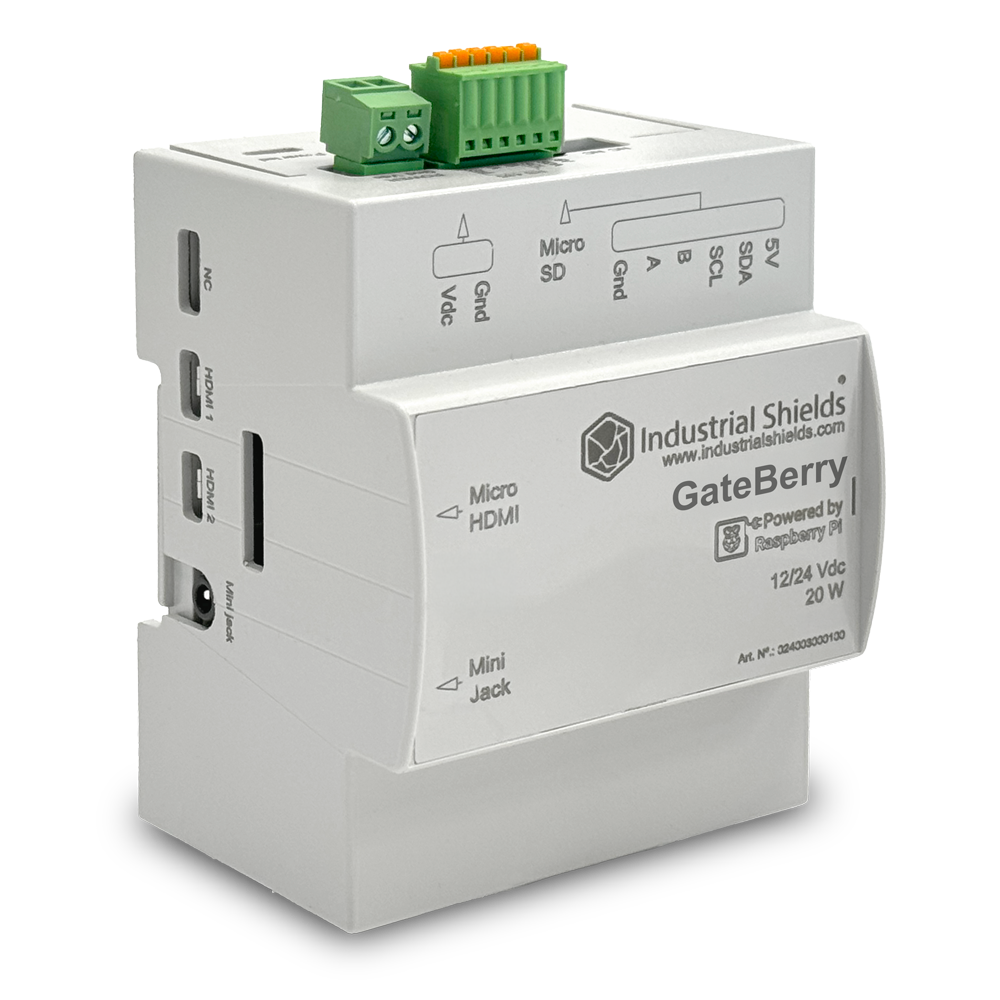
The GateBerry handles this heterogeneity natively. Running Node-RED, Python scripts, or purpose-built middleware, it can simultaneously poll Modbus RTU registers, read Modbus TCP data, query devices via SNMP or OPC-UA, and publish the aggregated dataset to an MQTT broker or a REST endpoint. The full Linux environment means any protocol for which a library or driver exists can be integrated without waiting for vendor support.
For operations teams, the result is a single, consistent data feed from a mixed-protocol field environment, delivered in a format that integrates directly with platforms like InfluxDB, Grafana, AWS IoT, Azure IoT Hub, or any MQTT-compatible analytics stack.
Raspberry Pi PLC: monitoring and control in a single industrial device
The Raspberry Pi PLC family from Industrial Shields combines industrial-grade digital and analog I/O with the full computational capability of the Raspberry Pi Compute Module. In monitoring applications, this combination removes the traditional boundary between the control layer and the data layer.
A conventional monitoring architecture requires a dedicated PLC for control, a separate data acquisition system or historian, and a middleware layer to bridge the two. On a Raspberry Pi PLC, a single device can simultaneously execute control logic (in Python, Node-RED, or other Linux-native frameworks), read sensor data from direct I/O connections, store time-series data locally, and transmit to remote systems — all without additional hardware.
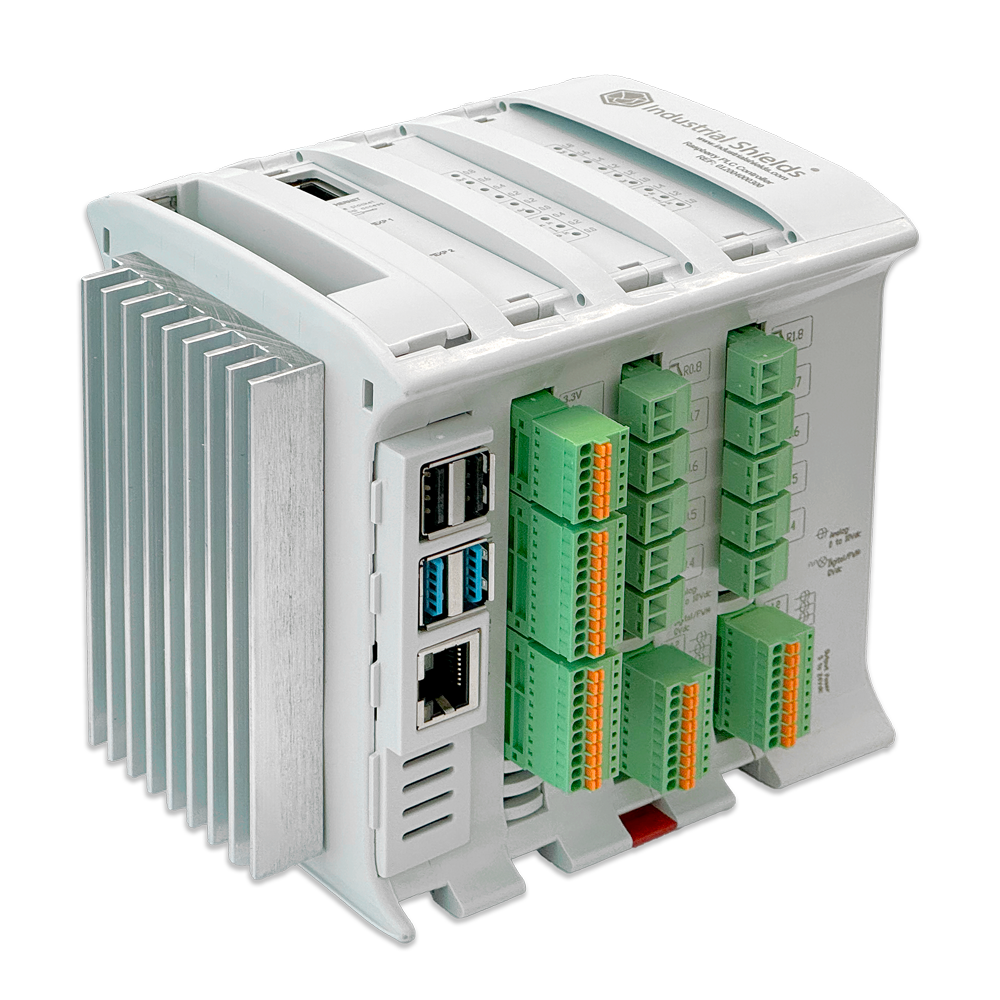
This consolidation is particularly valuable in distributed monitoring scenarios: remote pump stations, substations, agricultural installations, building management systems, and edge manufacturing cells where deploying and maintaining multiple devices per installation point is operationally costly. The Raspberry Pi PLC reduces the bill of materials per monitoring node while increasing the data intelligence available at each point.
The open Linux environment also enables monitoring capabilities that go beyond traditional PLC data acquisition. Machine learning models for anomaly detection can run directly on the device. Statistical process control algorithms can execute locally and generate alerts before data reaches the central system. Energy consumption data can be disaggregated and analysed at the source. These edge analytics capabilities are available today, using standard open-source tools.
Touchberry: operator interface and data visualisation at the machine level
The Touchberry Panel PC integrates a touchscreen HMI with the Raspberry Pi platform in an industrial enclosure, enabling local data visualisation and operator interaction directly at the point of measurement or control. In monitoring deployments, this addresses a critical gap: making data accessible and actionable at the machine level, not just in the control room or on a remote dashboard.
On a Touchberry, the local HMI can display live process data from directly connected sensors, trend visualisations from a local time-series database, and alarms generated by local analytics — all without requiring connectivity to a central system. This local data availability is not just a convenience; in environments with intermittent connectivity or where response time is critical, it is a safety and operational requirement.
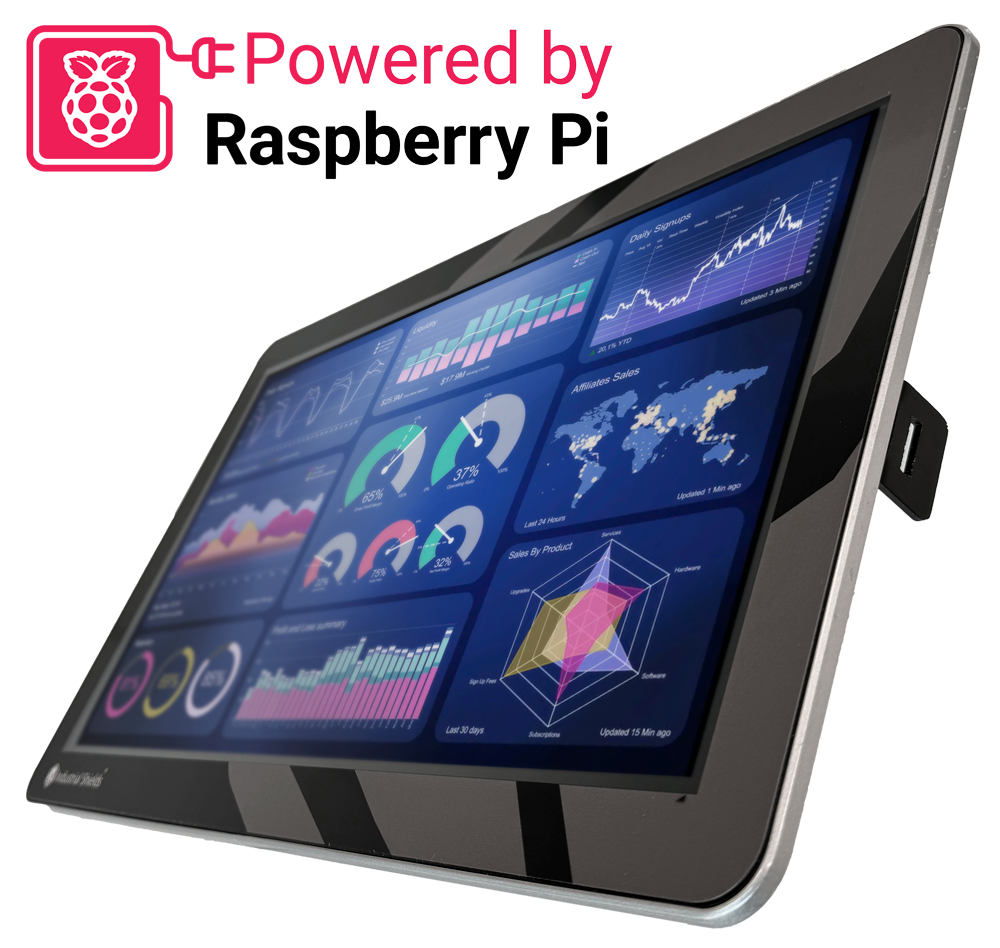
The web-based HMI paradigm enabled by the Raspberry Pi platform means that the same interface displayed on the Touchberry's local screen is accessible from any browser on the plant network, without proprietary SCADA clients or per-seat licensing. Engineering teams can build operator interfaces using Node-RED Dashboard, Grafana, or any web framework, then deploy the same application to both the local Touchberry display and remote monitoring workstations simultaneously.
For data extraction workflows, the Touchberry can also serve as a local data entry point, allowing operators to add contextual annotations, production counts, quality inspection results, or maintenance notes that are immediately associated with the time-series process data and included in the exported dataset.
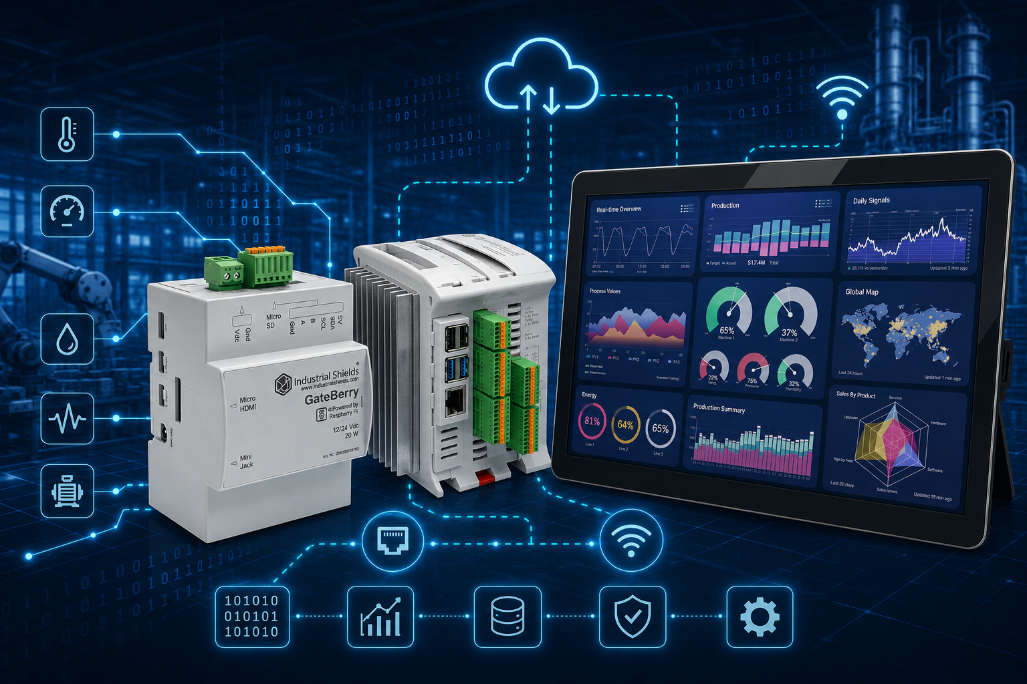
Connectivity and integration: the full open-protocol stack
Across the GateBerry, Raspberry Pi PLC, and Touchberry platforms, Industrial Shields devices share a common connectivity advantage: native support for the complete stack of industrial and IT communication protocols, without proprietary middleware.
For data extraction and monitoring integrations, this means direct connectivity to:
- Modbus RTU / Modbus TCP: the dominant legacy protocol in industrial sensor and actuator networks
- MQTT: the standard lightweight messaging protocol for IIoT data pipelines, compatible with all major cloud IoT platforms
- OPC-UA: the industry standard for secure, structured data exchange with SCADA, MES, and ERP systems
- REST APIs: enabling direct integration with enterprise IT systems, cloud databases, and SaaS analytics platforms
- InfluxDB / TimescaleDB / SQLite: open time-series and relational databases that can run natively on the device for local data storage and edge querying
This protocol breadth eliminates integration middleware costs and reduces the number of system components that require maintenance. Data flows from sensor to cloud — or from sensor to edge analytics to cloud — through open standards, auditable at every step.
Practical advantages for B2B monitoring projects
For engineering teams and procurement managers evaluating industrial monitoring solutions, the Raspberry Pi-based Industrial Shields platform delivers a set of concrete, measurable advantages over proprietary alternatives:
Reduced integration cost. Open protocols and Linux-native software stacks eliminate proprietary middleware and the professional services fees required to configure and maintain them. Integration with existing IT infrastructure follows standard engineering practice, not vendor-specific procedures.
Lower hardware cost per monitoring node. Consolidating control and data functions on a single device reduces the component count per installation point, with direct impact on bill of materials and installation costs for distributed monitoring deployments.
No software licensing. The full software stack — operating system, programming tools, database engines, messaging brokers, HMI frameworks — is available without per-device or per-feature licensing fees.
Field-upgradeable software. Because the platform runs a standard Linux operating system, software updates, new protocol drivers, and expanded monitoring capabilities can be deployed over the network to installed devices without hardware replacement.
Talent and community access. Python, Node-RED, Docker, and Linux are the dominant tools of the global developer community. Finding engineers who can build and maintain monitoring applications on this platform requires drawing from a broad talent pool, not a narrow community of certified specialists.
Raspberry Pi industrial devices: the right foundation for IIoT monitoring
Industrial monitoring and data extraction are no longer peripheral functions of automation systems. They are core business capabilities that drive predictive maintenance, energy efficiency, quality management, and operational decision-making. The hardware platform that supports these functions needs to be open, flexible, and capable of evolving alongside the data infrastructure it feeds.
The GateBerry, Raspberry Pi PLC, and Touchberry from Industrial Shields deliver this capability in industrial-grade hardware that meets the environmental and certification requirements of professional deployments. For B2B engineering teams building monitoring systems, integrating legacy equipment into IIoT architectures, or deploying distributed edge data collection networks, these platforms offer a technically sound and commercially competitive foundation.
Discover the full range of Raspberry Pi industrial devices from Industrial Shields at www.industrialshields.com.
Industrial monitoring and data extraction with Raspberry Pi: how GateBerry, Raspberry PLC and Touchberry are redefining the edge