

In B2B industrial automation, the choice of control hardware is rarely just a technical decision. It is a strategic one. The platform you select today will shape your engineering costs, your talent pipeline, your integration flexibility, and your ability to adapt over the next decade. For too long, that choice defaulted to proprietary PLCs from a handful of large vendors, with all the lock-in, licensing complexity, and hidden costs that come with them.
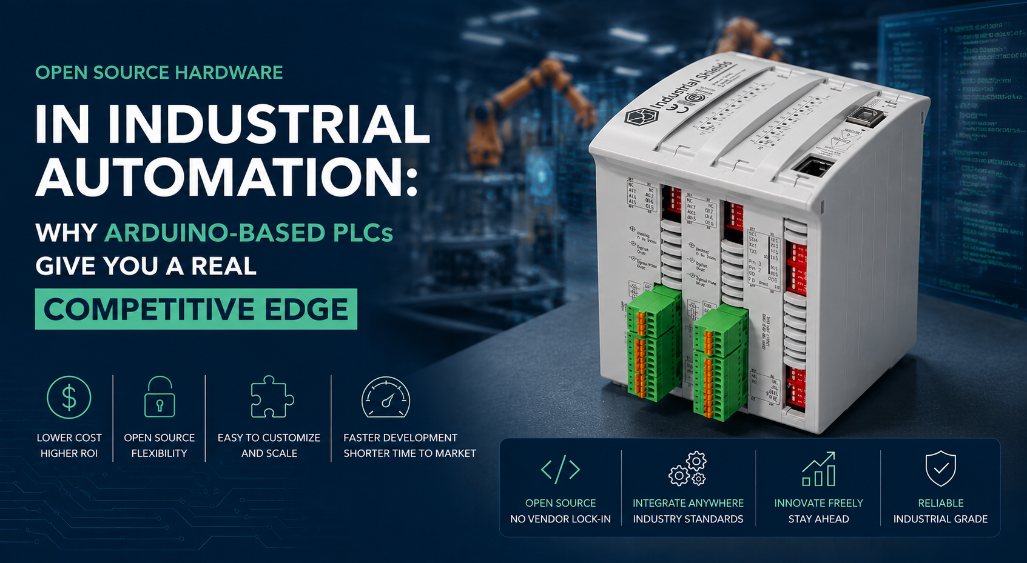
Open source hardware is changing that equation. Arduino-based PLCs, led in the industrial space by platforms like the M-Duino family from Industrial Shields, are no longer just a cost-saving alternative. They represent a fundamentally different approach to industrial control: one built on transparency, ecosystem depth, and engineering freedom. This post examines the concrete competitive advantages that open source hardware PLCs deliver to systems integrators, OEM manufacturers, and industrial engineering teams operating in B2B environments.
1. Total cost of ownership: the real numbers
The upfront price difference between an Arduino-based industrial PLC and a comparable proprietary unit is immediately visible. But the more significant savings emerge over the full project lifecycle.
Proprietary PLC ecosystems typically require vendor-specific programming software licenses, annual maintenance agreements, certified training courses for each product generation, and often per-seat or per-project fees for advanced features such as Ethernet communication modules, function block libraries, or remote access capabilities. These costs compound over time and across projects.
With an open source hardware platform, the core toolchain is available without licensing fees. The Arduino IDE, the Arduino PLC IDE (which supports IEC 61131-3 languages), and the vast ecosystem of open libraries carry no per-seat cost. Engineering teams can onboard new members, spin up development environments, and replicate projects without triggering additional vendor invoices. For systems integrators managing dozens of simultaneous projects, this difference in TCO is material, not marginal.
2. Eliminating vendor lock-in
One of the most underestimated risks in industrial automation procurement is vendor dependency. When your control infrastructure is built on a proprietary platform, you are committed to that vendor's pricing, product roadmap, support availability, and commercial decisions, for the entire operational life of the equipment.
Building on open source foundations inverts this dynamic. M-Duino PLCs are built on the Arduino open ecosystem, fully compatible with the Arduino toolchain, the Arduino IDE, the Arduino PLC IDE, and the vast library of open-source software that the global Arduino community has developed. This is the layer where lock-in risk matters most for engineering teams, and it is the layer that remains completely open.
If a communication library needs to be extended, the source code is accessible and modifiable. If a new engineer joins the team, they are working with the Arduino toolchain: an environment with a global community and millions of published resources, not a proprietary programming environment that requires brand-specific certification. If the project needs to integrate a new protocol or sensor, the open software ecosystem provides the starting point.
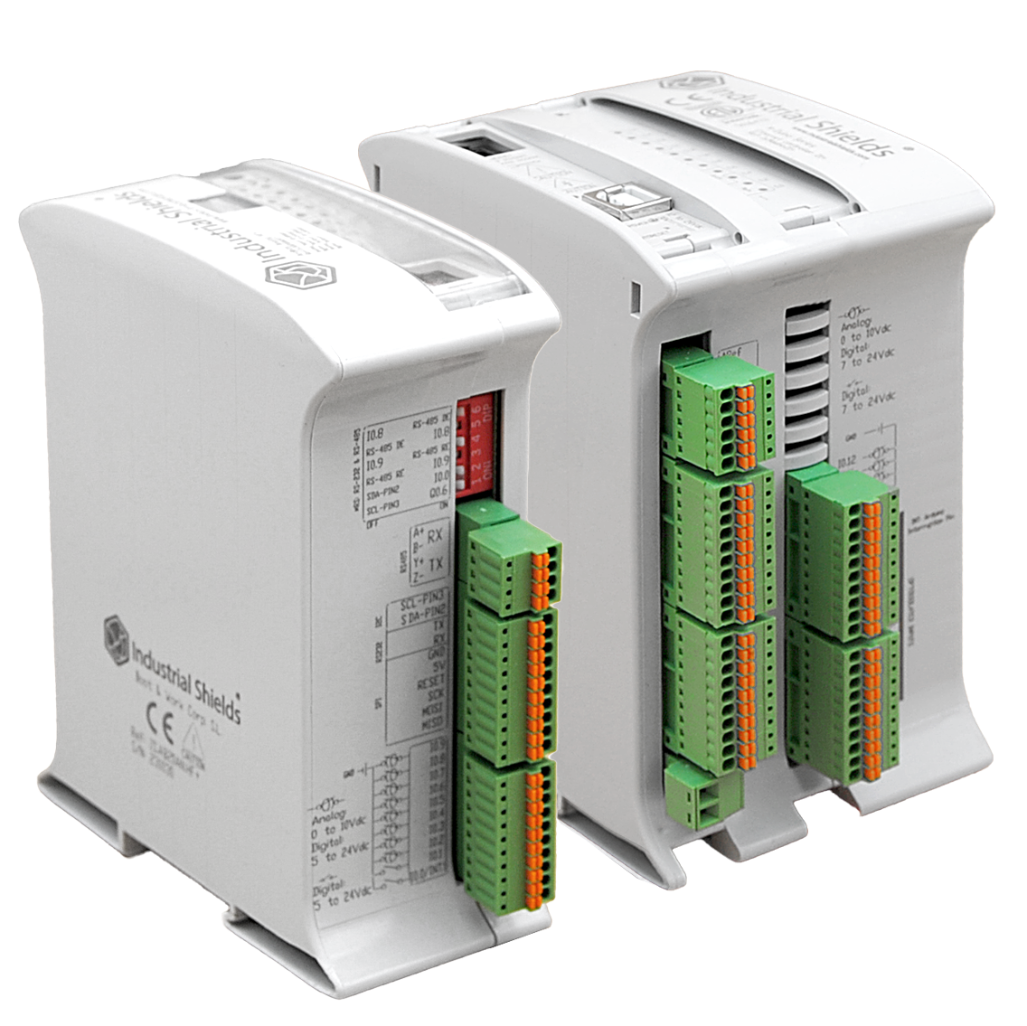
Industrial Shields adds to this the professional layer that industrial deployments require: CE-certified hardware, industrial-grade I/O, dedicated technical documentation, and support channels. The result is a platform that combines the engineering freedom of the open Arduino ecosystem with the reliability standards of purpose-built industrial hardware.
3. Access to the world's largest engineering ecosystem
The Arduino ecosystem is the most widely adopted open hardware platform in the world, with an active global community of engineers, makers, researchers, and educators. For industrial buyers, this translates into a decisive practical advantage: talent availability.
Finding engineers who can program a specific proprietary PLC requires recruiting from a narrow pool, often requiring brand-specific certifications and training. Finding engineers who are proficient in C/C++, familiar with the Arduino environment, or experienced with IEC 61131-3 languages (all supported on M-Duino platforms) means drawing from a vastly larger talent pool. This reduces both recruitment costs and the time-to-productivity for new team members.
Beyond human capital, the ecosystem richness delivers immediate engineering value. Thousands of battle-tested open libraries cover communication protocols (Modbus RTU, Modbus TCP, MQTT, OPC-UA, CANbus), sensor integrations, industrial networking standards, and real-time control patterns. What would require weeks of custom development on a proprietary platform is often a matter of integrating and adapting an existing, community-validated library.
4. Engineering flexibility and rapid iteration
Proprietary PLC platforms enforce a certain way of working. The programming environment, the data structures, the communication stack, the HMI integration: these are defined by the vendor, and deviating from the prescribed path is either impossible or prohibitively expensive.
Arduino-based industrial PLCs impose no such constraints. On an M-Duino platform, an engineering team can implement standard IEC 61131-3 logic in Ladder Diagram or Structured Text for the control core, while simultaneously running C++ code for custom preprocessing, data logging, or edge analytics. They can connect to any industrial protocol without waiting for a vendor to release a certified communication module. They can integrate directly with open-source SCADA systems, Node-RED, MQTT brokers, or cloud platforms without proprietary middleware.
This flexibility is especially valuable for OEM manufacturers, who need to differentiate their machines through software functionality. When the underlying control platform is open, the OEM's engineering capability, rather than the PLC vendor's feature roadmap, determines what is possible.
5. Transparency, auditability, and security
In regulated industries and safety-critical applications, hardware and software transparency is not a nice-to-have: it is a requirement. Open source hardware enables a level of design auditability that is impossible with black-box proprietary systems.
When the hardware schematics are public and the firmware is based on open software, engineering teams and compliance auditors can trace every signal path, verify every software dependency, and validate every communication interface. There is no reliance on vendor assurances about what the hardware does internally. This transparency supports documentation requirements under the EU Machinery Regulation, IEC 62443 cybersecurity standards, and sector-specific compliance frameworks in industries such as food and beverage, pharmaceuticals, and energy.
Industrial Shields reinforces this with hardware designed to industrial standards: M-Duino PLCs carry CE certification, operate across industrial temperature ranges, comply with EMC requirements, and are built for DIN rail installation in industrial panels. The combination of open architecture and industrial-grade certification addresses a concern that historically limited open hardware adoption in professional automation: the question of whether open platforms meet the same standards as proprietary alternatives.
6. Future-proofing in a rapidly evolving landscape
Industrial automation is being reshaped by IIoT, edge computing, AI-driven analytics, and increasing connectivity requirements. The vendors best positioned for this transition are those whose platforms can evolve without requiring customers to replace their entire installed base.
Open source hardware platforms evolve continuously, driven by community contributions and by manufacturers like Industrial Shields who build industrial-grade products on top of the open foundation. New communication standards, new processing capabilities, and new software integrations enter the ecosystem rapidly: customers benefit without waiting for proprietary vendor release cycles or paying for upgrade licenses.
For engineering managers responsible for long-lifecycle systems (production lines, infrastructure installations, or industrial machines with 10-to-15-year operating horizons), this adaptability is a meaningful risk reduction factor.
The Industrial Shields proposition: open hardware, industrial standards
The competitive advantages of open source hardware are only fully realized when the hardware itself meets the demands of professional industrial deployment. This is the market gap that Industrial Shields addresses with the M-Duino PLC family.
M-Duino PLCs bring the full Arduino open-source ecosystem to a hardware platform engineered for industrial environments: wide operating temperature, industrial power supply compatibility, protected I/O with opto-isolation and relay outputs, and certified compliance with CE and IEC standards. Programming flexibility, library access, community support, and zero licensing fees are all included. They support IEC 61131-3 languages via the Arduino PLC IDE, enabling teams to work with the same standardized control logic used across the industry, while retaining the option to extend functionality in C/C++ when the application demands it.
For systems integrators, the result is a platform that reduces project costs, shortens development cycles, and eliminates vendor dependency, without compromising on the reliability and certification standards that industrial customers require. For OEM manufacturers, it is a control foundation that amplifies engineering differentiation rather than constraining it.
Open source hardware PLCs: where the industry is heading
The competitive advantage of open source hardware PLCs in industrial automation is not theoretical. It is measured in reduced engineering costs, shorter time-to-market, lower recruitment barriers, greater flexibility in system architecture, and a lower long-term risk profile driven by the elimination of single-vendor dependency.
As the industrial automation market continues to evolve toward connectivity, edge intelligence, and software-defined functionality, open platforms are structurally better positioned to absorb and deliver these capabilities than closed, proprietary alternatives.
For B2B buyers evaluating their next control platform, the question is no longer whether open source hardware is viable for industrial applications. It is whether the strategic advantages of openness align with their engineering and business objectives. In most cases, they do.
Explore the full M-Duino Arduino PLC range and technical documentation at www.industrialshields.com.
Open source hardware in industrial automation: why Arduino-based PLCs give you a real competitive edge