
Remote monitoring has changed. The question is no longer "how do we see what is happening without being on site." It is "how do we capture enough data from distributed assets to act before something fails — and do it at a cost that makes sense per monitoring point."
Wind farms, solar fields and manufacturing lines share a common challenge: assets scattered across large physical areas, each generating data that matters, with no cost-effective way to collect it continuously. An unplanned failure — a bearing in a wind turbine nacelle, a degraded string in a solar field, a pump heading towards cavitation — costs far more than the monitoring system that would have caught it.
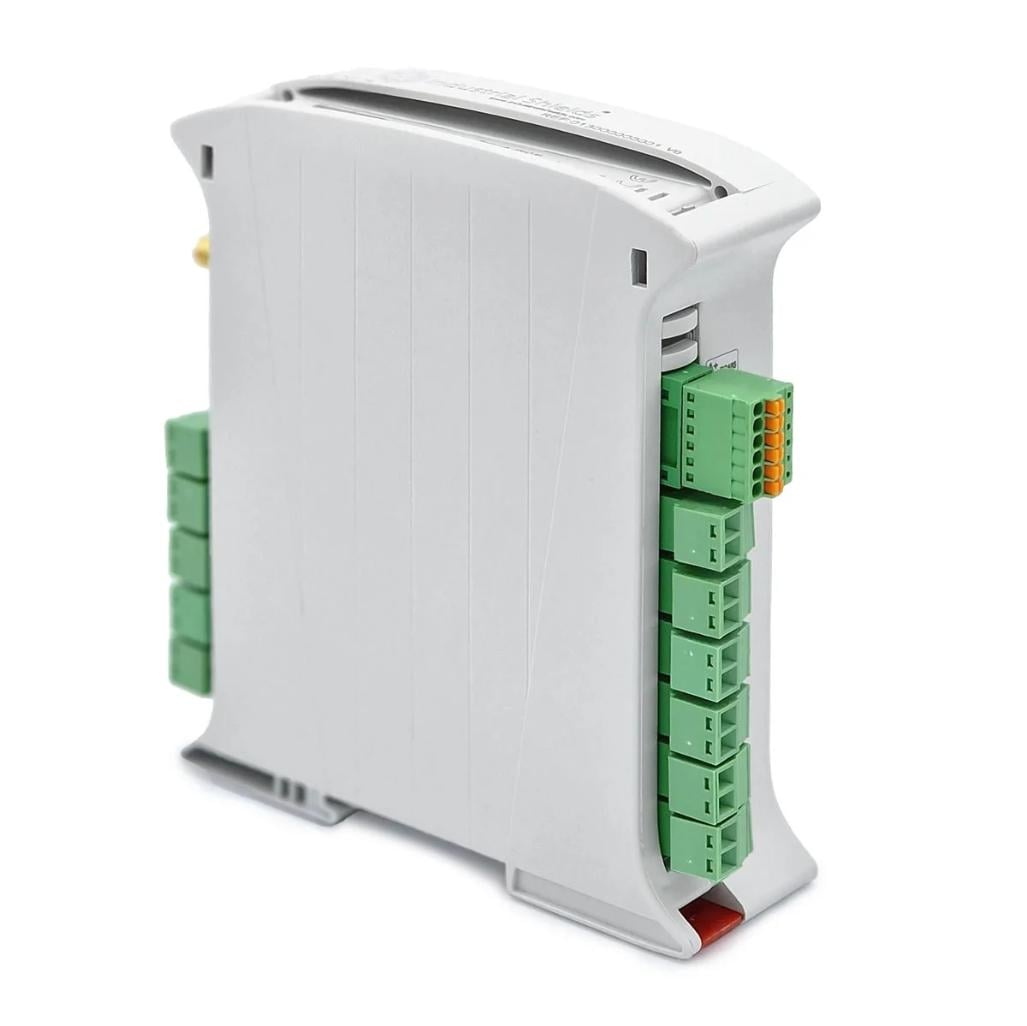
This post covers the monitoring architecture Industrial Shields deploys in these sectors: ESP32 PLC 14 as the field data capture node, GateBerry as the connectivity and edge processing hub.
Why the architecture has shifted to edge-first
The previous generation of remote monitoring sent raw sensor data to a cloud platform and let the platform do the analysis. The problem: most industrial assets in the field — wind turbines, solar inverters, pumps, compressors — are not next to a reliable internet connection. And even where connectivity exists, sending continuous raw data upstream creates bandwidth costs, latency, and a single point of failure in the control path.
Edge-first means the processing happens at the device or gateway level. Anomalies are detected locally. Only relevant events and aggregated metrics are forwarded upstream. The result: lower connectivity requirements, sub-second response times for local alerts, and a system that keeps working when internet access is interrupted.
This shift is visible across the energy sector. Wind farm operators are moving from scheduled maintenance intervals to continuous condition monitoring with local anomaly detection. Solar O&M teams are replacing manual string inspections with automated per-inverter performance deviation alerts. In both cases, the intelligence sits at the edge — not in the cloud.
The monitoring node: ESP32 PLC 14
The ESP32 PLC 14 is the data capture layer. Its I/O set covers the main monitoring signals across all three sectors:
- Vibration: MEMS accelerometers (ADXL345, MPU-6050) via I2C or SPI — 3-axis vibration for rotating equipment health
- Temperature: PT100/PT1000 via analog inputs, DS18B20 via 1-Wire, or 4–20 mA industrial transmitters
- Current: non-invasive current transformers on analog inputs — motor load, inverter output current
- Voltage: analog inputs with resistor dividers for DC bus monitoring, battery state, panel output voltage
- Digital status: circuit breaker trips, door contacts, emergency stop signals, relay feedback
Native WiFi and Bluetooth on the ESP32 PLC 14 give it direct connectivity for short-range deployments and local configuration without physical access. For wind farms and solar fields — where assets are kilometres apart — the LoRa module extends range to 5–15 km, transmitting to the GateBerry.
The ESP32 PLC 14's compact format and 12–24 VDC supply range suit installation directly inside existing electrical cabinets, nacelles, or inverter enclosures — without adding external housing.
The connectivity hub: GateBerry
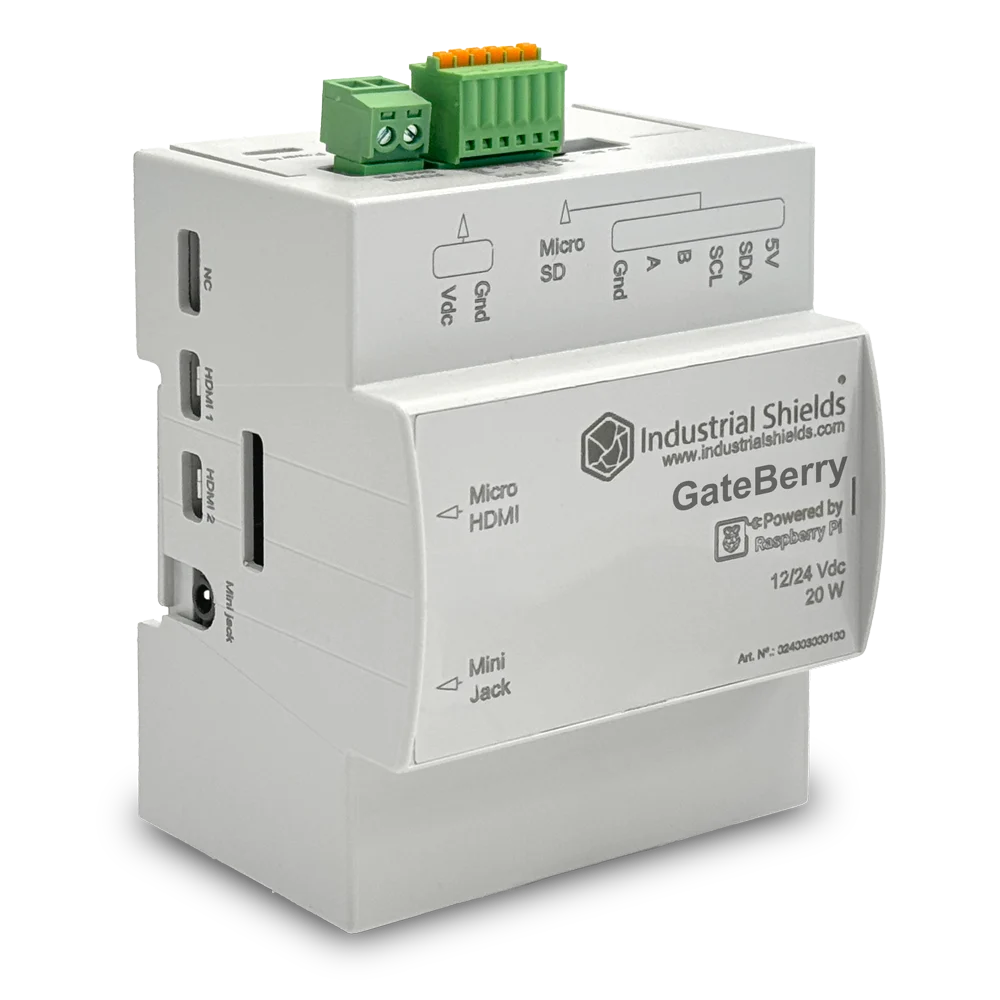
The GateBerry acts as the LoRaWAN gateway and edge server simultaneously. Based on Raspberry Pi and housed in a DIN Rail enclosure, it installs in an existing electrical cabinet at the wind farm substation, solar plant control room, or factory floor panel — no additional enclosure required.
One GateBerry covers a radius of 5–10 km in open terrain, handling 250+ ESP32 PLC 14 nodes. At each site, it runs:
- ChirpStack: LoRaWAN network server — device management, packet deduplication, ADR
- MQTT broker: local message bus for sensor data routing
- Node-RED: flow-based processing — threshold checks, FFT analysis, alert routing, data aggregation
- SCADA connector: forwards processed data upstream to existing monitoring platforms
The GateBerry processes sensor data locally before forwarding. A wind turbine bearing anomaly detected at 3 am triggers a local alert immediately — without waiting for cloud round-trip latency.
Wind energy: turbine condition monitoring
Each wind turbine generates data that predicts failure weeks in advance: vibration signatures in the drivetrain, main bearing temperature, rotor speed versus power output ratio. Continuous monitoring of these parameters detects bearing degradation, gearbox wear, and blade imbalance long before a forced shutdown.
A typical deployment puts an ESP32 PLC 14 in the nacelle electrical cabinet. It reads a 3-axis MEMS accelerometer for drivetrain vibration, a 4–20 mA temperature transmitter on the main bearing, and generator current via a current transformer. Data transmits via LoRa to the GateBerry at the substation every 5 minutes.
The GateBerry runs FFT analysis on the vibration data locally. When spectral signatures deviate from the established baseline — a classic indicator of bearing wear — it triggers an alert via MQTT without requiring a cloud connection. Maintenance is scheduled before the bearing fails, not after.

Solar energy: inverter and string performance tracking
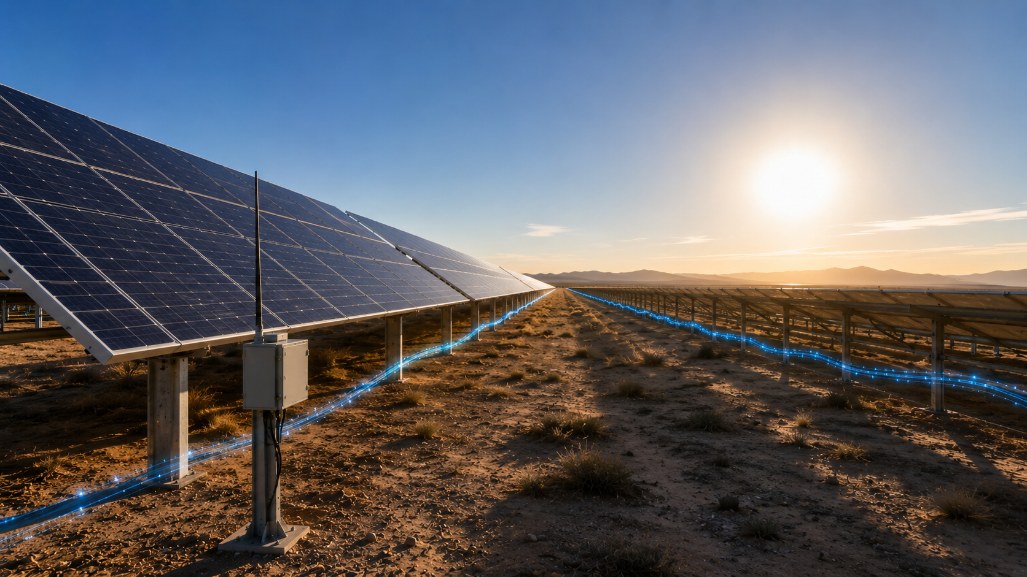
Solar O&M depends on identifying underperforming strings and degraded inverters quickly — before the energy loss compounds over weeks. A large solar field may have hundreds of string combiner boxes, each requiring individual monitoring to catch partial shading effects, connection degradation, or failed bypass diodes.
An ESP32 PLC 14 per inverter bank reads DC current and voltage from the combiner box inputs and AC output power. A pyranometer connected to a dedicated node provides reference irradiance. The GateBerry correlates actual output against expected output for the current irradiance level in real time. Any string or inverter deviating more than a configurable threshold triggers an alert with the exact location — giving maintenance crews a specific target rather than a field-wide inspection task.
The system also tracks inverter health parameters — operating temperature, fan status, grid frequency compliance — to catch inverter degradation before it becomes a forced outage.
Industrial machinery: predictive maintenance on rotating equipment
Motors, pumps, compressors, fans and gearboxes follow predictable failure patterns that show up in vibration spectra and temperature trends days or weeks before a failure occurs. Monitoring these signals continuously shifts maintenance from reactive to predictive.
An ESP32 PLC 14 mounted near the motor reads a 3-axis MEMS accelerometer, a bearing temperature sensor, and motor current via a current transformer. During commissioning, the GateBerry records baseline vibration signatures. From that point on, any deviation — increased 1x or 2x frequency components indicating imbalance or misalignment, high-frequency components indicating bearing wear — triggers a maintenance alert.
Current monitoring adds a second diagnostic layer: motor current signature analysis (MCSA) detects rotor bar defects, eccentricity, and load anomalies that don't always appear in vibration data. Together, vibration and current monitoring provide a complete picture of drivetrain health without invasive inspection.

Deployment notes
- Vibration sensor selection: MEMS I2C/SPI sensors (ADXL345, MPU-6050) connect directly to the ESP32 PLC 14 at low cost. For high-frequency analysis above 1 kHz — needed for gearbox and bearing defect frequencies — use 4–20 mA industrial accelerometers on the analog inputs.
- Sampling strategy: 10-minute averaged RMS values transmitted over LoRa cover standard condition monitoring. Burst captures at higher sample rates can be triggered locally on anomaly detection without increasing baseline LoRa traffic.
- LoRa configuration: SF10–12 for wind farm and solar field deployments (multi-km range). SF7–8 for factory floor (sub-500 m, higher data rate for burst transmissions).
- GateBerry placement: one per site in the existing electrical cabinet — substation for wind, control room for solar, MCC room for factories.
- Baseline period: run in monitoring-only mode for 2–4 weeks to capture normal signatures across load and temperature conditions before enabling anomaly alerts.