
In many installations, control and data still live in separate devices. A PLC runs the process. Next to it, a small PC or gateway collects the data, shows it on a screen and sends it to other systems. Ardbox Q puts both jobs in one DIN-rail device. This article explains how it works, where it helps and when another controller is the better choice.
Why control and data were split
Control and data processing have different needs.
Control has to react to the process: read the inputs, run the logic, switch the outputs. It cannot wait because something else in the device is busy.
Data work needs memory, storage, a network connection and software libraries. Logging months of readings, running a Python script or an AI model is hard to do on a classic PLC CPU.
That is why many projects end up with two or three devices in the same cabinet: a PLC, a gateway and a PC. Each one needs power, wiring, updates and spare parts, and the integration work between them is repeated on every project.
Two processors, one device
Ardbox Q does not try to make one processor do everything. It uses two, each for the job it does best.
- A microcontroller (STM32U585) runs the control. You program it in C++ with the Arduino IDE and the Industrial Shields boards package.
- A quad-core 64-bit processor running Debian Linux handles data logging, dashboards, protocol conversion and AI models, with Python, Node-RED or Docker.
- Arduino App Lab lets the two sides share data in one project.
The two sides work separately. If a Linux application fails, the control program keeps running and the installation keeps working.
AI on the device, data on site
AI is now part of many automation projects: detecting a pattern that does not look normal, checking a product with a camera, or deciding when an alert is worth sending.
With Ardbox Q, the model runs inside the same device. There is no extra AI module and no PC next to the controller. The data is processed where it is generated, and only the results need to leave the site. If you plan to run heavier models or several containers, choose the 4 GB RAM version.
Not only machines
The same device fits many kinds of installations:
- Production lines: read current, vibration or temperature and warn before a failure stops production.
- Pumping stations and tanks: control pumps and valves, log levels and send an alert only when something changes.
- Greenhouses and buildings: regulate climate or irrigation with 0 to 10 V outputs and keep the history on the device.
- Remote sites: read field devices over RS-485 (Modbus RTU) and send summaries over Wi-Fi.
When another controller fits better
Ardbox Q is not the answer for every project.
- For simple on/off logic with no data, a classic PLC is simpler.
- For safety functions, use a certified safety controller.
- If the project needs wired Ethernet or many more I/O points, look at our M-Duino or Raspberry PLC families.
Ardbox Q: the armour around the board
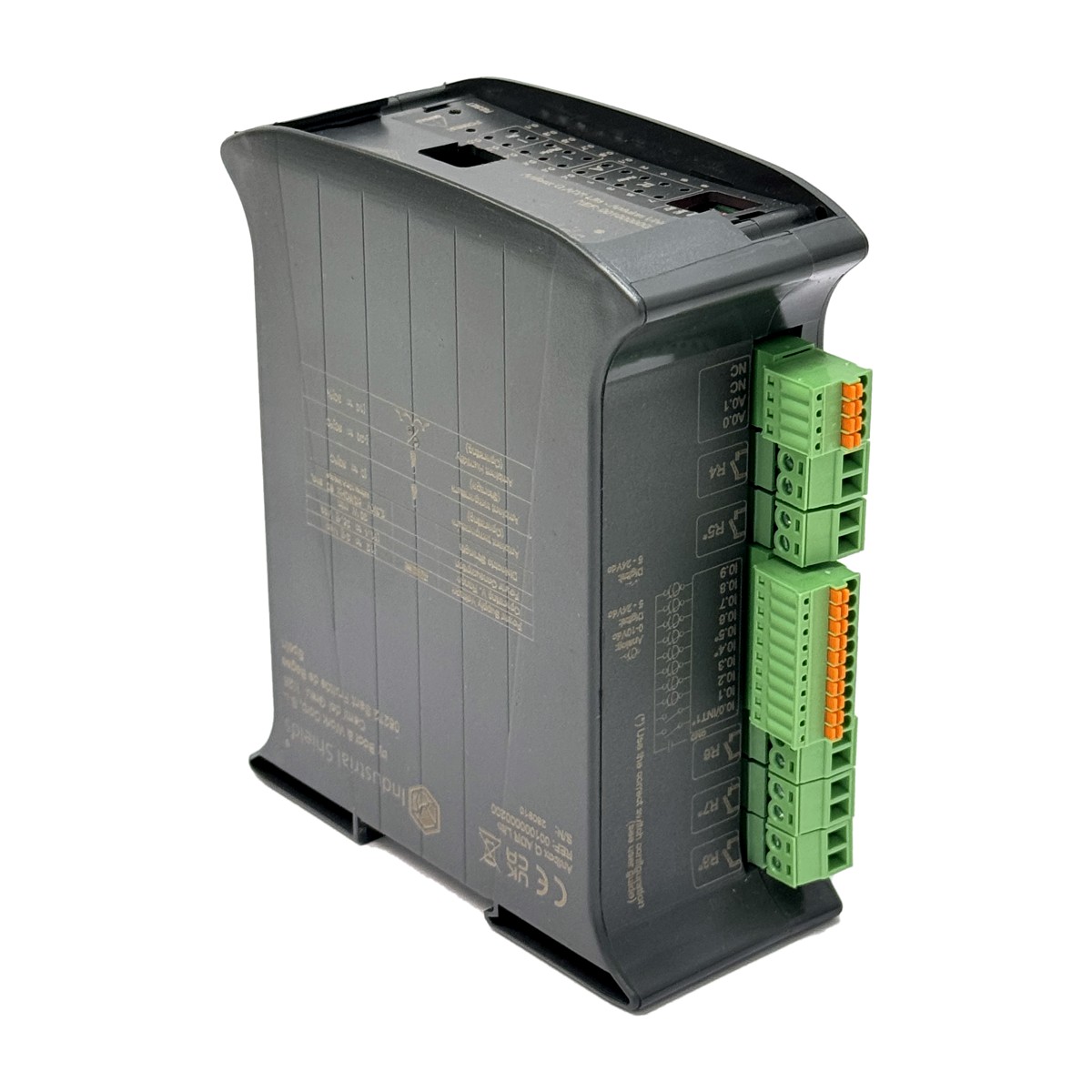
Ardbox Q is the first industrial PLC based on Arduino UNO Q, developed by Industrial Shields in collaboration with Arduino. A development board on its own would not last long in a control cabinet. Ardbox Q gives it the protection it needs: DIN-rail enclosure, 12 to 24 Vdc supply, digital inputs (2 of them optoisolated), IP20 and CE marking.
It comes in two versions with 19 (Analog) or 20 (Relay) I/O:
- Analog: 4 digital inputs, 6 analog or digital inputs (0 to 10 V), 3 digital outputs and 6 analog outputs (0 to 10 V). For measurement and proportional control.
- Relay: 4 digital inputs, 6 analog or digital inputs (0 to 10 V), 8 relay outputs and 2 analog outputs (0 to 10 V). To switch motors, pumps and valves directly.
Both have RS-485, RS-232, Wi-Fi and Bluetooth, USB-C, and 2 GB RAM with 16 GB eMMC or 4 GB RAM with 32 GB eMMC. Prices start at 225 € (excl. VAT). The tools are open and there are no licence fees.