

We received a message this week from FeedSpot: the Industrial Shields Arduino blog has been selected as one of the Top 30 Arduino Blogs on the web, 2026 edition.
We are glad to be on that list. And it is a good moment to explain something we do not always say directly: why we built an industrial hardware company on top of open source.
Open source hardware is not a workaround. It is a design choice.
When Industrial Shields was founded, the industrial automation market was — and largely still is — built around proprietary controllers, proprietary software, and proprietary communication protocols. You buy the hardware. You pay for the programming tool. You renew the license. You stay in the ecosystem.
That model works. It also creates dependency by design.
Arduino changed something in the electronics and engineering world: it showed that open, documented, community-supported hardware could be serious. Not a toy. Not a prototype platform. A foundation you could build real things on.
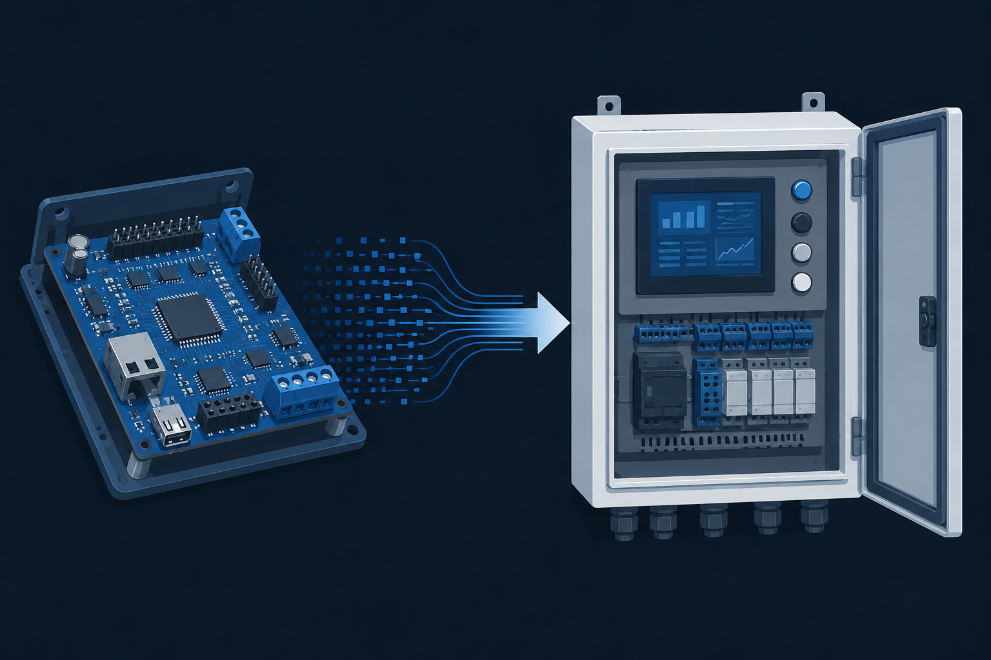
We took that seriously. Our entire Arduino-based product range is built on the Arduino ecosystem — not just the processor, but the IDE, the libraries, the community, the documentation. When you buy an Industrial Shields Arduino PLC, you program it with the same tools you already know, and the skills you build stay with you.
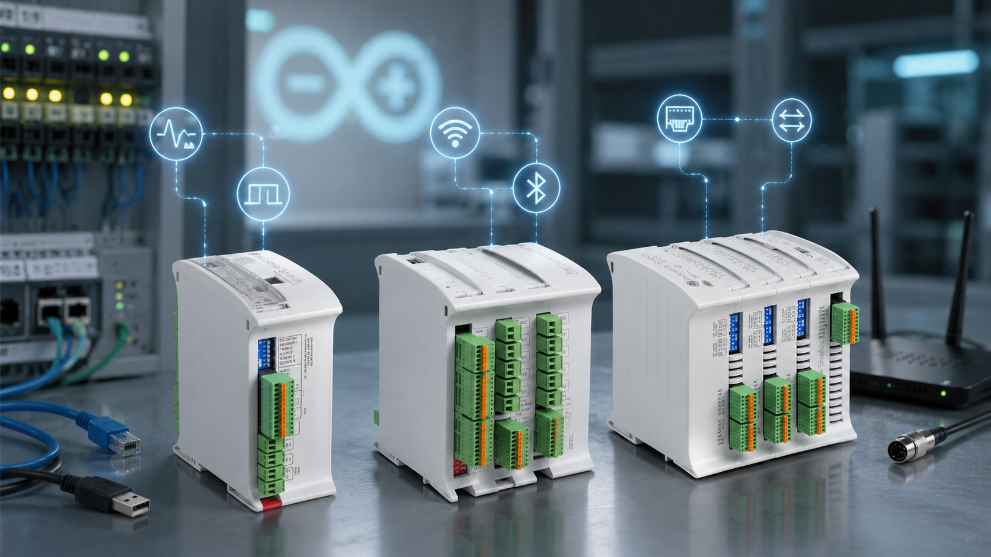
The Arduino-based product range
M-Duino family — Ethernet industrial PLCs based on Arduino Mega and Arduino MKR. Available from 19 to 58+ I/Os. DIN-rail mounted, panel-ready, built for machine automation, building control, water management and many more applications.
Ardbox family — compact Arduino PLCs for applications where space matters. Same programming environment, same industrial-grade construction, smaller footprint. Available in relay and analog variants.
ESP32 PLC family — built on the dual-core ESP32 with WiFi and Bluetooth BLE onboard. Ethernet, RS485, and modular expansion for cellular and LoRa connectivity. Designed for distributed monitoring, IIoT edge nodes, and OEM integration.
All three families are programmed with Arduino IDE. No seat licenses. No proprietary toolchain.
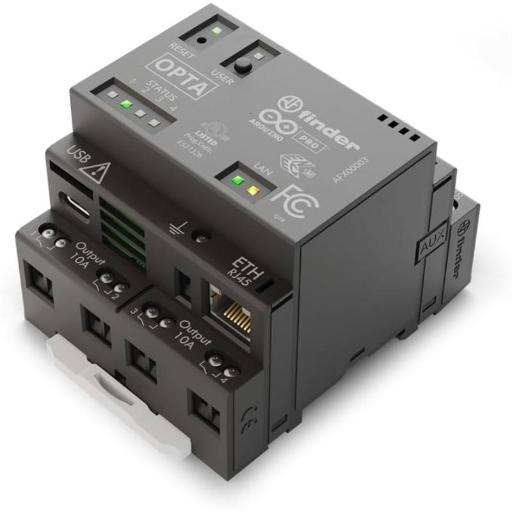
Arduino is serious about industry too
Industrial Shields is not the only one moving in this direction. Arduino has made a clear commitment to professional and industrial applications with its Arduino PRO ecosystem — and the results speak for themselves.
The Arduino Opta, developed in collaboration with Finder — one of Europe's leading names in industrial relays and automation components — is a direct signal of that commitment. Opta is a genuine industrial PLC that combines Finder's decades of field experience with the full Arduino PRO platform: free programming in both IEC 61131-3 languages (Ladder, FBD) and Arduino IDE, access to the complete open-source library ecosystem, and Arduino Cloud integration for remote management. Available in three versions — Lite, Plus, and Advanced — it is a product that reduces programming time significantly and removes the barrier between embedded development and industrial deployment.
The broader Arduino PRO line — including the Portenta family — extends this into high-performance computing, machine vision, and real-time edge control. And Arduino Cloud provides the managed infrastructure layer: device management, over-the-air updates, dashboards, and data pipelines.
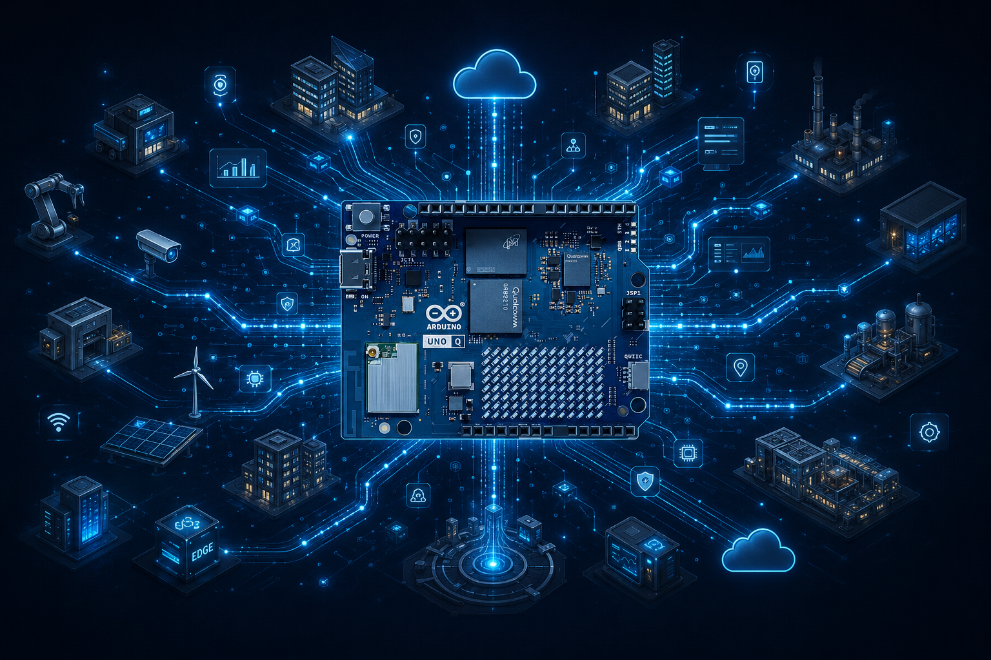
The Arduino UNO Q and what we are building with it
Arduino recently launched the UNO Q — arguably the most significant step forward for the platform in years. The board combines two independent processing units in a single device: a Qualcomm Dragonwing QRB2210 quad-core processor with a built-in GPU running Debian Linux, paired with an STM32H5 real-time microcontroller running Arduino Core on Zephyr OS. Python on one side. Arduino C++ on the other. Both running simultaneously, each handling what it does best.
For industrial applications, that architecture opens possibilities that did not exist before on a single Arduino-compatible board: edge AI, computer vision, complex data processing, and real-time I/O control — together, without compromise.
At Industrial Shields, we are currently developing a new PLC built on the Arduino UNO Q. We are not ready to share full specifications yet. What we can say is that it will be the most versatile and application-rich controller we have ever designed — not because it replaces existing products like the M-Duino 58 in raw I/O count, but because it opens an entirely different range of use cases. A different kind of industrial controller, for a different kind of industrial challenge.
More details soon.
What open source hardware actually means for the engineers who use it
It means you can read the schematic. You can understand how the hardware works, not just how to configure it. You can adapt the firmware, extend the libraries, and share what you build with others.
It means the knowledge you develop using an Industrial Shields PLC is transferable. You are not learning a vendor's abstraction — you are learning real electronics, real protocols, and real software.
It means the project you built five years ago still runs, because the tools that support it are maintained by a community, not discontinued when a product line ends.
In industrial automation, where systems run for ten or twenty years, that is not a small thing.
Why we write about it
The FeedSpot recognition is for the blog, and we appreciate it. But the blog exists because we think the engineering community benefits from documentation, examples, and real explanations of how these systems work.
We will keep writing — about protocols, applications, product updates, and what comes next. If you have questions or topics you would like us to cover, we are easy to find.
FeedSpot helps you find the best blogs on the web.
https://bloggers.feedspot.com/
→ Explore the full Arduino-based PLC range at industrialshields.com
Top 30 Arduino blogs and what it says about open source hardware in industry