

In 2022, the first city council switched on its public lighting managed by a Smart Light Controller. It was not a pilot. It was a real decision, with real budget and real public accountability.
The Smart Light Controller is an integrated public lighting management platform built on open-source technology: Industrial Shields PLC hardware for field control and real-time data acquisition, paired with a complete desktop and mobile interface for remote control, network monitoring, energy consumption tracking, fault detection, and maintenance management.
What the Smart Light Controller does
It gives municipalities complete control over their lighting network: remote on/off switching, dimming via DALI and 12–24V, real-time monitoring of power consumption, voltage and current, and automatic alerts in case of luminaire failure or cable theft.
The system communicates over the existing power line network — no additional cabling required — with each node reporting back to a central hub connected via GPRS or fiber. A mesh network architecture means that nodes connected to the hub can extend coverage to the rest of the installation.
Key capabilities in deployment:
- Remote on/off and dimming control
- Accurate scheduling based on location, calendar, and weather conditions
- Adaptive dimming during sunrise and sunset transitions
- Real-time energy consumption monitoring
- Lamp failure notification and predictive maintenance alerts based on temperature, current, power factor, and operating hours
- Electrical panel tamper detection and cable theft alarm
- Energy savings of up to 60% compared to unmanaged installations
From Arduino PLC to ESP32 PLC: an upgrade within the same ecosystem
The Smart Light Controller was originally built on Industrial Shields Arduino-based PLCs — the M-Duino family, programmed with Arduino IDE. That foundation proved itself in the field: reliable, maintainable, open to modification without vendor dependency.
When Industrial Shields launched the ESP32 PLC family, the decision to upgrade the SLC platform was straightforward. The ESP32’s dual-core architecture changes the equation for a connected field controller: one core handles the I/O and lighting logic, the other manages communications — Modbus, MQTT, GPRS data transmission — without either function competing for processing time.
For a system managing thousands of luminaires across multiple sites, that separation matters. Latency in communications does not affect control response. Control logic does not stall waiting for network operations.
Both generations remain in active service. Installations built on M-Duino PLCs continue to run without interruption. New deployments use the ESP32 PLC. The programming environment — Arduino IDE — is the same in both cases. The skills transfer completely.
Why public administration chose the Smart Light Controller
Public administrations do not make procurement decisions lightly. Lighting infrastructure runs for decades. The hardware and software managing it needs to remain operational, auditable, and maintainable across budget cycles, staff changes, and technology updates.
Built on open-source foundations, the Smart Light Controller runs on Industrial Shields hardware engineered for continuous operation in industrial environments: CE-certified, designed to handle grid noise, temperature variation, and the electrical conditions of real public infrastructure. The programming environment is stable, well-documented, and accessible to engineering teams without proprietary licensing or training dependencies.
For public sector procurement, that combination of proven field performance, industrial-grade hardware, and a maintainable software stack is a concrete answer to a real concern.
Four years. More than 300,000 luminaires. Still growing.
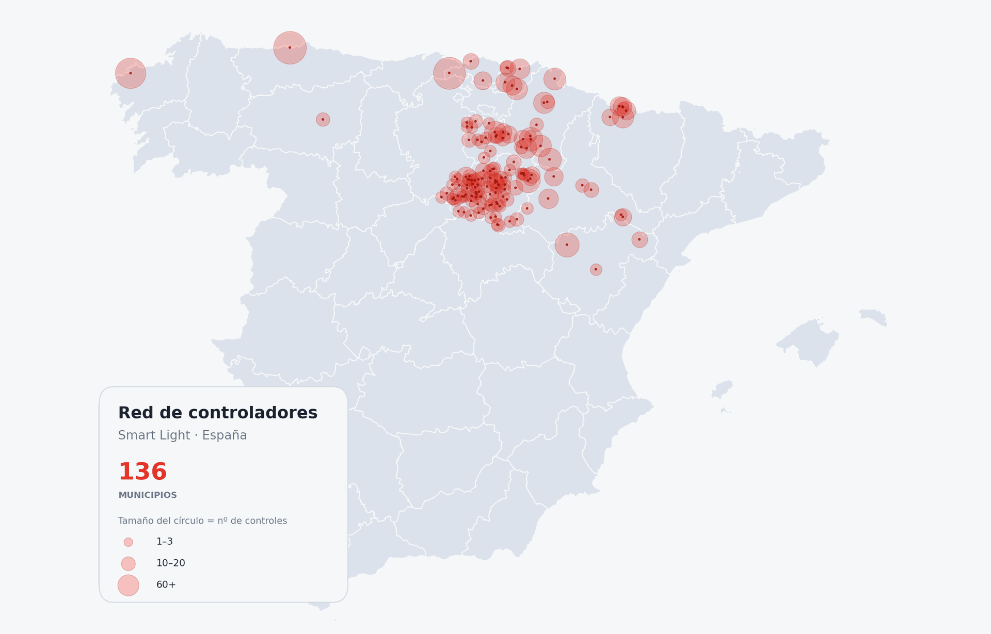
The scale matters not as a marketing number but as evidence. A system managing 300,000 luminaires and 800 control points across dozens of Spanish municipalities has been tested against real-world conditions: grid noise, temperature variation, network interruptions, hardware failures, software updates across deployed units.
It has not stopped growing since 2022. New city councils and provincial governments continue to adopt the Smart Light Controller. The platform that started with one municipality now spans multiple provinces.
Technical foundation
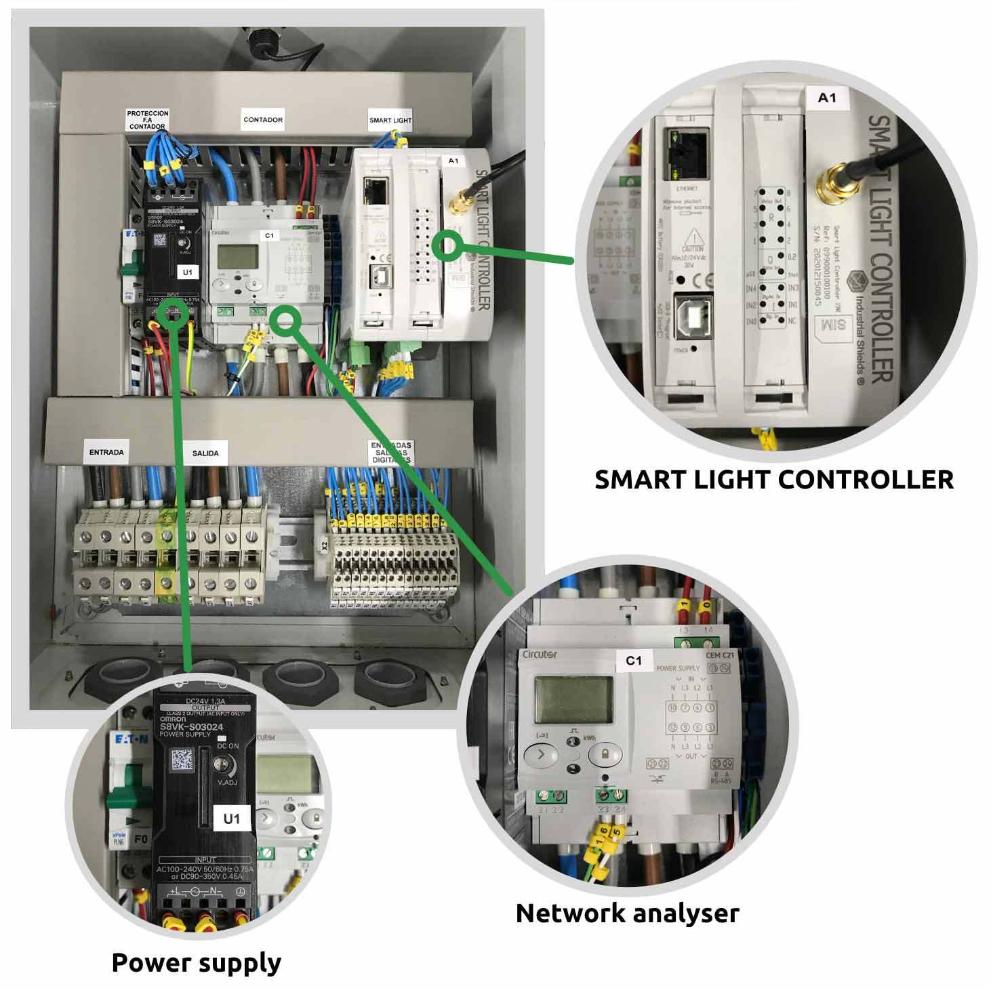
The Smart Light Controller is built on Industrial Shields hardware and programmed with Arduino IDE. Communication options include GPRS/GSM for cellular backhaul and PLC over power line for local node communication. The system supports DALI and 12–24V for luminaire control, and includes an electrical network analyser monitoring voltage and current across three lines.
The ESP32 PLC variant adds WiFi and Bluetooth BLE to the connectivity stack, and the dual-core architecture ensures that control logic and communications run independently without resource contention.
→ Explore the Smart Light Controller — full technical specifications and cabinet solution
Four years, more than 300,000 luminaires: the Smart Light Controller story